
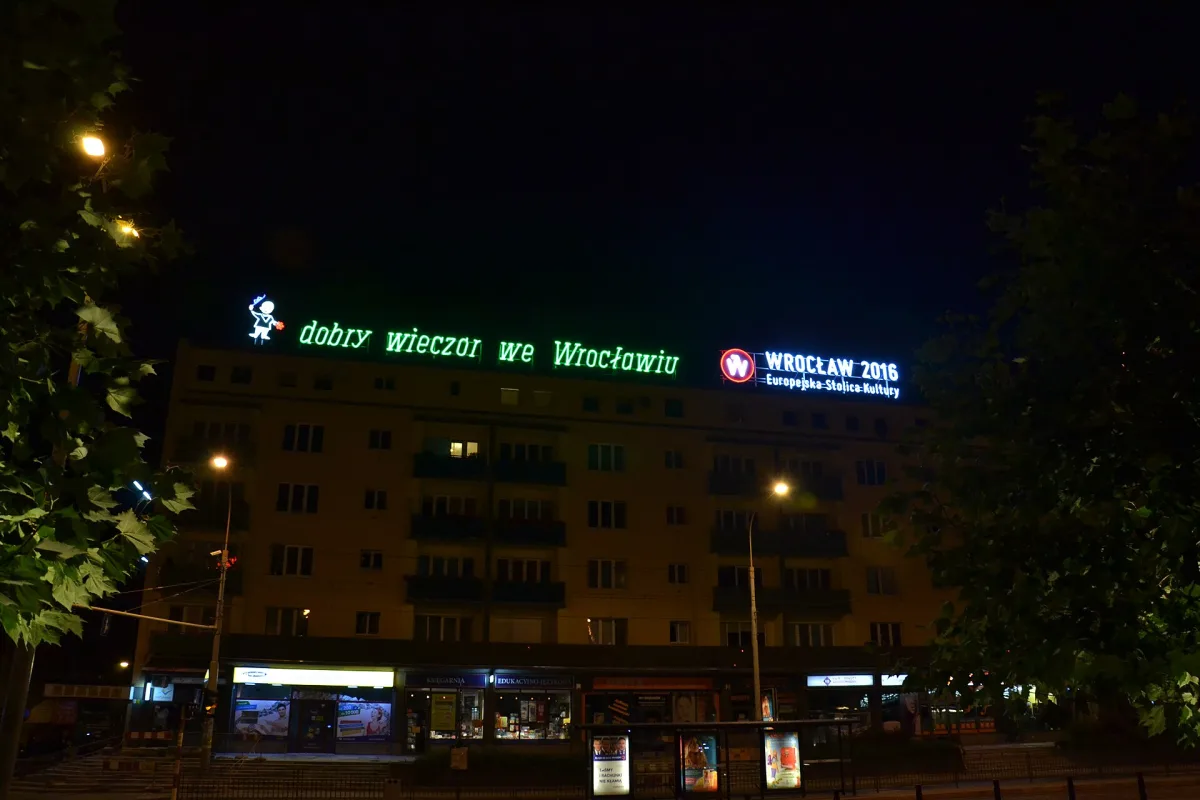
Neonisation, or the City Lit Up by Communist Poland
During the era of communist Poland, Polish cities, Wrocław included, underwent what was popularly called neonisation - illuminated advertising and informational signs were installed on a mass scale on the facades of shops, cinemas, workplaces and offices. The history of this phenomenon in Wrocław was later recounted in recordings by Professor Jan Miodek, played during the opening of the renovated gallery on Ruska Street. Over time, as the institutions and shops that these neon signs advertised closed down or changed owners, the signs began to disappear from the streets - many went straight to scrap, with no chance of being preserved.
The Courtyard on Ruska Street as a Refuge for the Signs
Some of the rescued neon signs ended up in a courtyard on Ruska Street in Wrocław, where the Neon Gallery gradually took shape, run today by the Neon Side foundation. Sources differ as to who was behind the beginnings of this initiative. One states that the gallery was created in 2005 on the initiative of artist Ilja Schubert, as part of the "Neon Side" project aiming to restore the shine to forgotten signs. Another source describes Tomasz Kosmalski as the initiator of the project, who is said to have gathered neon signs from across the whole of Lower Silesia, not limiting himself to Wrocław alone. It is possible that both people were involved at different stages of building the collection, but the material available does not allow this to be settled conclusively.
Where the Rescued Neon Signs Come From
The collection on Ruska Street holds around 30 exhibits, most of them dating from the 1960s and 1970s. They were taken down from shops, cinemas and industrial plants in Wrocław and the surrounding area. Among the names recognisable on the restored signs are the neon of Elwro, a Wrocław electronics manufacturer, the neon of the Polish Post in the shape of a post horn, and the signs of the former Liverpool club, the Literatka café and the Bufet Barbara bar. The collection also includes neon signs connected with institutions such as NOT, the Warszawa cinema, and the Cuprum and Elam works. Together they form a cross-section of Wrocław's advertising landscape from several decades ago, spanning culture, commerce and industry.
Renovation and the Agreement with the City
Restoring the collection is not a one-off effort. The renovation of the neon signs in the courtyard at Ruska 46c cost 250,000 złoty in total. In June 2024, the city of Wrocław signed a ten-year lease agreement with the Neon Side foundation, intended to allow further conservation of the collection, with the municipality committing to fund the repair of the wiring, which had deteriorated over time - some signs were only partially lit. After several months of renovation, the gallery reopened to visitors in April, during an evening event attended by city representatives and featuring a multimedia show.
A Courtyard, Not a Museum
The gallery on Ruska Street differs from a typical museum display in that the neon signs are not kept behind glass, but light up live, in the evenings, in an ordinary city courtyard covering around 7,000 square metres, where dozens of artists' studios, galleries, clubs and non-governmental organisations operate at the same time. This means visitors view the rescued signs surrounded by living, ongoing cultural activity, rather than in an exhibition hall detached from the city.
The collection can be seen today as part of the Neon Gallery on Ruska Street. A separate, still-working neon sign from the communist era, "Dobry wieczór we Wrocławiu" ("Good evening Wrocław") from 1962, still hangs on the roof of a tenement building by the Main Railway Station - it can be seen in the entry for the Dobry wieczór we Wrocławiu neon sign.

Be the first! Add a comment.
You need to log in to add a comment.
Log in