
The Low from Italy That Flooded Half of Central Europe
In the summer of 1997, a low-pressure system formed over southern Europe, one that meteorologists classify as a Vb-type situation: the low travelled from northern Italy towards the northeast and, on its way, collided with warm, humid air and cooler air masses from the Baltic. The result was several days of very intense rainfall over the basin of the upper and middle Oder. The water moved down the river across the whole of Silesia: on 7 July it flooded Prudnik and Głuchołazy, on 8 July Racibórz, on 10 July Opole. Between Opole and Wrocław the wave built up further and reached a height of around 6 metres above the normal level before it reached the city's borders.
12 July: The Water Enters Wrocław
The flood wave reached Wrocław on 12 July 1997, around midday. Earlier that day, at around 6 am, an evacuation alarm was announced for the Księże Małe district, threatened from the direction of the Oława river basin. At around 1 pm the water spilled over Opolska Street and swept into the district, reaching a height of 180 centimetres within an hour. That evening the wave also broke through at Żabia Grobla and Traugutta Street, beginning to spread further into the city. Two days later, on the afternoon of 14 July, residents and emergency services managed to stem the water at Żabia Grobla - one of the turning points of the whole defence effort.
Sandbags and the Defence of the Old Town
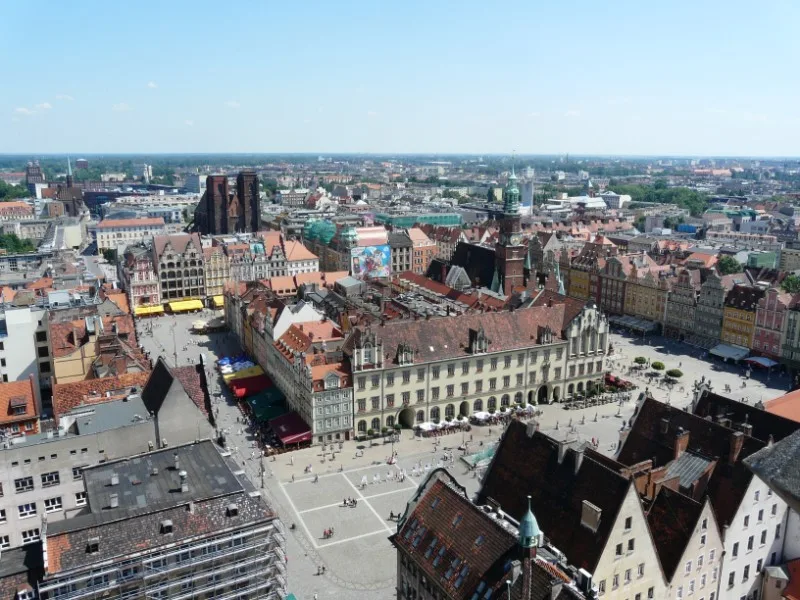
Before the wave reached the city, on 10 and 11 July, a controlled breach of the levees at Jeszkowice and Łany was considered, to relieve the centre of Wrocław at the cost of flooding smaller localities. This plan was abandoned after opposition from the residents gathered there. The defence of the city involved military Mi-17 helicopters, soldiers and firefighters brought in from across Poland, and thousands of residents and volunteers, who spent days and nights stacking sandbag levees. According to City Hall estimates, between 300,000 and 480,000 sandbags were laid in Wrocław at the time. Thanks to these intensified efforts, it was possible to protect the Old Town with its historic buildings, even though water was flooding districts right next door.
Flooded Districts and Losses in the City
The water flooded, among others, Katowicka, Chorzowska, Bytomska, Tarnogórska and Głubczycka streets, as well as entire districts in the west and north of the city: Kozanów, Księże Małe, Księże Wielkie, Maślice, Widawa and Rakowiec, referred to by residents at the time as the "Bermuda triangle". In Kozanów and Rakowiec, the water reached the first floor of the tenement buildings. Among the facilities damaged were the water treatment plant, the court archive, the landfill in Maślice, the Philharmonic, the Polish Theatre and the Academy of Music. Nationwide, the Flood of the Millennium claimed 56 fatalities in Poland alone, and 114 counting the Czech Republic and Germany together, with material losses estimated at around 12 billion zlotys. 7,000 people lost their homes, and around 40,000 residents of Poland suffered the total loss of their property. Around 680,000 flats, 843 schools and 4,000 bridges were destroyed across the whole country. The sources do not give separate, itemised figures for Wrocław alone.
What Was Changed in Flood Defences After the Flood
The Flood of the Millennium showed that Wrocław's flood protection system, known as the Wrocław Water Node and regarded as one of the largest systems of waterways and hydrotechnical structures in Europe, could not cope with a wave of this size. The Szczytniki weir was destroyed at the time, and parts of Wielka Wyspa (Great Island) were flooded. In 2012, a thorough rebuilding of the entire node began. At the same time, flood defences on the upper Oder were expanded: the Buków polder near Racibórz, under construction since 1989, became operational in 2002 and today protects, among others, Racibórz and Kędzierzyn-Koźle, and to some extent also Opole and Wrocław, from flooding. Its role grew after 2020, when the neighbouring Racibórz Dolny reservoir was put into operation - together, the two facilities today form the main barrier against a wave like the one that reached the tenement buildings of Wrocław in 1997.

Be the first! Add a comment.
You need to log in to add a comment.
Log in