
Silesia cut into pieces: where so many duchies came from
The Silesian Piasts are the longest-ruling line of the Piast dynasty - they ruled here from 1138 to 1675, while in the rest of Poland the dynasty had already died out in the 14th century with the death of Casimir the Great. It began with the testamentary decision of Bolesław III Wrymouth in 1138, who divided his state among his sons. Silesia fell to the eldest, Władysław II the Exile, and was meant to remain a single province in the hands of his descendants. It turned out differently: successive generations of dukes divided the land among their own sons, until one province became more than a dozen, and in time over twenty separate small duchies. Historians list among them the duchies of Wrocław, Legnica, Brzeg, Głogów, Oleśnica, Jawor, Świdnica, Opole, Racibórz, Cieszyn, Żagań, Bytom, Ziębice, Nysa, Wołów, Ścinawa, Oława, Koźle, Bierutów and Opava. Each had its own ruler, its own court and, as a rule, its own castle as a seat.
Castles as capitals of individual lines
The fragmentation into so many duchies meant that Silesia had to have many separate ducal residences, rather than a single common capital. Piast Castle in Legnica is among the oldest: it was built in the second half of the 12th century by Bolesław I the Tall and extended by his son Henry the Bearded. It was one of the oldest brick castles in the Polish lands, and its palace, more than sixty metres long, was counted at the time among the largest secular masonry buildings in this part of Europe.
A similar role was played by the castle in Brzeg, today known as the Castle of the Silesian Piasts - the first mention of a ducal governor's seat here dates from 1235, and around 1300 the square, brick Lion Tower was added. The best-known element of the Brzeg residence is the representative entrance gate from 1554-1560, funded by Duke George II and his wife Barbara of Hohenzollern, and designed by the Italian architects Jacopo and Francesco Parr. Carved in stone on it are portraits of the first twelve rulers of Poland and an equal number of Piast dukes of Silesia, each with a caption - a stone family tree of the whole dynasty in one place.
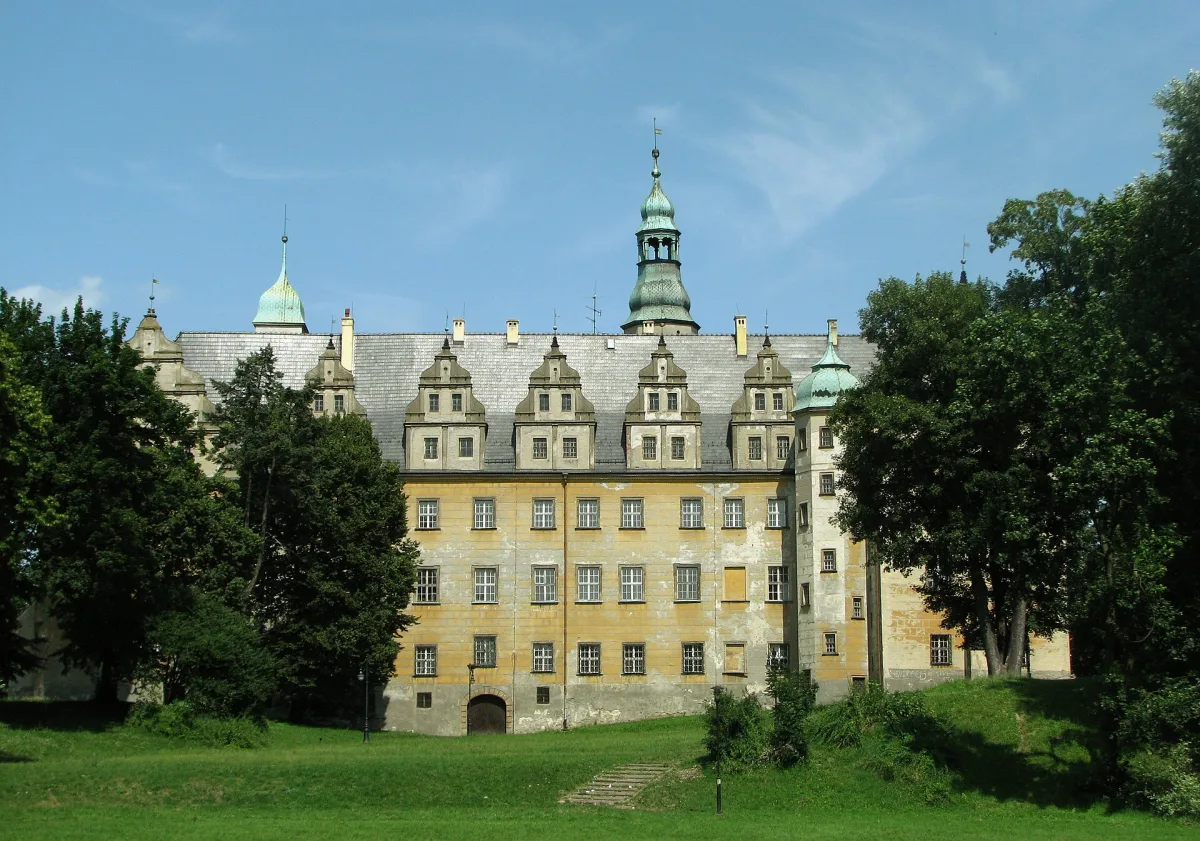
The Castle of the Dukes of Głogów was built in the second half of the 13th century by Konrad I of Głogów, originally as a brick tower with wooden buildings controlling a ford across the Oder. After a fire in 1291 it was extended by his successor, Henry III, and in the following decades the castle even hosted kings of Poland: in 1462 Casimir IV Jagiellon stayed here. Today it houses the Museum of Archaeology and History. The Ducal Castle in Oleśnica grew out of a stronghold first mentioned in 1239 - construction of the castle was probably initiated by Konrad I of Oleśnica, and the residence reached its golden age only after the local Piast line had died out, when the duchy was taken over by descendants of the Bohemian king George of Poděbrady. Not far from here, in Jawor, stands the Jawor Castle, built as a defensive tower even before 1224 - over the following centuries it changed function from a ducal seat into a prison, which operated until 1956.
Feudal homage to Bohemia and what it changed
The fragmented duchies did not have the strength to stand up to stronger neighbours, so successive dukes began seeking support from the King of Bohemia. In February 1327 in Opava, homage was paid to John of Luxembourg by dukes Bolesław of Niemodlin, Leszek of Racibórz, Casimir of Cieszyn and Władysław of Bytom; a few days later they were joined by John of Oświęcim, and in Wrocław homage was also paid by Bolesław of Opole and Henry VI of Wrocław. In the following years, between 1327 and 1336, almost all the remaining Piast lines followed their example, turning their hereditary duchies into fiefs of the Bohemian Crown. In 1339, in the so-called Kraków act, King Casimir the Great renounced his rights to the Silesian lands in favour of the Luxembourgs. The last independent duchy, Świdnica-Jawor, lost its independence in 1392. From then on, Silesia's fate was tied no longer to Kraków but to Prague: after the Jagiellonian dynasty died out on the Bohemian throne, in 1526 Silesia passed, together with the whole Kingdom of Bohemia, under Habsburg rule, where it remained until the Silesian Wars of the 18th century, when most of the region was taken by the Prussian army of Frederick II.
The last Silesian Piasts
Despite the loss of political independence, the individual Piast lines survived in Silesia as vassals for the following centuries, longer than anywhere else in Poland. The last duke of the family was George IV William, ruler of Legnica, Brzeg and Wołów, who died childless in 1675. With his death the entire Silesian line of the Piasts died out, and its hereditary duchies passed to the Habsburgs. Just two years after his death, between 1677 and 1679, the Mausoleum of the Silesian Piasts was built beside the Church of St John the Baptist in Legnica - the first Baroque burial chapel in Silesia, dedicated to the memory of the last dukes of Legnica-Brzeg and the whole family. Many members of the dynasty were laid to rest in monastic necropolises founded by their ancestors. In the basilica in Trzebnica, built between 1208 and 1219 by Henry the Bearded as a family mausoleum, 22 members of the Silesian branch of the dynasty were buried. The graves of further dukes were also found in the Cistercian abbey in Lubiąż - in 1945, after the monastery was occupied, Soviet soldiers searching for valuables broke open the coffins there holding the remains of the Silesian Piasts.
What remains of these castles today
The state of preservation of the Piast residences varies widely. The castle in Legnica suffered the most in May 1945, when nearly 70 percent of the buildings were destroyed - it was not rebuilt until 1960-1970, and today it opens up the remains of the Romanesque chapel and the Gothic tower. The castle in Brzeg has survived in much better condition and since 1952 has operated as a museum devoted precisely to the Silesian Piasts. The Castle of the Dukes of Głogów also serves a museum function today, while the Oleśnica residence, despite its preserved Renaissance facade with sgraffito decoration, has for decades housed the headquarters of the Voluntary Labour Corps, and only part of its interiors can be viewed from within. The Castle in Jawor, after years of service as a prison, now stands as a historic monument accessible for viewing from the outside.
The Piast Castles Trail
Some of the Lower Silesian residences, including Książ in Wałbrzych, built on the initiative of Bolko I of Świdnica, today lie on the designated Piast Castles Trail, linking places connected with the history of the dynasty. It is a route that allows visitors to see, on a single trip, both the grand residences rebuilt over successive centuries and the more modest strongholds that never became more than the seat of one side branch of the ducal family. Together they show what a great state, divided into dozens of small courts but ruled for centuries by a single family, Piast Silesia was.

Be the first! Add a comment.
You need to log in to add a comment.
Log in