
The failed 1505 foundation and Leopold I's Jesuit academy
Wrocław tried to have its own university much earlier than 1702. In 1505, Vladislaus II Jagiellon, King of Bohemia and Hungary, issued a founding charter for a four-faculty college in the city. Pope Julius II, however, never confirmed it - the decisive factor was a protest from the Jagiellonian University in Kraków, which did not want competition so close to its own borders. The project collapsed, and Wrocław had to wait almost two hundred more years for its own institution of higher learning.
The foundation that finally succeeded had a different character from Jagiellon's original plan. On 21 October 1702, Emperor Leopold I of Habsburg issued a golden bull establishing the Jesuit Leopoldine Academy, and its solemn inauguration is recorded on 15 November of the same year. The new institution was founded in a city where the great majority of burghers were Lutheran, and it was one of the tools of the Counter-Reformation in Silesia pursued by the Habsburg court. It was run by Jesuits, and its curriculum covered philosophy and Catholic theology.
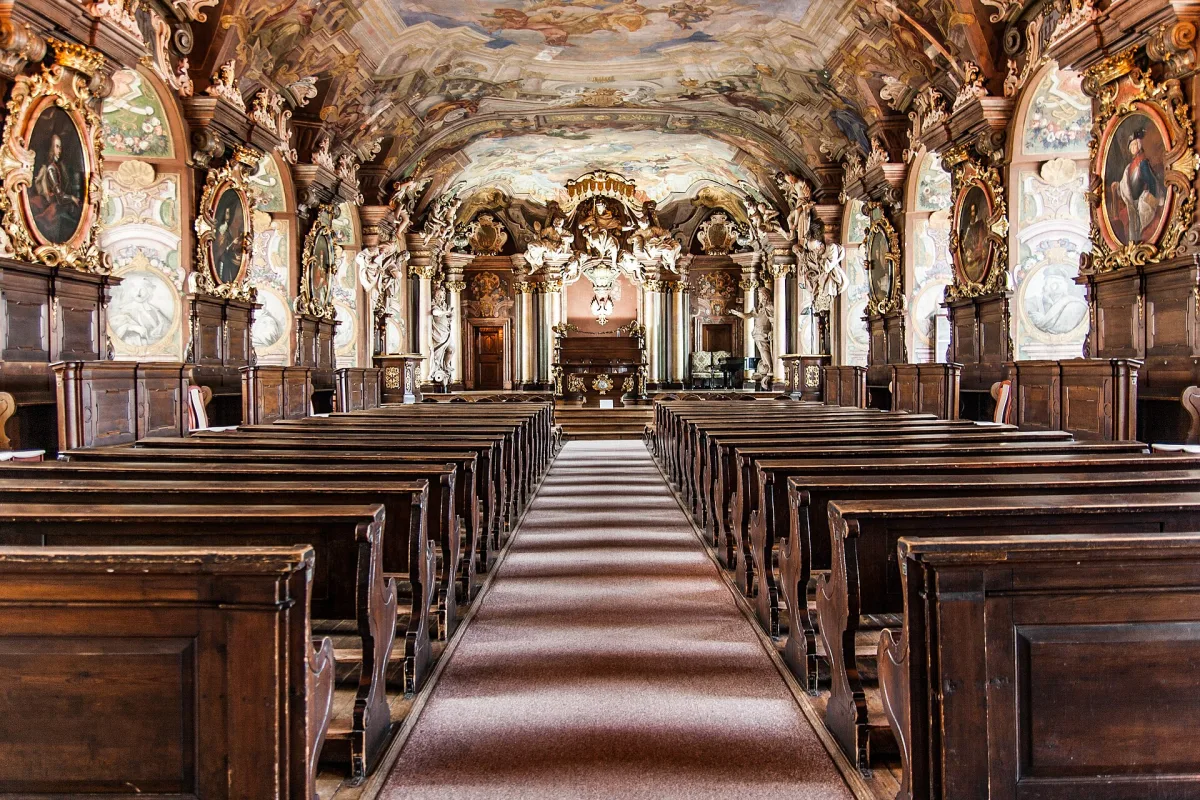
Aula Leopoldina - the heart of the baroque academy
The new academy's grand hall was built in 1728-1732 to a design by the architect Christophorus Tausch. Its name - Aula Leopoldina - was taken from the founding emperor. The rich stucco decoration was made by Albrecht Siegwitz, the ceiling and wall frescoes were painted by Johann Christoph Handke, and the wooden sculptures came from the hand of Krzysztof Hollandt. The main fresco depicts the dedication of the university to the Mother of God, while smaller compositions in the window niches show scholars from antiquity and modern times. On the dais sits a sculpture of Leopold I himself, surrounded by personifications of the virtues, flanked by statues of his sons, the emperors Joseph I and Charles VI.
The hall was also decorated with sixteen portraits of the academy's Jesuit benefactors. Eight of them were stolen in 1997, and only two have been recovered. The hall survived later wars and sieges without serious damage, but in 2015-2018 it underwent a thorough conservation - the structure was reinforced and the paintings, polychromes, frescoes and sculpted elements were restored. After this work, the hall reopened to visitors on 21 March 2022. Today it is part of the university museum and the venue for the most important academic ceremonies, including student matriculations.
From Jesuit academy to Prussian university
After the dissolution of the Jesuit order in 1773, the institution passed under state control - this became formal in 1776. The real turning point, however, came only at the start of the 19th century. On 24 April 1811, King Frederick William III of Prussia signed a cabinet decision to move the declining Protestant Viadrina University from Frankfurt an der Oder to Wrocław. The solemn merger of the two institutions took place on 19 October 1811, in the Aula Leopoldina itself. The institution created this way already had five faculties: Catholic theology, Protestant theology, law, medicine and philosophy. It received its official name - the Royal University of Wrocław - on 21 February 1816.
In the following decades the university grew in academic standing and in numbers. By 1914 the number of students had reached 3,224, of whom only 100 were women. During this period, several scholars who later received the Nobel Prize worked at Wrocław's faculties - their full biographies and achievements are covered in a separate article about Nobel laureates linked to Wrocław, so here it is worth noting only that the presence of this staff made the university one of the more important centres of German scholarship at the turn of the 19th and 20th centuries.
The destruction of 1945 and scholars from Lwów
The war and the siege of Wrocław as the fortress of Festung Breslau destroyed or damaged about 70 percent of the city's buildings, and the university's main building was no exception. When, in May 1945, a team of Polish scholars arrived in Wrocław from Kraków under Professor Stanisław Kulczyński, they found the building in a state of general devastation. Kulczyński had previously been rector of the Jan Kazimierz University in Lwów - he led the group tasked with rebuilding Polish academic life in a city where German had until recently been the language of instruction.
The first lecture at the reviving Polish university was given on 15 November 1945 by Professor Ludwik Hirszfeld. The official inauguration took place on 9 June 1946, and four days later, on 13 June, the first Polish diplomas were awarded. The university built its new staff largely from professors and assistants relocated from the Jan Kazimierz University in Lwów, who after the war found themselves outside Poland's new borders.
The university museum and the Mathematical Tower
The Museum of the University of Wrocław was established on 6 August 1992, turning the existing Museum Collections Section of the University of Wrocław Archive into an independent unit. On 13 May 2005, the university opened its branch - the House of the Archaeologist at 3 Koszarowa Street, where temporary exhibitions linked to archaeological research are presented. The museum's main seat, however, is in the main building above the Oder, where, besides the Aula Leopoldina, visitors can also go up to the viewing terrace of the Mathematical Tower, built at a height of 42 metres.
The University of Wrocław today
Today the university has 12 faculties. According to data from December 2023, it had 20,293 students, with a staff of 1,959 academics, including 216 professors and 361 habilitated doctors. The university's heritage also includes the Botanical Garden, founded in 1811 by Ostrów Tumski - the second oldest botanical garden in Poland, right after the garden of the Jagiellonian University. From Jagiellon's failed foundation of 1505, through Leopold I's Jesuit academy, to today's multi-faculty university, the institution's path has been shaped by the city's successive political turning points - Habsburg, Prussian, and finally the postwar Polish one.

Be the first! Add a comment.
You need to log in to add a comment.
Log in