
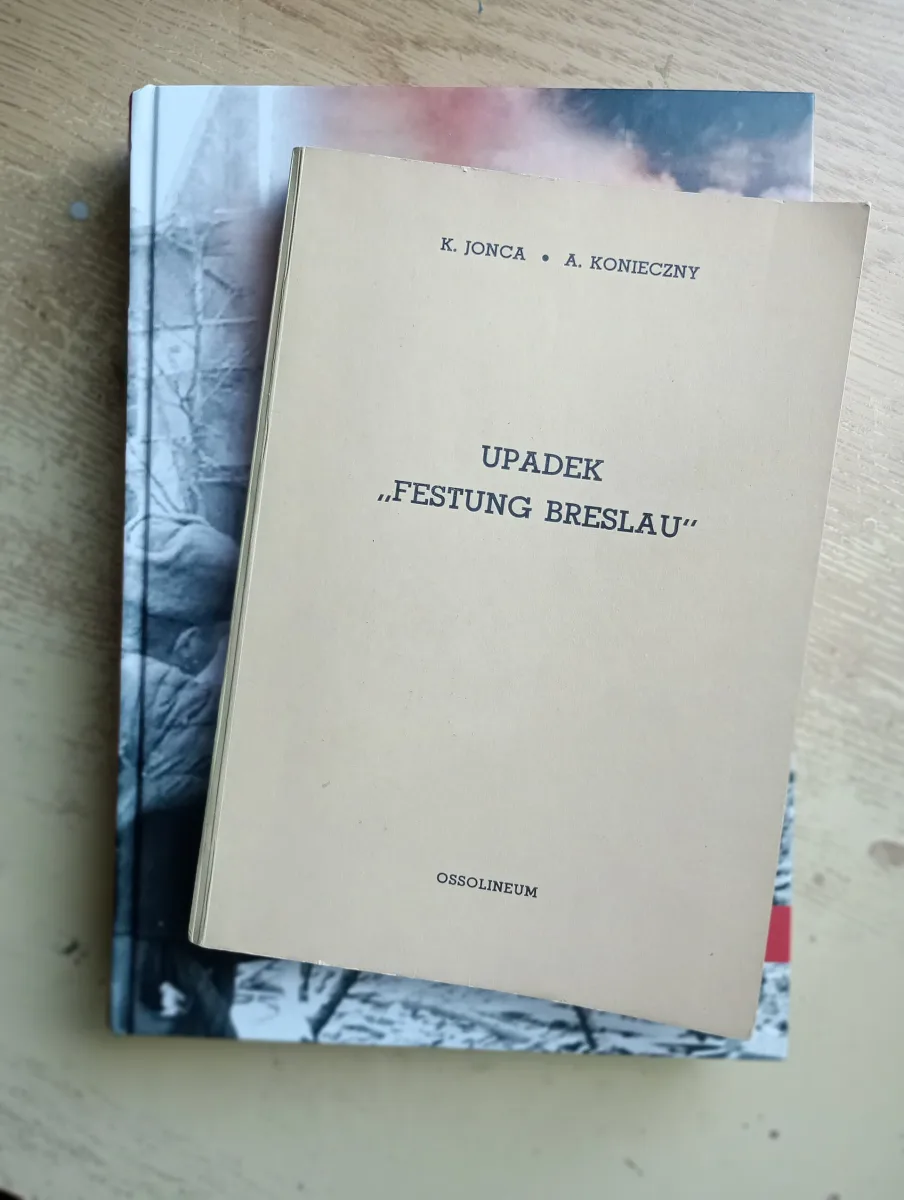
In the final days of the siege of Wrocław in the spring of 1945, the city had two commanders, a civilian and a military one, and each made the opposite decision. Gauleiter Karl Hanke, who had demanded the fortress be defended to the last soldier, fled the city by plane on the day of the surrender. General Hermann Niehoff, the last commandant of Festung Breslau, finished what Hanke had left behind and himself signed the city's capitulation. Their subsequent fates differ just as sharply as their final decision.
Karl Hanke: from miller to Goebbels's secretary
Karl Hanke was born on 24 August 1903 in Lubań in Lower Silesia, into the family of a railway engineer. He trained as a miller, working in that trade between 1921 and 1926, and in 1928 completed teacher-training studies in Berlin that qualified him to teach the milling trade. He joined the NSDAP on 1 November 1928 and rose quickly through the party hierarchy: he was a member of the SA reserve, held successive posts in the Berlin organisation, and in 1931 became the party's district leader in the Westend district.
The turning point in his career was the post of Joseph Goebbels's personal secretary at the Ministry of Propaganda, which he took up on 1 April 1932. At the same time he was a deputy, first to the Landtag and then to the Reichstag, for the Potsdam constituency, a mandate he held until the end of the war. In 1934 he joined the Allgemeine SS, and in 1937 he became deputy president of the Reichskulturkammer, the Reich Chamber of Culture. His career at Goebbels's side was cut short by a scandal: during the minister's affair with the Czech actress Lída Baarová, Hanke grew close to Goebbels's wife Magda, and Hitler's intervention closed off any further advancement for him at the ministry.
In 1939 he volunteered for the army, fighting in the 3rd Panzer Division during the Polish campaign, and in 1940 in France in Rommel's 7th Panzer Division, known as the Ghost Division. He received both classes of the Iron Cross and was recommended for the Knight's Cross. He left the army in 1941 with the rank of lieutenant.
Gauleiter of Lower Silesia
In 1941 Hitler appointed Hanke Gauleiter of Lower Silesia, and a year later Himmler promoted him to SS-Gruppenführer. As Gauleiter he was responsible for the region, with its capital in Wrocław, and his rule is remembered above all for repression: more than a thousand executions were carried out in the city on his orders, earning him the nickname the Butcher of Breslau.
Hitler had declared Wrocław a fortress back in August 1944, many months before the siege began, but it was Hanke who formally confirmed that status on 20 January 1945, setting in motion the evacuation of the civilian population and the conscription of men aged sixteen to sixty. Women and children had to leave the city on foot, in temperatures of around minus twenty degrees. In February 1945 he ordered the construction of a runway in the city centre, for which buildings and three churches were demolished, with children from the age of ten and forced labourers also put to work on the demolition. Right to the end he demanded the city be defended to the last soldier. The course of the siege is described in a separate article on Festung Breslau.
Flight and an unclear end
On 29 April 1945, when Hitler, in besieged Berlin, declared Himmler a traitor, Hanke received the appointment of Reichsführer-SS and chief of the German police, formally the highest post in the SS structure, though in practice it had no operational significance left. A few days later, once the fate of the fortress was sealed, the Gauleiter who had earlier demanded fighting to the end withdrew from it himself.
On the morning of 6 May 1945, the day Wrocław's capitulation was signed, Hanke fled the city in a stolen Fieseler Storch aircraft. The plane crashed after hitting a fuel tank near the airfield at Mirosławice, from where, after repairs, he flew on to the Luftwaffe airfield at Świdnica. His further fate remains unclear. According to one version he transferred to another plane, which crashed in the Sudetes. According to another he survived, joined the SS Horst Wessel division, was taken prisoner and died either trying to escape or at the hands of Czech guards near Chomutov. Neither version has been confirmed, and the date and place of Hanke's death remain unresolved to this day.
Hermann Niehoff: a soldier's career across three eras
Hermann Niehoff was born on 3 April 1897 in Papenburg on the Ems. He began his military service at the age of eighteen in 1915, in the army of Imperial Germany during the First World War, where he rose to officer rank in the infantry. He continued his career in the Reichswehr of the Weimar Republic, and then in the Wehrmacht: by September 1939 he already held the rank of major. He was promoted to regimental commander in 1940, divisional commander in 1943, general in 1944 and general of infantry in April 1945. He fought in France in 1940, at Stalingrad in 1942, in Italy in 1943, and in the Balkans and on the Eastern Front, for which he received numerous decorations.
On 7 March 1945 he landed at the Gądów Mały airfield in besieged Wrocław, and the following day, 8 March, took command of the city's defence, becoming the last commandant of Festung Breslau. In the order taking up command he wrote that he was doing so on the Führer's orders and that the fortress was to remain a bastion of the Reich against the Soviet advance.
Capitulation and ten years in captivity
When Hanke fled the city on 6 May 1945, Niehoff, as the commander who remained on the spot, signed Wrocław's capitulation and surrendered his staff to the Soviet side. Unlike the Gauleiter, who had earlier demanded fighting to the end and then withdrew from it himself, Niehoff stayed with the troops under his command.
After the capitulation he was taken into Soviet captivity, held for a time in a prisoner-of-war camp at Psie Pole, and later transported deep into the USSR. He did not return to Germany until 1955, after ten years in captivity, as part of a further wave of repatriated prisoners of war. After his return he worked in industry, and together with Hans von Ahlfen wrote the memoir "So kämpfte Breslau", published in Polish as "Festung Breslau w ogniu" ("Festung Breslau in Flames"), presenting the siege from the perspective of the defenders' command. He died on 5 November 1980 in Riegsee.
How the two commanders are judged today
Karl Hanke and Hermann Niehoff are judged quite differently today, even though for two months they were responsible for the same stretch of the city. Hanke, the Gauleiter responsible for the executions in the city and for the decision to defend the fortress at the cost of civilian lives, is recorded in historiography as a war criminal, and his flight, after he himself had demanded fighting to the end, is cited as an example of the gap between rhetoric and conduct among Nazi dignitaries.
Niehoff, a career soldier across three eras of the German army, is sometimes judged more ambiguously: on the one hand he carried out orders to defend the city that cost the lives of thousands of civilians and soldiers, on the other it was he who signed the capitulation once further resistance had become pointless, and who stayed with his subordinates instead of fleeing. His memoir, written together with von Ahlfen after years in captivity, is today among the primary sources on the final weeks of Festung Breslau, though, like any account by a participant in the events, it describes them from the perspective of the German command.

Be the first! Add a comment.
You need to log in to add a comment.
Log in