
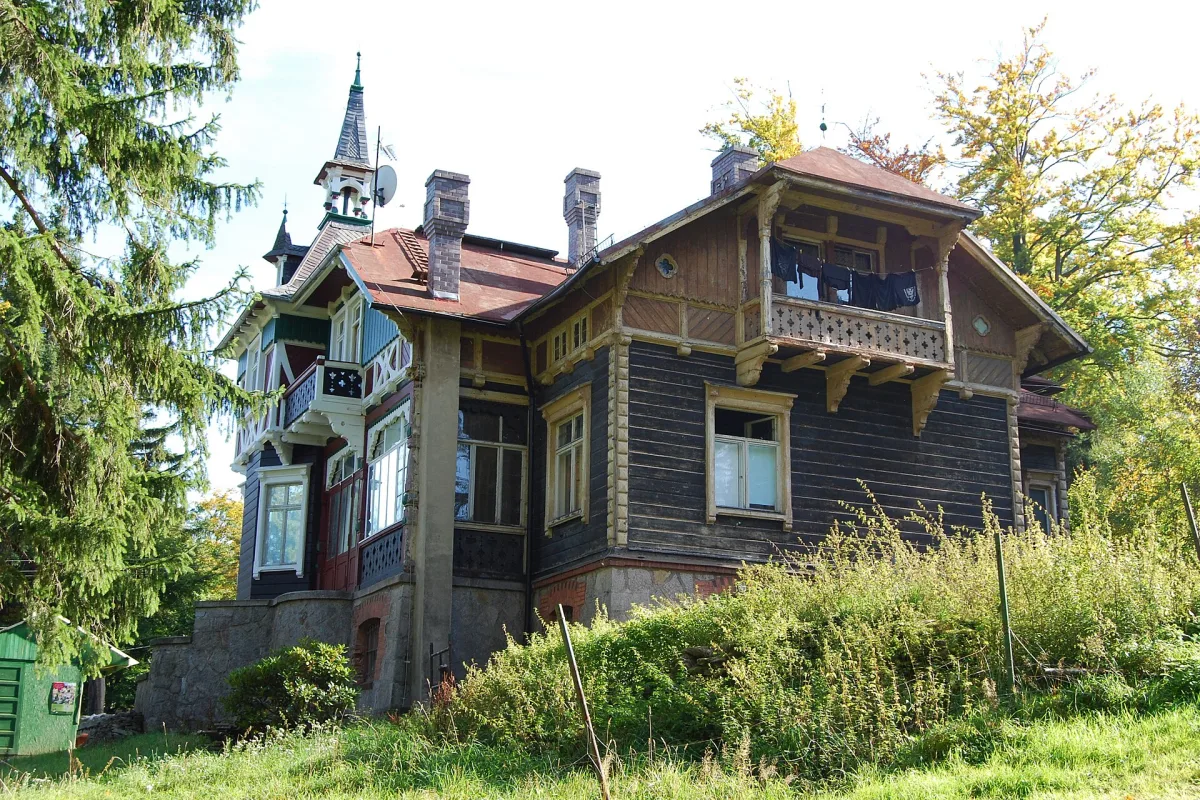
Before permanent glass factories appeared in the Sudetes, for centuries makeshift furnaces moved across the local forests. This was not down to chance or a taste for a nomadic way of life, but to a raw material that kept running out: wood.
The furnace that devoured the forest
Melting glass in the era before coal consumed huge amounts of wood. It fuelled the furnace, and wood ash was burned down into potash, the potassium carbonate needed to melt quartz sand into molten glass. A single season of a glassworks could strip the woodland from a sizeable area around the furnace. Once the forest within an economical transport radius had been used up, it was cheaper to build a new furnace a little further on, closer to the next stand of trees, than to cart wood and quartz over long distances. That is why forest glassworks moved from generation to generation, leaving burned-out clearings behind and pressing further into the wilderness.
The first documented glass furnace on Polish territory operated as early as around 1310 near Poznań, but in the Sudetes the production of forest glass developed in earnest later, mainly between the 14th and 16th centuries. The earliest glassworks appeared in the southern part of the Kłodzko Valley, around what are now Idzików, Marcinków and Długopole Górne. From there, following the shrinking forest, the migration continued further north and into the higher parts of the mountains.
Why beech forest specifically
Forest glassworks were sited where beech-dominated woodland grew. Beech wood gave a good heat and, more importantly, ash rich in potash, a better raw material for glassmaking than ash from conifers. That is why the map of glassworks migration in the Sudetes matches the former range of beech forests, not simply the boundaries of forest in general. When authorities began protecting the depleted woodland of the Kłodzko Valley in the 16th century, production shifted to the northern foothills of the Owl Mountains, into further, still untouched forest complexes.
In the Izera Mountains and the Karkonosze, the same mechanism operated right up to the 19th century. Szklarska Poręba is the best example of this: from the mid-14th to the 17th century, the local glassworks changed its site as many as five times, always a little further up the valley, closer to unexploited forest.
Glass the colour of the forest
Glass melted in makeshift furnaces was called forest glass, in Latin vitrum silvestre. It had a characteristic greenish tint, which was not an intended decorative effect but the result of iron oxide impurities present in the local sand and in the wood ash. The less refined the raw material, the more intense the colour, ranging from light green to a deep, bottle-glass shade. Only later sand-purification techniques, developed already in permanent, brick-built glassworks, made it possible to produce colourless, fully transparent glass.
Forest glass was thus a product of its place of origin in the most literal sense: its shade changed along with whatever sand and wood a given glassworks happened to have to hand. To a modern eye this looks more like a flaw than a virtue, but in an age where what mattered was above all the usefulness of a vessel or a pane, nobody was surprised by a greenish tint.
Traces on the map and in the forest
Few physical relics of the migrating glassworks survive in the Polish mountains; the old furnaces were makeshift and were dismantled or simply abandoned once a glassworks closed. The more lasting trace turned out to be the place name. In spots where a glass furnace once stood, toponyms such as Huta, Stara Huta or Hucisko can still be found today; in Poland alone there are a dozen or so places called Szklana Huta or Huta Szklana, and most of them owe that name precisely to the old glassmaking craft rather than to metalworking.
In the Izera Mountains and the Karkonosze, this memory is more scattered than in the Kłodzko Valley, where the naming survived in a purer form. What has lasted most durably from the Sudetes' forest glassworks is Szklarska Poręba itself, a town that took its name from the craft, though the buildings standing within its boundaries today already bear witness to the era when the glassworks stopped wandering and settled for good.
The end of the migration
The era of migrating glassworks ended when the economics of production changed. In the 19th century, the development of transport and access to raw materials from further afield meant it was cheaper to cart wood and sand to a single large, brick-built works than to build another makeshift furnace every time the forest ran out. In Szklarska Poręba, this change is symbolised by the Józefina glassworks, founded in the 1840s: a permanent, industrial plant rather than another wandering forest glassworks. The portal covers its later history, right up to today's crystal-making tradition of Szklarska Poręba, in a separate article.
Raw material for these later, permanent glassworks no longer had to be sought in any old forest; quartz for glass production was mined, for example, at the "Stanisław" quartz mine in the Izera Mountains, one of the highest-altitude open-pit mines in central Europe. Today, the mineral resources of the region, which for centuries powered both the migrating and the permanent glassworks, are told through the collections of the Mineralogical Museum in Szklarska Poręba.

Be the first! Add a comment.
You need to log in to add a comment.
Log in