
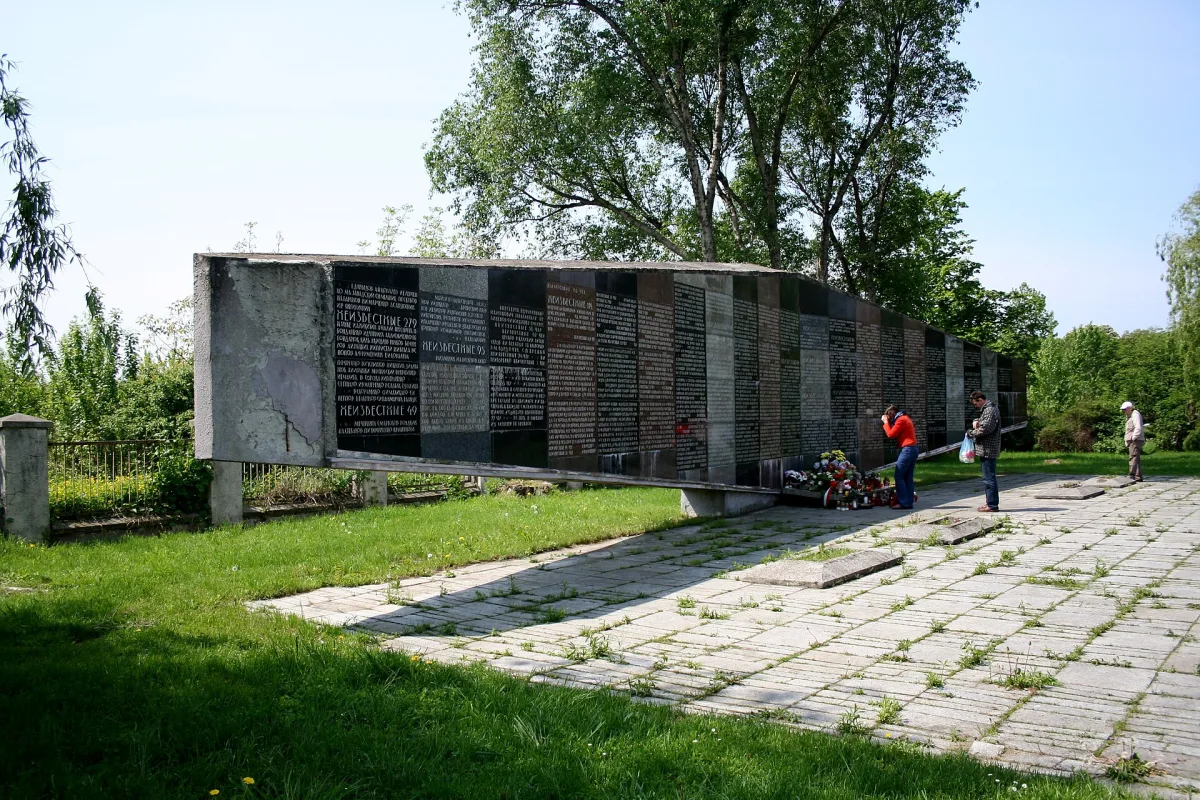
Lower Silesia ended the Second World War as a region of several parallel waves of burials: soldiers of various armies who fell in the fighting of 1945, victims of the Gross-Rosen concentration camp and its subcamps, and civilians affected by evacuation and expulsion. Graves were dug in haste, often in several places at once, and it was only in later decades, sometimes even after 1990, that they were turned into permanent necropolises.
Red Army soldiers: from temporary fields to permanent necropolises
During the siege of Wrocław in the spring of 1945, Red Army soldiers were buried provisionally in eight burial fields scattered across the city and its surroundings. In 1947-1948, as part of the reorganisation of war graves, one destination site was chosen: the Cemetery of Soviet Soldiers on Skowronia Góra. Remains were transferred there from the remaining seven fields, creating a necropolis where about 7,500 soldiers now rest, mainly from the 6th Army of the 1st Ukrainian Front under General Vladimir Gluzdovsky. The cemetery, covering 4 hectares, took its final shape during rebuilding in 1965-1967, when a monument by the sculptor Łucja Skomorowska was also erected.
Officers were buried separately: 763 people rest at the Soviet Officers' Cemetery in Wrocław, including 69 unknown by name, alongside two German anti-fascists, Horst Viedt and Josef Wagner, killed on 6 May 1945, the day the city surrendered. Similar, though much smaller, Soviet cemeteries also appeared outside Wrocław. In Lwówek Śląski, in 1946-1947 the remains of soldiers from the whole county were brought together and placed in 42 mass graves on a plot of just 0.10 hectares, where 172 people rest. The cemetery was officially opened on 9 May 1947, on the second anniversary of victory.
Polish soldiers of the 2nd Polish Army
Polish soldiers died in the spring of 1945 further from Wrocław, though still in Lower Silesia, while crossing the Lusatian Neisse, in the fighting for Niesky and Horka as part of the Lusatian and Bautzen operations, and during the march on Dresden and the Czech town of Mělník. Their cemetery in Zgorzelec lies on Bohaterów II Armii Wojska Polskiego Street, right next to the municipal cemetery.
In Wrocław a separate necropolis, the Cemetery of Polish Soldiers, was only established in 1968-1970 and extended until 1979. 604 people rest here: soldiers of the 2nd Polish Army who fell at the front, but also participants of the September Campaign of 1939 who died in German captivity, that is, victims from six years before the fighting for the city, buried in one place together with the fallen liberators. In 1979 a monument was also erected here in the shape of two twenty-three-metre hussar wings, carved by the same Łucja Skomorowska-Wilimowska who had earlier designed the monument at Skowronia Góra.
Italian prisoners from a hundred years ago and graves from 1945
Not all the region's war cemeteries are linked to the Second World War. The Italian Soldiers' Cemetery in Wrocław, in the Grabiszyn-Grabiszynek district, was created as early as 1927-1928, entirely with money from the Italian government. 1,016 people rest here, above all Italian soldiers taken prisoner after Italy's defeat at the Battle of Caporetto on 24 October 1917 and who later died in prisoner-of-war camps in eastern Germany, that is, victims of the First World War. In 1943-1944, however, twenty Italian civilian workers were also buried here, and after 1945, soldiers who fell during the siege of Wrocław. This same patch of ground thus brings together victims of two wars a quarter of a century apart.
Graves and monuments to victims of Gross-Rosen and the death marches
Another kind of war cemetery is formed by the graves and monuments to victims of the Gross-Rosen concentration camp and its network of more than a hundred subcamps, scattered across Lower Silesia. On the site of the main camp in Rogoźnica, the Gross-Rosen Museum now operates, with a preserved quarry where prisoners extracted granite. In total, about 125,000 prisoners passed through the whole complex, and about 40,000 died there, although the breakdown of this figure between the main camp and the individual subcamps has not been fully established.
In Kamienna Góra, where the Arbeitslager Landeshut subcamp operated, the victims are today commemorated by a double memorial site, a symbolic grave at the municipal cemetery and a monument on the slope of Góra Parkowa. In the subcamps of the Riese complex in the Owl Mountains, where nearly 13,000 people were imprisoned, almost all of them Jews from various European countries, at least 4,775 died, and if those who died in the first weeks after the war are also counted, the figure reaches 4,929. Exactly where most of them were buried is not specified in the available sources. Many prisoners also died during the evacuation in February 1945: the march from the Wolfsberg subcamp to Bergen-Belsen, Flossenbürg and Mauthausen, begun on 16 February 1945, cost the lives of at least 256 people, who died along the way from exhaustion and frost.
German soldiers: reorganising the graves after 1990
The fate of German war cemeteries in Lower Silesia was different from the others. After 1945 most of them were closed down or neglected, and the remains of German soldiers were buried provisionally, wherever they happened to fall. It was only after the change of political borders and the Polish-German agreements of the 1990s that systematic exhumations and reburials began. This is how the German War Cemetery and Peace Park in Nadolice Wielkie came about, opened as a Peace Park on 9 October 1998 and formally renamed a cemetery on 5 October 2002. It covers 3 hectares, planted with over 600 trees. By 2001, 10,800 people exhumed from the areas of today's Lower Silesian, Opole and Lubusz voivodeships rested here, and by October 2016 the number buried had risen to 17,000, as further exhumations continued from individual, scattered graves.
Monuments to civilian victims: Katyń and shared memory
A separate group of memorial sites is formed by monuments dedicated to civilian victims and crimes not directly linked to the fighting for the region. In Wrocław, in Juliusz Słowacki Park, stands the Monument to the Victims of the Katyń Massacre, built between 1994 and 2000 to a design by Tadeusz Tchórzewski and unveiled on 22 September 2000. It takes the form of a cross with four granite slabs and two bronze figures, the Angel of Death and the Katyń Pietà, and commemorates the victims murdered at Katyń, Mednoye and Kharkiv and the prisoners of the camps at Kozelsk, Starobelsk and Ostashkov.
In Głogów, in the Forest Park, stands the Monument to the Victims of War, unveiled on 27 May 2000. It is a simple granite block without further ornament, dedicated jointly to Polish and German victims of war, violence and expulsion, one of the few monuments in Lower Silesia that does not place the two nationalities on opposite sides of remembrance.

Be the first! Add a comment.
You need to log in to add a comment.
Log in