
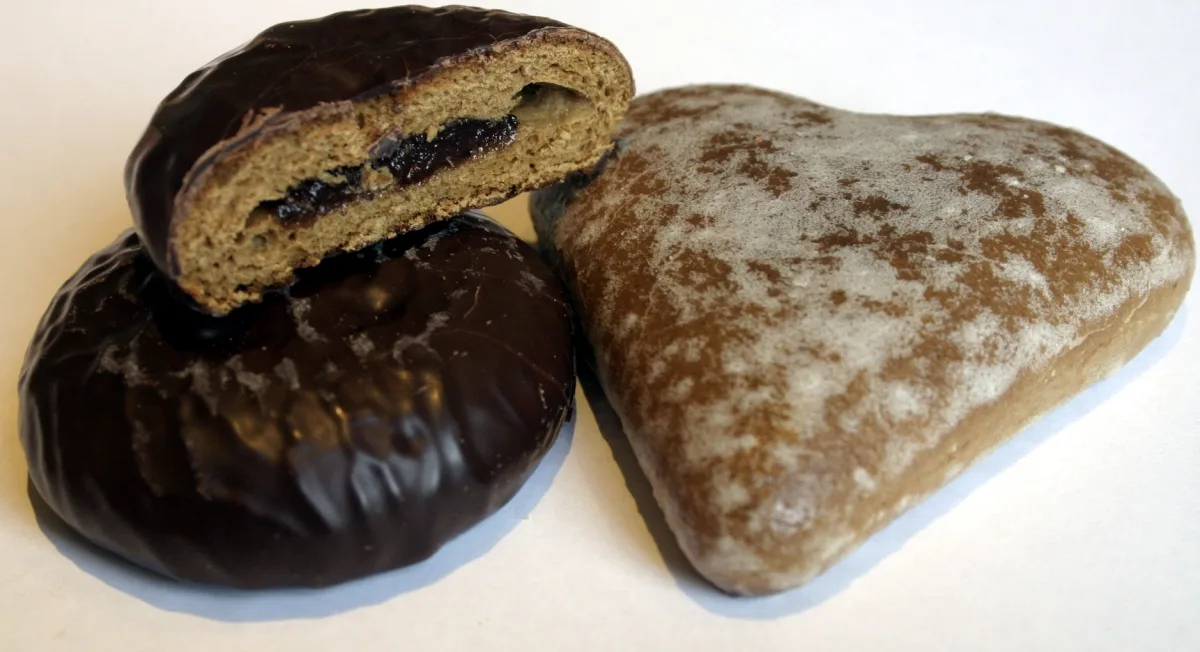
A gingerbread that doesn't resemble market gingerbread
The Legnica Bomb is a soft spiced gingerbread with rich marzipan filling - not a flat, hard biscuit for decorating with icing, but a dense, moist bake more like a spice cake. Its ingredients include wheat flour, honey, sugar, butter, cocoa and eggs, and the flavour is rounded off with dried fruit, oranges and orange peel, marzipan, orange and apricot jams, orange liqueur, pistachios and dark chocolate. Its characteristic, spicy aroma comes from ginger, cinnamon, cloves and pepper. The bake is produced today on both sides of the border - in Legnica and on the German side, where it goes by the name Liegnitzer Bomben.
A gift for the emperor that has lasted a century and a half
The history of this bake goes back to around 1875. The occasion for its creation was a visit by the German Emperor Wilhelm I to Legnica, announced for September of that year. The town was preparing to receive the monarch, and local craftsmen were preparing commemorative gifts. Among them were the Müller brothers: the elder Hermann, who ran a confectionery opened in 1853, and the younger Eduard, who was learning the trade from him. It was Eduard Müller (1828-1914) who invented a new, sweet speciality for the occasion. The bake proved so popular that, as early as November 1875, Eduard became a partner in the family firm, and from the 1880s onwards the bomb became firmly established in the canon of Lower Silesian bakes.
Where the name comes from
The name refers to the circumstances of the bake's creation - it was meant to carry a patriotic meaning, symbolising in sweet form the Prussian victory that Emperor Wilhelm I embodied for the residents of Legnica at the time. The association with a "bomb" - something striking and strong in flavour - captured well the character of a dense, intensely spiced gingerbread, very different from the light pastries served in confectioners' shops at the time.
Awards and place in the regional cuisine
The Legnica Bomb won first prize in the nationwide "Our Culinary Heritage - Tastes of the Regions" competition, as well as the Medal of the Tastes of the Regions fair. It also belongs to the Tastes of Lower Silesia Culinary Trail, and its producer uses the European Regional Culinary Heritage mark. These are distinctions different from the national list of traditional products kept by the Ministry of Agriculture, on which some other Lower Silesian specialities feature, such as Milicz carp, Kłodzko trout or Kamienna Góra blue cheese - in the case of the Legnica Bomb, it was not possible to confirm an entry on this particular list.
The gingerbread heritage of Lower Silesia
The Legnica Bomb was not created in a culinary vacuum. The towns of the Oder region, including Legnica, had long been famous for making spiced gingerbread, so when the Müller brothers were looking for an idea for a commemorative gift for the emperor, they had at their disposal hundreds of years of local gingerbread-making tradition and spices brought in by Silesian merchants. Thanks to this, the bake, although it arose from a specific, one-off occasion, fitted into an already existing strand of regional confectionery, and survived both changes of borders and residents that the town went through after the Second World War. Today the Legnica Bomb functions as one of the few bakes that link the town's history before 1945 with its post-war, mostly newly settled population - a flavour with no national pedigree, since it was born on the border between a German recipe and the Lower Silesian gingerbread tradition, and today is unambiguously associated with Legnica on both sides of the former border.
The Legnica Bomb against other flavours of the region
The Legnica Bomb is not the only Lower Silesian speciality with a pedigree reaching back into the region's history. On the national list of traditional products, kept by the Ministry of Agriculture, there are currently 52 registered products from Lower Silesia - from cheeses to honeys and fish. Among them is Milicz carp from the Barycz Valley, Kłodzko trout from the Kłodzko area, Kamienna Góra blue cheese, Łomnica goat's cheese and Zgorzelec cheese from Zgorzelec county. A separate, EU designation, Protected Geographical Indication, is held by heather honey from the Lower Silesian Forests, recognisable by its amber-brown colour. Each of these products arose at a different moment in the region's history and for a different reason: carp and trout are the result of hundreds of years of farming in a particular landscape, the cheeses and honey derive from local agriculture, and the Legnica Bomb from a one-off, 19th-century occasion that became a permanent part of the town's cuisine. Together they show that Lower Silesia's culinary identity does not rest on a single type of product, but on dozens of separate, often local traditions.
Be the first! Add a comment.
You need to log in to add a comment.
Log in