
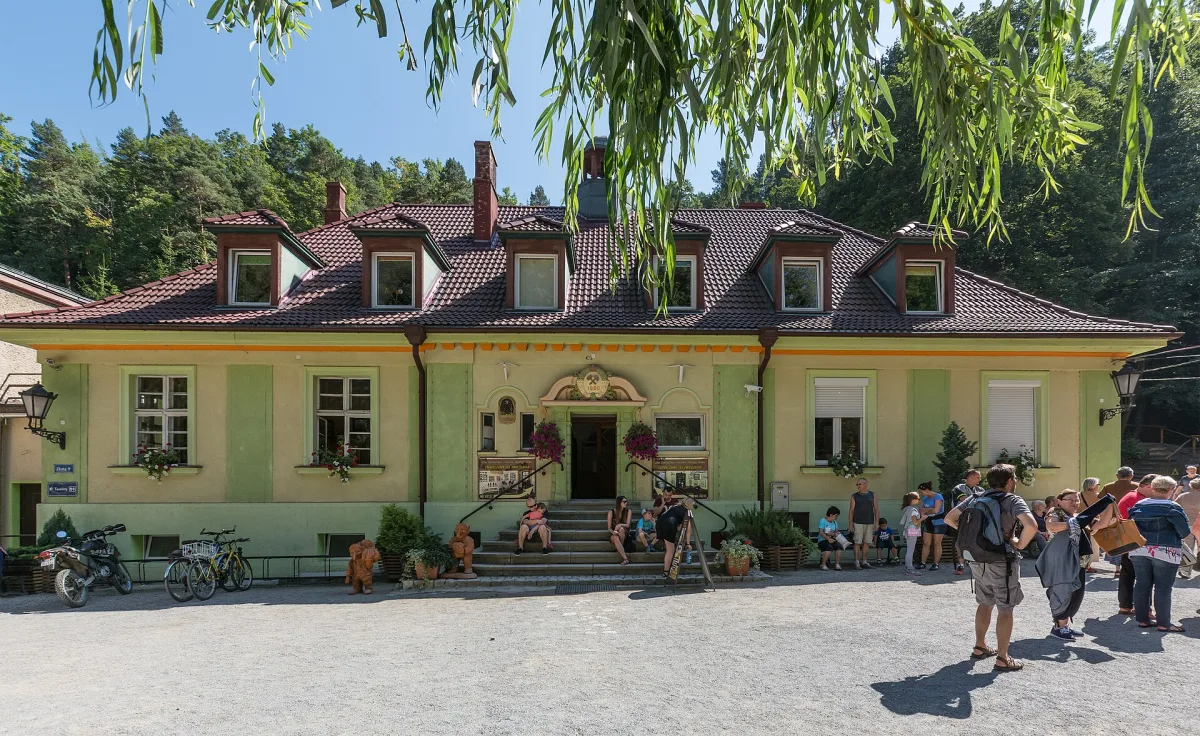
Gwarkowie - the people who lived off gold and silver
A "gwarek" was the name for a miner digging precious metal ores, and Lower Silesia gave them work in several centres at once for centuries. In Złotoryja gold mining goes back to the Middle Ages - as late as the mid-13th century nearly fifty kilograms of pure ore were mined there a year, before the deposits ran out and the final blow to mining came with the flooding of the mines in the early 15th century. In Złoty Stok, 16th-century mining reached an even greater scale: almost two hundred mines and twenty smelting works operated there, and the region supposedly supplied around eight percent of Europe's gold production at the time. Under the town, over three hundred kilometres of galleries were dug in total, from which around sixteen tonnes of pure gold were extracted over centuries of exploitation. A gwarek's work involved manually cutting passages through hard rock, hauling the extracted material to the surface and washing the ore in search of grains of metal - a dangerous occupation, dependent on the yield of the deposit and usually ending either when the deposit was exhausted or when mining stopped being profitable. A similar fate later befell the silver and copper mining in Boguszów-Gorce, where the local shafts moved in turn from silver through hard coal to barite, and the town of Miedzianka in the Rudawy Janowickie mountains, which at the height of 16th-century silver, tin and copper mining had more than one hundred and sixty shafts and galleries, and of which today only ruins remain of the former mining settlement.
Coal and copper miners - a trade that changed eras
Alongside the gold and silver prospectors, the region also had coal mining, centred around Wałbrzych, where the first mentions of extraction go back as far as the 15th century. Under the ground in this area a total of two hundred and fifty-four kilometres of galleries were dug, the result of more than four hundred years of mining work, which finally ended on 20 September 1996, when the last wagon of coal left the Julia mine. In 1945-1998 more than a thousand miners died underground in the Wałbrzych Coal Basin. A completely different chapter opened with the 1957 discovery of an enormous copper ore deposit between Lubin and Głogów, one of the largest in the world - it was on this basis that today's Copper Basin arose, along with plants that still employ thousands of people in the region, though now no longer by hand with a pickaxe, but using mining machinery.
Glassmakers on the move for wood
In the Izera Mountains, glassmaking developed a completely different model of work from mining - the old glassworks there were called "wandering" ones, because the whole plant would be moved further up the mountains once the surrounding forest was exhausted, rather than transporting wood and quartz down the river. The glass melted in such works, forest glass, in Latin vitrum silvestre, had a characteristic green tint from the impurities in the local sand. This wandering, scattered production gradually concentrated in fixed centres, the most famous of which became the Józefina glassworks in Szklarska Poręba, opened on 8 July 1842 by Count Leopold von Schaffgotsch. Its products gained worldwide renown after the London industrial exhibition of 1851, and after the war, by then known as the Julia Crystal Glassworks, artists including Henryk Albin Tomaszewski and Jan Owsiewski worked there - it is from here that the chandeliers and wall lamps hung in 1953-1955 under the ceilings of Warsaw's Palace of Culture and Science came. The portal covers the region's glassmaking traditions separately and in more detail; here it is worth only noting that old glassmakers, unlike miners, were not so much exhausting a deposit as constantly having to look for new fuel - and that it was the lack of wood, rather than a lack of raw material, that most often ended the work of the next glassworks in a given place.
Potters with a centuries-old tradition
In Bolesławiec, the production of ceramics has a documented history going back to at least 1380, when the first written mentions of local potters appear, though archaeological excavations confirm ceramic production at this site as early as the early Middle Ages. Unlike gold mining or glassmaking, the potter's craft in Bolesławiec did not die out - local clay with the right properties and the continuity of the workshops allowed the craft to survive to this day, even as technologies, decorative patterns and the scale of production changed, from individual craft workshops to today's manufactories and factories.
Ghosts, foremen and the language underground
Work in the mines had its own language and its own customs, which survived in regional folklore longer than mining itself. In the Silesian and Wałbrzych mines, tales were told of Skarbnik, a spirit in the form of a bearded foreman with a lamp on his forehead, who would warn miners of cave-ins and fires, but punished the lazy and careless by leading them to their doom. A "sztygar", or supervisor of underground mining works, was in this hierarchy something like a guild master - it is his image that the legendary spirit of the mine bore, which shows well how much work underground had its own separate, closed culture, properly understood only by the miners themselves. Weaving, the region's other great occupation, has already been covered on the portal in separate texts about the 1844 uprising of the Silesian weavers and about the architecture of weavers' houses, so here it is only flagged as another, equally important thread among Lower Silesia's old trades. Likewise described separately are the Walloons, medieval prospectors for precious stones in the Izera Mountains, whose legend warned the curious against spying on their work with a tale of a black billy goat carrying off the bold onto its back.
Traces in names and landscape
Old trades have left traces in the region more lasting than the workshops themselves. Place names refer directly to old mining - Złotoryja and Złoty Stok carry in their names the ore mined there for centuries ("złoto" meaning gold), and Miedzianka, though today it barely exists as a town, owes its name to the copper deposits exploited in its vicinity ("miedź" meaning copper). The landscape of the Sudetes is dotted with the remains of old extractive industry: disused shafts, spoil heaps and galleries, some of which have been renovated and turned into viewpoints, such as the former Witold mining shaft in Boguszów-Gorce.
Where to see tools and workshops today
Several places in Lower Silesia let you see old workshops and equipment up close, rather than just reading about them. At the Gold Mine in Złoty Stok a tourist route leads through the galleries where gold and arsenic were mined from the Middle Ages onward. At the Aurelia Gold Mine in Złotoryja you can go down into an underground passage with troughs for washing gold. The Stara Kopalnia Centre for Science and Art in Wałbrzych occupies the site of the former Julia coal mine, with a preserved bathhouse and hoisting machines from 1911, and a ceramics workshop also operates there. The Kowary Adits, in turn, let you tour a former, strictly guarded uranium mine. The pottery tradition is documented by the Bolesławiec Ceramics Museum, which runs two permanent exhibitions of Bolesławiec ceramics from before and after 1945.
Be the first! Add a comment.
You need to log in to add a comment.
Log in