
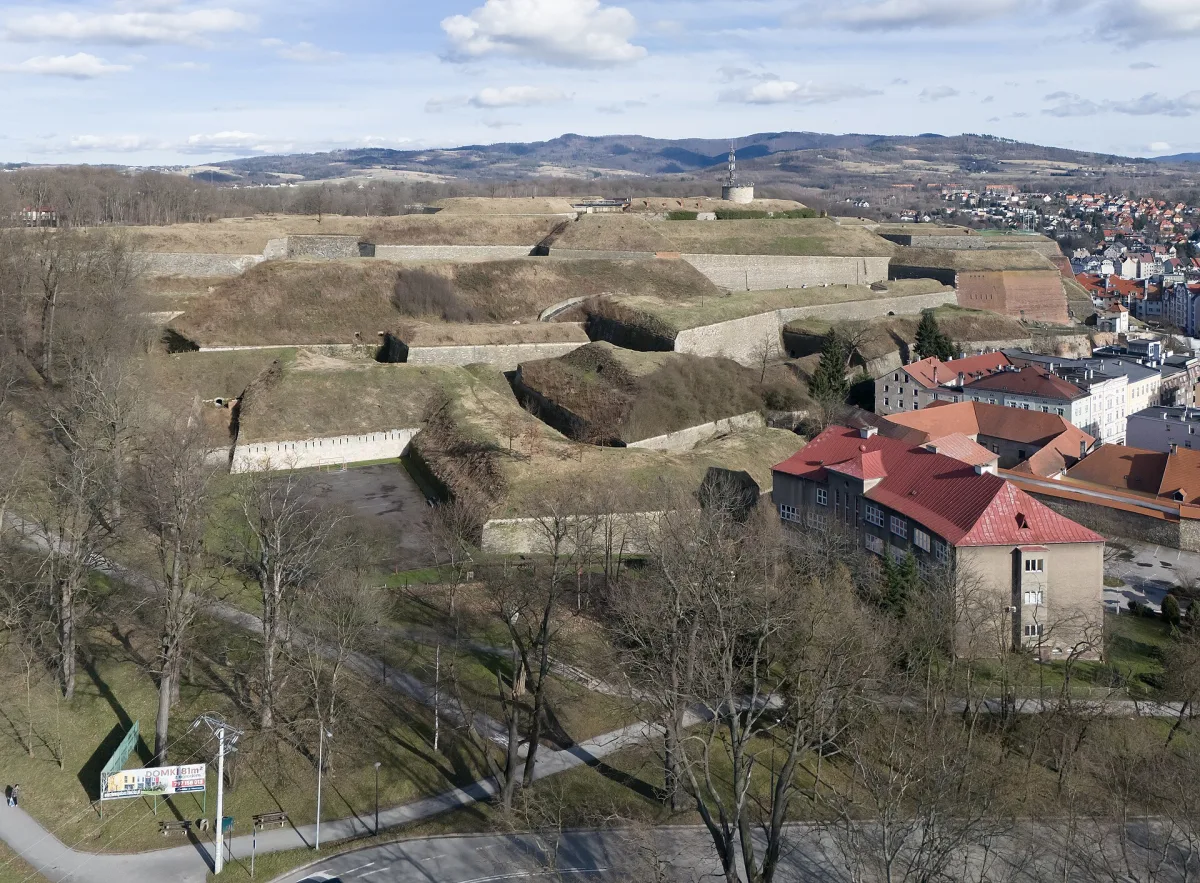
From a disarmed fortress to an arms factory
Kłodzko Fortress lost its military significance as early as the 19th century, when the Prussian authorities judged it outdated and disarmed it. For the following decades the hill above the town served mainly civilian and museum functions. The Second World War, however, gave the fortress a role it had never had before - not a battlefield, but a place of confinement and forced labour. The massive casemates and underground corridors, once built for defence against enemy armies, turned out to be an excellent shelter for a prison and a production line that could not be seen from outside and that air raids could not reach.
A high-security prison and a Gross-Rosen subcamp
In 1940-1943 Kłodzko Fortress operated as a high-security prison for political prisoners and a place of confinement for prisoners of war and people suspected of acting against the Third Reich - during this period it functioned as a subcamp of the Gross-Rosen concentration camp. Prisoners of many nationalities passed through its walls: Russians, French, Italians, Belgians, Czechs, Finns and Britons. Poles were also among those held, including a member of the structures of the Polish Scouting Association operating in Germany.
It is worth noting a discrepancy in the source material: the official, extensive catalogue of Gross-Rosen subcamps kept by the Gross-Rosen Museum in Rogoźnica does not list Kłodzko Fortress among the more than eighty described subcamps, even though the encyclopaedia and local historical material place it there. This may stem from the site's separate status - it functioned more as a prison and place of confinement than a typical labour subcamp attached to a factory, of which the Gross-Rosen network already had more than a hundred by then.
The underground AEG factory and production for the front
In 1944, as the German arms industry, faced with air raids on western Germany, moved production en masse further inland, the AEG plant evacuated from Łódź was relocated to the fortress grounds. Production of parts for V-1 flying bombs and electrical equipment for submarines and aircraft was set up in the underground corridors and casemates. The work therefore took place literally underground, in the same corridors that, a hundred and fifty years earlier, had been meant to detect the enemy's mines, and which now concealed an assembly line for parts of a weapon that could strike targets hundreds of kilometres away.
Production did not last long. As the eastern front approached Silesia, in February 1945 the Germans began evacuating the factory further inland, to Thuringia. The fortress ceased to function as an arms plant even before the war ended in May 1945.
The site's post-war repurposing
After the war the fortress did not immediately become a tourist attraction. Until 1958 it housed military stores and depots, and only afterwards did food and construction production plants start occupying the site - the casemates and corridors, designed to store ammunition and provisions in case of siege, once again served as storage, this time in peacetime. This means that fifteen years passed between the dismantling of the underground AEG factory and the fortress opening to tourists, during which the site remained closed to visitors and was used purely for economic purposes.
The turning point came in 1960, when the site was entered into the heritage register and part of the fortress was opened to tourist traffic. Today, since 2007, the fortress has been managed by the Kłodzko Municipality, which promotes it as one of the best-preserved fortifications in Europe - though as its history of 1940-1945 shows, for most of the 20th century the site had nothing to do with tourism.
How this chapter is presented to visitors today
The history of 1944-1945 - the fate of the prisoners and forced labourers employed in AEG production - is documented today on the fortress grounds by a separate AEG Exhibition. It complements the main, so-called Upper Route, which takes visitors through the site's entire history, from the medieval stronghold to the 20th century, so the wartime episode is just one of many stages in the story of this place, not its central point.
A similar Second World War episode features in the history of Srebrna Góra Fortress in the Kłodzko region, where a prisoner-of-war camp for officers was housed in the forts. Comparing the two sites shows how different the wartime uses of the region's old fortifications were - from a prison and secret factory in Kłodzko to a POW camp in Srebrna Góra.
Be the first! Add a comment.
You need to log in to add a comment.
Log in