
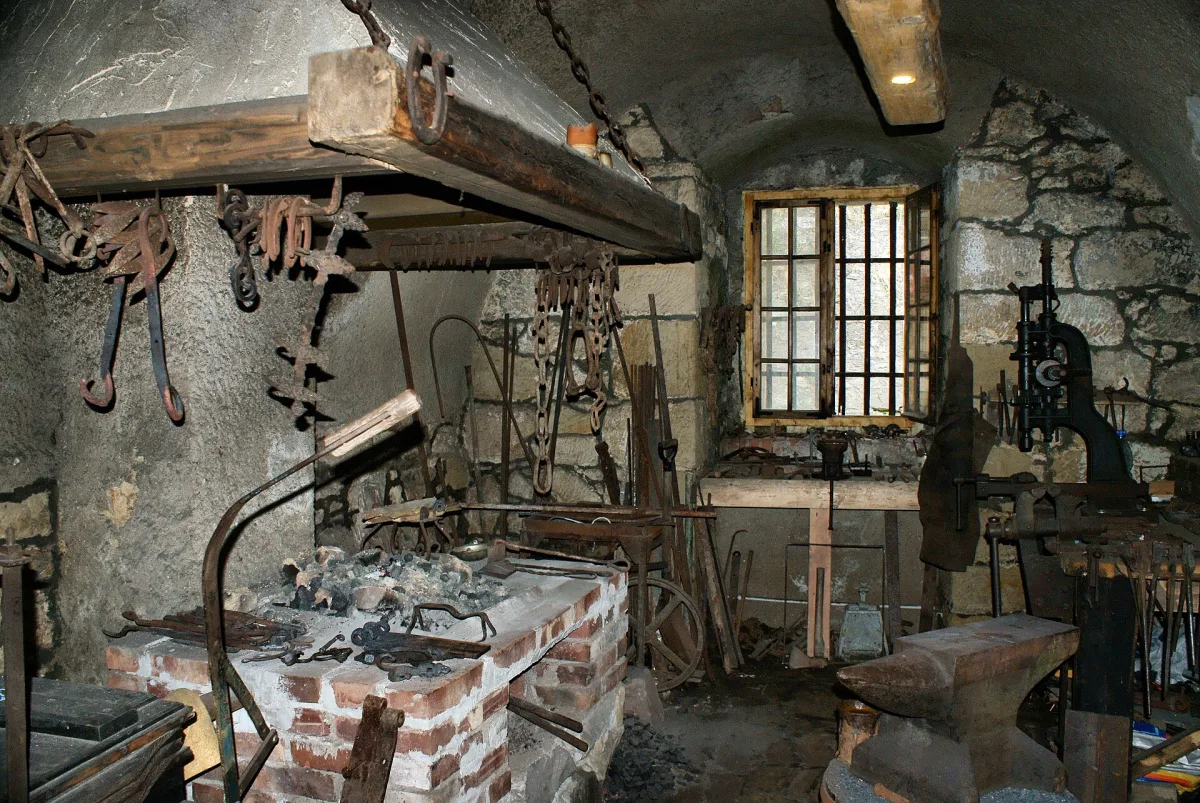
From a stronghold to a Prussian fortress
Kłodzko Fortress has stood on the hill above the town for more than a thousand years, though its present shape is the result of many successive rebuildings. The original stronghold on this site was already described in 981 by the Czech chronicler Cosmas. Around 1300 it was converted into a brick residential castle, and in the 16th and 17th centuries bastions and earthworks were added, adapting the site to firearms. The genuinely modern, extensive fortress began to be built after Prussia took over Kłodzko in 1742 - it was then that most of the fortifications visible today were created.
Why the mining tunnels were dug
In 1790-1793 a system of mining and counter-mining tunnels was cut under the fortress and its outworks - more than 20 kilometres of underground corridors in total. This technique was standard in the fortifications of the period: defenders dug a network of tunnels running out from under the walls towards the open field, so that in the event of a siege they could detect the attackers' mines and detonate explosive charges under their positions before the enemy managed to lay mines of their own under the walls. Counter-mines therefore worked as an early-warning and counter-attack system underground - the defender listened for the enemy's digging and blew up their tunnels before they reached the fortifications.
Why they were never used in combat
The mining tunnels under Kłodzko Fortress were never used for their original purpose. The reason was technical: by the time this part of the fortifications was built, artillery had developed fast enough that armies stopped approaching walls at all by the classic method of siege with mines. Instead of drawing near to the fortress step by step and digging under its foundations, forces besieging it could bombard it with artillery fire from ever-increasing distances. The whole intricately designed system of underground defence against enemy mines became obsolete almost the moment it was finished.
The greatest real threat the fortress ever faced came, in fact, from the air, not from underground. In 1807 Napoleonic forces besieged Kłodzko for more than three months, launching a decisive assault on the night of 23 to 24 June. The fortress formally surrendered only on 26 July - in the meantime a ceasefire was in force, and the Peace of Tilsit meant the fortification ultimately remained in Prussian hands. It is this siege - not any underground battle - that is re-enacted every year on the second weekend of August during the Kłodzko Fortress Days, in which re-enactment groups from Poland, the Czech Republic, Germany, France and Lithuania take part.
The scale of the system and later discoveries
More than 20 kilometres of mining and counter-mining tunnels is still an incomplete picture of what the hill conceals. In 2022 speleologists discovered a previously unknown system of 18th-century counter-mining tunnels under the fortress - in the water-flooded corridors they even found traces of treasure hunters from several decades earlier, from the 1990s. This shows that despite centuries of research, the underground network still hides sections that no one had mapped before.
From disarmament to museum
The fortress's military significance began to fade already after the Napoleonic wars. Around 1867-1869 (sources date the decision differently) the Prussian authorities decided to disarm the fortress as an outdated fortification, and in the following years the earthworks were gradually removed and the moats filled in, adapting the grounds for civilian use. During the Second World War the fortress took on a much darker function: in 1940-1943 it operated as a subcamp of the Gross-Rosen concentration camp, where Russians, French, Italians, Belgians, Czechs, Finns and Britons were held, among others. In 1944 the AEG plant evacuated from Łódź was moved onto its grounds, producing parts for V-1 rockets and electrical equipment for submarines and aircraft here.
The fortress was entered into the heritage register in 1960, and since 2007 it has been managed by the Kłodzko Municipality.
What can be visited today
Today Kłodzko Fortress is a museum combining a tour of the above-ground bastions with access to part of the underground corridors. A separate attraction in the town is the Underground Tourist Route in Kłodzko, running through a different section of the town's cellars and passages, independent of the main fortress complex. The permanent exhibitions include, among others, a display devoted to the Second World War period. For comparison, it is also worth visiting the nearby Srebrna Góra Fortress - another, equally extensive Prussian fortification complex from the same era, where a prisoner-of-war camp also operated during the war.
Be the first! Add a comment.
You need to log in to add a comment.
Log in