
Who she was and how she came to Silesia
Marianne of Orange, in full Wilhelmine Frederica Louise Charlotte Marianne, was born on 9 May 1810 in Berlin. She was the daughter of William I, King of the Netherlands, and the Prussian princess Frederica Louisa. Between 1830 and 1849 she was married to her cousin, Albert of Prussia, with whom she had five children, three of whom lived to adulthood.
She came to Silesia as an heiress: in 1838 she inherited the Kamieniec estate from her mother, including the so-called Stronie key, an extensive landed estate around what is now Kamieniec Ząbkowicki. That same year, on 15 October, the foundation stone for her new residence was laid on Grodowa Hill.
Building the palace and Schinkel's design
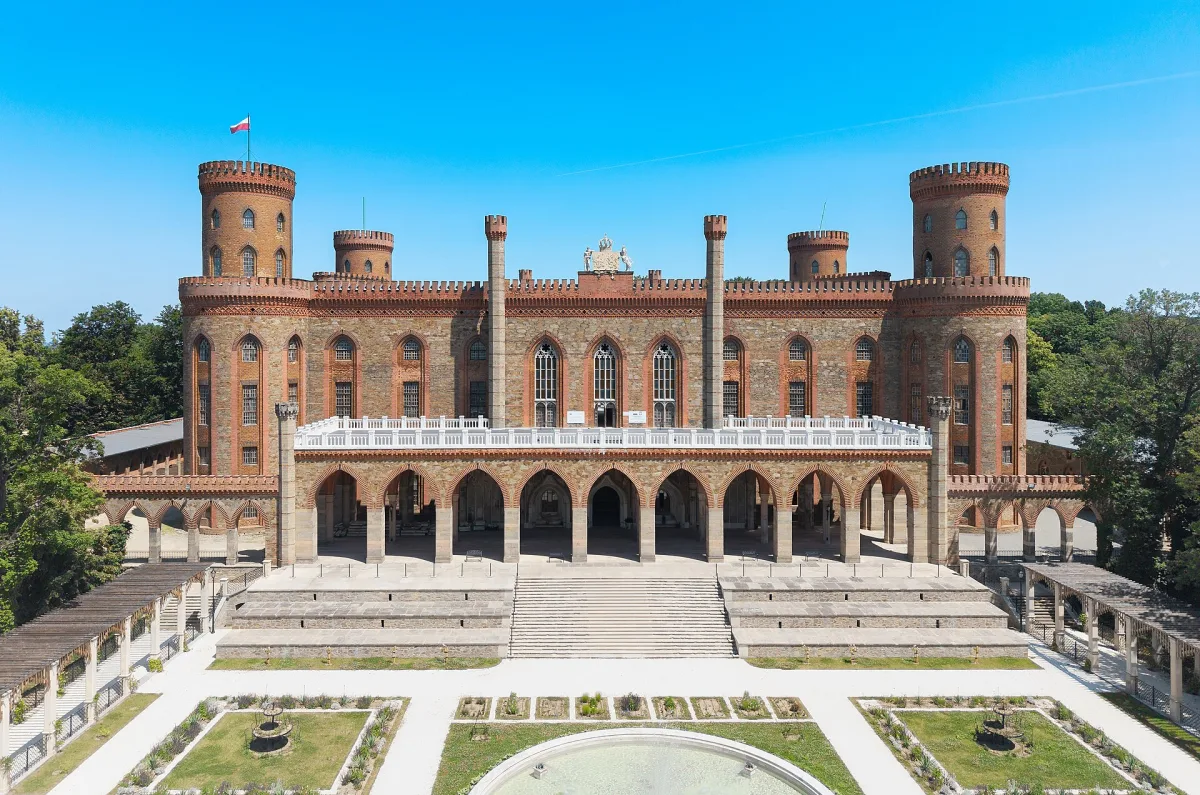
The palace design was prepared in 1838 by Karl Friedrich Schinkel, one of the leading architects of his era and the creator of many Berlin buildings. The work on site was directed by Ferdinand Martius, while Schinkel oversaw the project from Berlin. Construction of the building began in the spring of 1839. The result was a monumental neo-Gothic residence with four towers, today listed in the portal's database as the Kamieniec Ząbkowicki Palace.
The construction took a very long time and did not go without setbacks. Work was halted because of the scandal and divorce surrounding Marianna (sources give different years here: 1848 or 1849), and resumed in 1853, when the palace was formally handed over to her son, Frederick William Albert. The fourth floor was completed and the first rooms were inhabited in 1857, but sources differ on when construction was considered fully finished: one gives the year 1872, after thirty-three years of work and a cost of 971,692 thalers, while another speaks of completion in 1857 and a cost of around three million marks. The discrepancy most likely stems from the difference between the palace first being inhabited and the interior decoration being finished off in later years.
Terraced gardens and the scale of the estate
The residence was surrounded by an extensive park with terraced gardens, descending towards the valley of the Nysa Kłodzka and conceived as an integral part of the whole estate. The scale of the investment matched the position and wealth of its founder, the daughter of the King of the Netherlands, who could afford to build a residence comparable in grandeur to the ducal residences of the Germany of her time. Today the palace, together with its surrounding park, forms an architectural and landscape complex, recognised in 2024 as a historic monument.
Investment in roads and the local economy
Marianne of Orange did not limit herself to building her own seat. On the Kamieniec estate and the Stronie property key she built over 55 kilometres of roads, which at the time significantly changed the transport and economic conditions of the surrounding villages. She established fish ponds and set up iron foundries and a glassworks known as Oranienhütte. To this day the Kłodzko region retains the memory of her as the "Good Lady": her name has survived in the names of local buildings and institutions.
Scandal and exile
In 1845 Marianna left her husband and took up with her stable master, Johannes van Rossum, with whom she had a son. The relationship caused a scandal both at the court in The Hague and in Berlin. The consequences were severe: she was placed under a ban of infamy, forbidden from contacting the children of her first marriage, and banned from staying in Prussia for more than a day at a time, with an obligation to report to the police. The divorce, formally granted in the 1840s, held up construction of the Kamieniec palace for several years.
She died on 29 May 1883 in Reinhartshausen, where she was buried beside Johannes van Rossum. Her turbulent life is also tied to a legend according to which the ghost of Marianne of Orange would appear at night on the terraces, in the park and inside the Kamieniec residence - a story known from local accounts, not a documented event.
The palace's fate after the war and today's reconstruction
In 1945, as the front approached, Marianna's descendants evacuated from Kamieniec Ząbkowicki. The abandoned palace burned down and fell into ruin over the following years: in the 1950s it suffered further, progressive devastation, and sources even mention an attempt to bring down part of the building with a tractor. Some of the marble floors and columns from the interiors were removed and used in the post-war reconstruction of Warsaw, including in the construction of the Palace of Culture and Science.
Reconstruction did not begin until the second half of the 20th century. In 1986 the site was leased out for forty years, and after that agreement expired in 2012 the palace returned to the management of the Kamieniec Ząbkowicki municipality. Following restoration and reconstruction work, the residence was reopened to visitors in 2013. Today, besides the palace itself, the region also recalls the former owners of the Kamieniec estate through the castle in nearby Ząbkowice Śląskie, another residence tied to the history of these lands, though it survives only as a ruin.
Be the first! Add a comment.
You need to log in to add a comment.
Log in