
Ślęża and Sobótka: the starting point of the route
The Sudeten Foreland begins south of Wrocław, where Ślęża rises from the plain, the region's highest peak and a former centre of pagan worship. The portal already has a separate text about the stone carvings on its slopes, so here it's worth noting only that the summit itself and the whole Mount Ślęża nature reserve are the oldest form of nature protection in the area, established in 1954. The small town at its foot, Sobótka, has a longer history than it might seem: the first mention of the local market settlement, recorded as Sabath, comes from a bull of Pope Eugene III from 1148, and the town's name comes precisely from the markets held on Saturdays. Between 1128 and 1134, the magnate Piotr Włost brought regular canons to Sobótka, whose task was to root out cults still alive around the mountain. The word sobótka, meaning the Midsummer's Eve bonfire night, also derives from Ślęża - ritual fires have been lit on the summit on St John the Baptist's Eve for centuries.
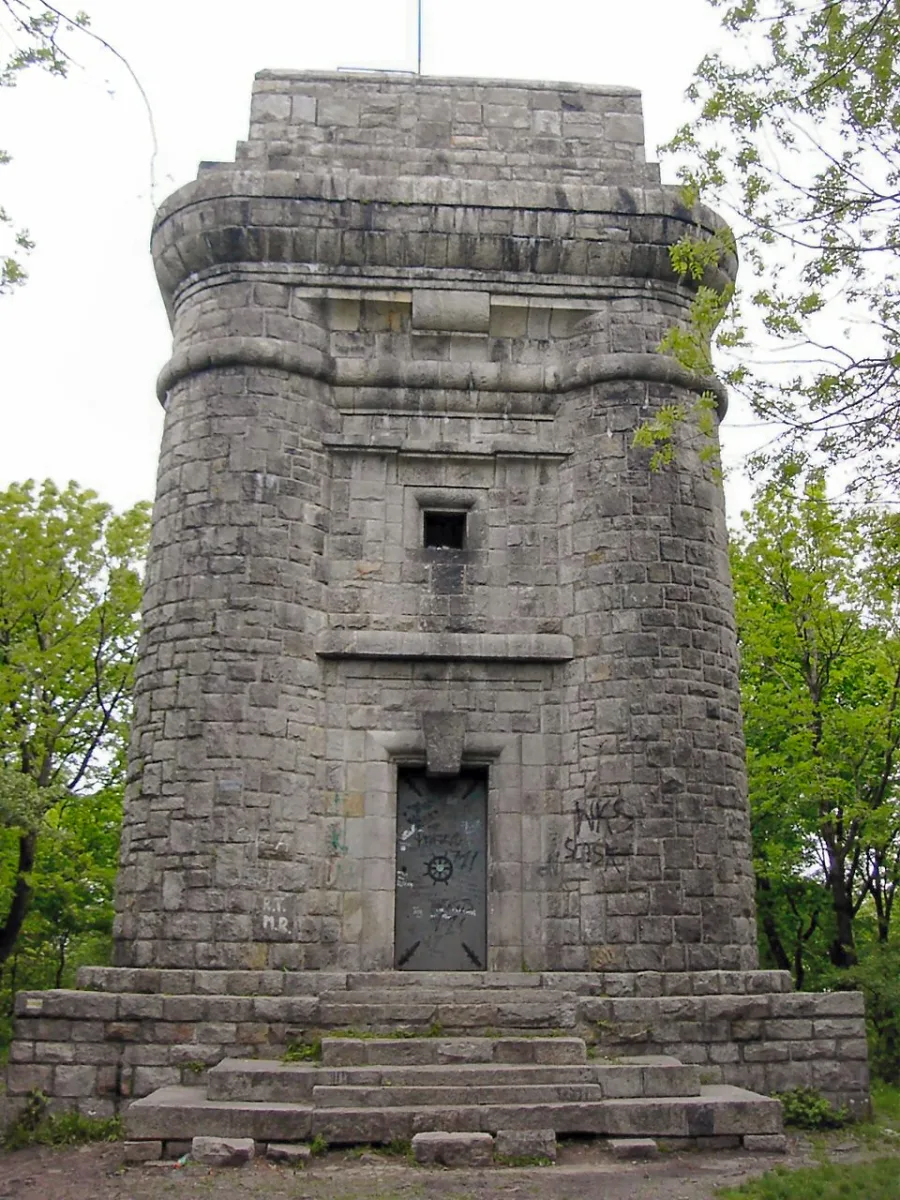
From Sobótka it's worth climbing the neighbouring Wieżyca, where a stone observation tower from 1907 stands, built from granite quarried on the spot, in the Ślęża massif. The history of the region and the mountain itself is told by the Stanisław Dunajewski Ślęża Museum, housed in a Renaissance Abbot's House from 1568.
Ząbkowice Śląskie and Kamieniec Ząbkowicki: towns the portal has already written about
Further south lie Ząbkowice Śląskie, formerly Frankenstein, and neighbouring Kamieniec Ząbkowicki with the palace of Marianne of Orange. The portal has devoted separate texts to both places, so here just a brief pointer to what's worth seeing on site: the brick ruins of the castle in Ząbkowice Śląskie, raised between 1522 and 1532 on the site of an older Gothic stronghold, and the Regional Heritage Chamber, housed in the house of the knight Kauffung, with its Dr Frankenstein's Laboratory. In Kamieniec Ząbkowicki stands the palace of Marianne of Orange, designed for her by Karl Friedrich Schinkel.
A dozen or so kilometres further, in Ziębice, the case of the serial killer Karl Denke came to light in 1924 - he had killed several dozen people, beggars, homeless people and travellers, and kept leather goods made from his victims' skin and preserved meat in his house. He hanged himself in his cell on the day of his arrest. It's the darkest episode in the region's history, but a permanent entry in its criminal chronicles.
The abbey in Henryków and the oldest sentence written in Polish
The Cistercian abbey in Henryków was founded in 1222 by Duke Henry I the Bearded, and the first monks arrived here from Lubiąż in 1227. It was here that, after 1241, Abbot Peter wrote the monastery chronicle known as the Book of Henryków. It contains the sentence "Daj, ać ja pobruszę, a ty poczywaj" ("Let me grind, and you rest"), supposedly spoken by the knight Boguchwał to his wife as she ground grain on a quern - the oldest sentence written down in the Polish language, predating other known written records by decades.
The abbey's history wasn't easy. In 1810, after the Prussian authorities dissolved the order, the abbey's library, comprising 132 manuscripts and 20 thousand volumes, was confiscated. A legend survives, though, that before the Prussian army's invasion in the 18th century the Cistercians hid an enormous treasure in the monastery's cellars, which no one has found to this day. This is only a story, not a confirmed event, but it has circulated in the area for generations.
Niemcza: the stronghold that stopped an emperor
In August and September 1017, the fortified stronghold in Niemcza held off a three-week siege by the twelve-thousand-strong army of Emperor Henry II. The failed assault forced the emperor to retreat, and a year later led to the peace of Bautzen. The chronicler Thietmar of Merseburg, describing the defence, wrote that he had never heard of besieged people who defended their safety with greater persistence and resourcefulness.
Today in Niemcza it's worth visiting the Church of St Adalbert, and in nearby Wojsławice, the Wojsławice Arboretum, a botanical garden of the University of Wrocław known for its collection of rhododendrons, azaleas and daylilies, laid out in a picturesque basin above the Ślęza river.
Srebrna Góra Fortress: a stronghold built in record time
Srebrna Góra Fortress is considered the largest mountain fortress in Europe, and the portal already has a separate text about the attempt to capture it by Napoleon's army. It's worth adding, though, how fast it was built: the fortress went up in just 12 years, between 1765 and 1777, on the order of Frederick the Great. Nine wells were carved into the rock, with a combined depth of over 478 metres, the deepest reaching 84 metres - meant to supply the garrison with water even during a long siege. Between 1830 and 1848 the fortress's casemates served Prussia as a prison for activists of the opposition Young Germany movement.
Strzelin: a Romanesque rotunda and Europe's deepest granite quarry
The Romanesque Rotunda of St Gothard in Strzelin, built in the first half of the 13th century from rubble granite, is the town's oldest monument and one of the few buildings to survive the destruction of Strzelin during the Second World War. Nearby operates a granite quarry over 120 metres deep - the deepest active granite quarry in Europe and the second deepest in the world. Strzelin granite was used, among other things, in the construction of the Palace of Culture and Science in Warsaw, the Warsaw Nike monument and Berlin's city hall. Once a year, in September, during the town's festival, the working quarry is opened to visitors - the only chance to see the pit up close.
Palaces and small towns of the region
In Dzierżoniów, formerly Reichenbach, it's worth remembering Jan Dzierżon, a 19th-century priest and beekeeper who discovered the phenomenon of parthenogenesis in bees and built a hive with movable comb frames, for which he is regarded as the father of modern beekeeping. The town was renamed in his honour only in 1946, even though Dzierżon himself had no documented connection to this particular place. An exhibition devoted to his memory is held at the Dzierżoniów City Museum, housed in a factory owner's villa from 1897.
In the surrounding villages, it's worth stopping at the palace in Kondratowice, a 17th-century palace and farmstead complex, and at the manor house in Siemisławice in Przeworno, where a Renaissance residence of the von Czirn family was raised on the site of a former castle of the dukes of Legnica. The route is best closed at the Muszkowice Beech Forest reserve near Przeworno, where beeches over 250 years old and more than a metre in diameter grow, and where Lusatian culture burial mounds have survived within the reserve's boundaries.
Be the first! Add a comment.
You need to log in to add a comment.
Log in