
A Courland family in Silesia
The Biron family had nothing to do with Silesia until 1734. Their roots lie in Courland and Semigallia, territory in today's Latvia, and the family name became permanently written into the history of Russia thanks to Ernst Johann von Biron, born in 1690 in Kalnciems. He became an adviser and favourite of Duchess Anna Ioannovna, and when in 1730 she took the Tsarist throne as Empress of Russia, Biron moved with her to St Petersburg and began collecting titles and offices through her favour. In 1737, after the death of Ferdinand Kettler, Empress Anna granted him the hereditary title of Duke of Courland and Semigallia. It was in this period, in 1734, drawing on imperial protection, that Biron bought the Free Standing State of Syców in Silesia from the Dohna family, a legally separate entity whose status matched that of the Silesian duchies and which had existed in this form since 1489, the first of its kind in Silesia.
Biron's career was not, however, paved with success alone. After Anna Ioannovna's death in October 1740, Biron became regent for the underage Tsar Ivan VI, but he held power for only a few weeks: he was arrested, imprisoned in the Shlisselburg Fortress, convicted of treason and exiled in 1741 to Tobolsk in Siberia. Empress Elizabeth did not pardon him until 1762, and a year later, with the support of Catherine II, he regained the ducal throne of Courland. He died in 1772 in Mitau. Throughout this time, despite its owner's exile, Syców remained in the family's hands and passed from generation to generation, from his grandson Gustav Calixt Biron, through successive heirs, until 1945, when the family's rule in Silesia ended along with the war.
Building a residence of unusual scale
The palace in Syców itself was built much later than the Birons' acquisition of the town. The foundation stone was laid on 26 May 1853, and the initiator of the project was Gustav Calixt Biron. The design was prepared by the architect Karl Wolf, and the building took the form of a quadrangle with four corner towers, in the English neo-Gothic style, with an attic decorated with pseudo-machicolations, an architectural detail imitating medieval fortifications, though purely decorative. In the following decades the residence was extended: in 1886 work was carried out under Gustav Peter Johannes Biron von Curland, in 1894 an entrance gate with turrets was added, and in 1906, under the direction of the architect Felix Henry, a new, three-storey wing was built. The total area of the complex, including its outbuildings, reached an estimated nearly 1,700 square metres, an unusual scale for the residence of a noble family ruling a town, rather than the rulers of an entire duchy. The location itself was also unusual: the palace stood not on the edge of the town, as most similar residences did, but woven into the fabric of Syców, directly on a busy town thoroughfare.
Curiosities of the interior
Accounts preserved in regional sources describe the palace's interior as full of splendour and rare collections. Among them is mentioned a Meissen porcelain service for a hundred and twenty people, given to the family by King Augustus III the Strong, as well as a set of Chinese tea porcelain which, according to local tradition, was said to have come from a gift of the Emperor of China to Ernst Johann von Biron in 1734. This claim, based solely on local tradition, should be treated with caution, as it is not confirmed in firmer sources. As in many European residences of the era, Asian vases and Venetian glass were also collected in Syców. A curiosity mentioned by regional guides was the clock collection: some accounts speak of as many as fifty-eight pieces, one in every drawing room and guest room, while other sources put the number at around a hundred. The discrepancy probably stems from the different periods these estimates refer to, but none of these sources is solid enough to settle the exact number. The palace library held around five thousand titles, and the interiors were lined with silk, cork and richly decorated wallpaper.
The park and garden grounds
The residence was surrounded by an extensive park, laid out at the start of the 19th century, even before the present palace building was built, which at its peak covered more than a hundred hectares. It included a palace park, an orchard and a vegetable garden, as well as an orangery, where oranges and hundred-year-old palms were grown, and numerous greenhouses. Such a layout, combining a representative function with a practical one, was typical of the great landed and princely residences of the era, though in Syców it reached a scale rarely seen at a town residence rather than a rural one.
Fate after 1945 and the present state
The entry of Soviet troops in January 1945 brought the palace a fate similar to many other Silesian aristocratic residences: the building was plundered and then set on fire, and according to witness accounts it burned continuously for two weeks. In 1949 plans for rebuilding emerged, but the authorities ultimately decided otherwise: between 1951 and 1956 the ruins were completely demolished, and the salvaged brick was carried away, among other places to help rebuild Warsaw. Even requests from the Biron family themselves, addressed directly to President Bolesław Bierut, did not lead to permission to rebuild the residence. Today a town square stands on the site of the former palace, and nothing of the building itself remains above ground beyond foundations hidden underground.
What can be seen in Syców today
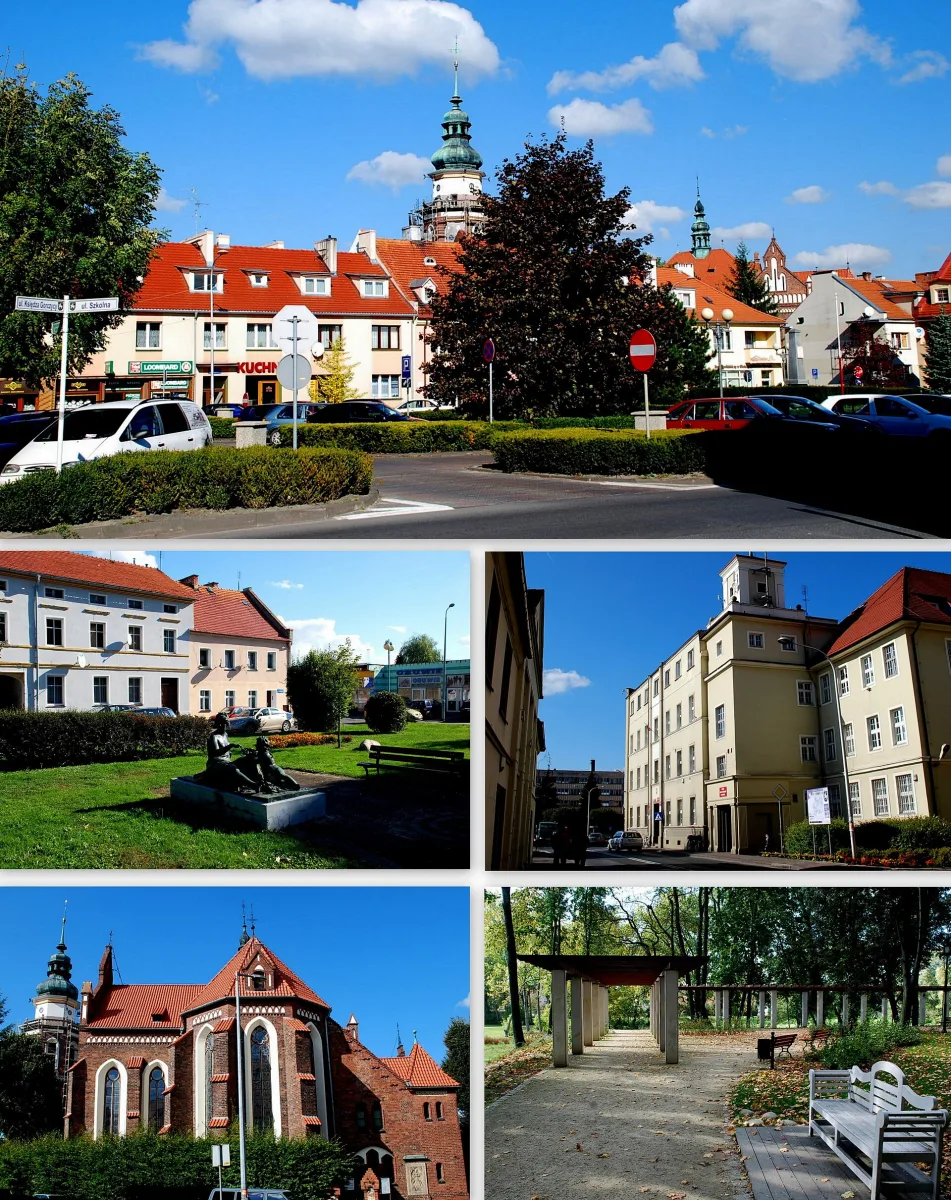
Traces of the Birons have survived in the town in a scattered, fragmentary form. In the park that was created on the site of the former palace grounds and was revitalised in 2012, eight sculptures stand: some are replicas of figures known from Versailles, others are marble depictions of the seasons. Fragments of the old town walls bearing the coats of arms of the Biron family have also survived, along with the family mausoleum, which is not open to visitors. The fullest picture of the former residence and the family's rule in the town is given by the Regional Museum in Syców, which holds a separate section in its collections devoted to the Biron von Curland family, and among its exhibits are documents related to the town's history, including the oldest surviving one from 1377, predating the Birons' arrival. Anyone wishing to see what the demolished residence looked like can view a model of it there, the only form in which the palace has survived intact to this day.
Be the first! Add a comment.
You need to log in to add a comment.
Log in