
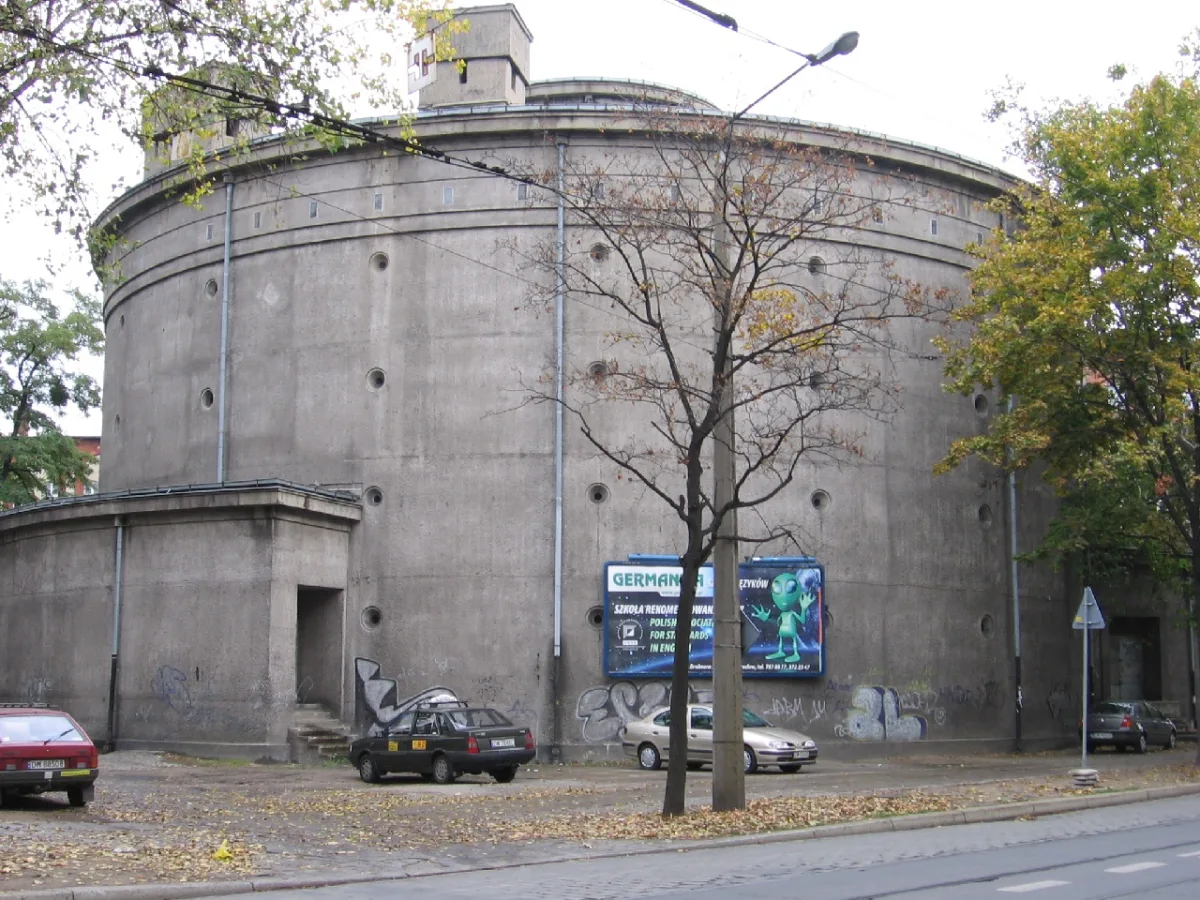
Concrete cylinders in the city
Wrocław has several above-ground air-raid shelters from the Second World War that do not hide underground but stand as massive structures among the tenement houses. One example is the shelter on Ołbińska Street in Nadodrze, built in 1941. It takes the form of a cylinder about 32 metres in diameter and over 20 metres high, with walls 1.10 metres thick and a roof 2 metres thick - dimensions meant to withstand bombing. The building is listed on the heritage register and today serves as a museum storage facility, though sources do not say whether it is open to visitors.
Shelters of this type, so-called Hochbunker, were built in German cities from the early 1940s, once Allied air raids became a real threat. Wrocław, as a large industrial centre and railway hub, received several such structures embedded in residential areas - some of them survive today as blind spots in the skyline of their districts, serving a different purpose from the tenement houses around them.
Wzgórze Partyzantów - a bastion that became a park
Wzgórze Partyzantów (Partisans' Hill) in the Old Town is what remains of the former Sakwowy Bastion from Wrocław's system of city fortifications. It stands 132 metres above sea level and is the tenth highest elevation in the city. After the defensive walls were demolished in 1807 on the orders of the French occupiers, the recreational Sakwowe Hill was created on the site of the bastion. In 1867 a belvedere and a tower were erected on it, and the hill was renamed Liebichs Höhe. In 1932 a Colonial Monument was erected on its slope, dismantled in 1945 - the hill was then given the name Wzgórze Miłości (Hill of Love), and since 1948 it has borne its current name, Wzgórze Partyzantów. This shows how a fortification from the Napoleonic era could change function over two centuries: from a defensive bastion, through a park with a propaganda monument, to today's green viewpoint close to the city centre.
Wrocław as Festung Breslau
In August 1944, even before the siege began, Hitler declared Wrocław a fortress - Festung Breslau. The city was prepared for defence to the last soldier. On 23 February 1945 Gauleiter Karl Hanke ordered the demolition of buildings between the Grunwaldzki and Szczytnicki bridges, so that a makeshift field airstrip could be built in the besieged city - children as young as ten and forced labourers were also put to work on the demolition. Sources differ on the exact dimensions of the resulting runway, but they agree that several thousand buildings, including churches, were demolished for the project.
Earlier, on 20 January 1945, Hanke ordered the evacuation of women and children on foot towards Opperau and Kanth, in frosts reaching minus 20 degrees at night. This march is later described as a death march - according to some sources, an estimated 90,000 people died during it, though this figure is uncertain and variously cited. Among the buildings destroyed during the fighting were the Chapel of the Blessed Virgin Mary, the Church of St John and the Brothers Hospitallers' monastery. The portal has a separate piece on the siege of Wrocław itself and on Kłodzko Fortress - here Festung Breslau appears only as context for the concrete traces it left behind.
Forts and fortifications in Lower Silesia
Besides the wartime shelters, the region also has older fortifications. The baroque Star Fort in Głogów was built between 1747 and 1749 on the initiative of the Prussian king Frederick the Great, as part of turning the town into a fortress. Głogów itself was declared a fortress in 1944 - Festung Glogau - which was meant to slow the advance of the Red Army but led to the destruction of about 95 percent of the town's buildings.
In the Owl Mountains, in the Owl Mountains Landscape Park, lies the stronghold on Forteczna Hill in Rościszów - an earthen rampart and moat at an altitude of 535 metres. The surviving earthworks are a form somewhere between an early medieval stronghold and a late medieval castle, but the summit also shows remains of field fortifications from the Seven Years' War in the 18th century, built by Austrian troops. A similar episode is the fort in Szalejów Górny in the Kłodzko region - a timber-and-earth structure built by the Prussians at the turn of 1778 and 1779, intended as an obstacle to slow an advance, not a stand-alone fortress. On 17 January 1779 the fort was attacked by Austrian troops, and its sixty-strong garrison under Captain Capellery successfully delayed the assault. Today no trace of the fort itself remains on the ground.
The region also has larger, brick-built fortresses in Kłodzko and Srebrna Góra, as well as the underground Riese complex in the Owl Mountains, whose actual purpose has still not been conclusively established. The portal covers these sites separately, in pieces devoted to the fortresses and to Riese.
What happened to them after the war
The fate of these structures after 1945 went in different directions. Fort Wrocław No. 9 on Pełczyńska Street, a 19th-century infantry fort, today houses the Social Military Museum. Its casemates hold an exhibition on the military history of Wrocław, while outside stand, among other things, a T-55 tank, an SKOT armoured personnel carrier, a BRDM-2 vehicle and a Su-20 aircraft. The fort can only be visited in organised groups, with a guide.
Some sites changed their purpose entirely. On the grounds of the former fortifications in Sołtysowice there is now Fort Przygody (Fort Adventure), an amusement park with paintball, quad bikes and rafting trips. In Wałbrzych, meanwhile, there is an indoor shooting range called Strzelnica Wałbrzych "Bunkier". The shelter on Ołbińska Street has stayed closest to its original, defensive form - it stands as a listed monument and storage facility, with no tourist function.
Visiting with your eyes open
Most of the forts and shelters in this list are not set up for casual visiting. Ruins such as Fort Karol on Góra Ptak or Fort Wilhelm in the Bystrzyckie Mountains stand in the forest, without marked trails and without any certainty about the technical condition of the walls and moat - it is worth checking this at a local tourist information point before a trip, rather than climbing onto the remains of the ramparts or into collapsed casemates on your own. Concrete air-raid bunkers are often closed or in private use, so their interiors are not accessible without the manager's permission. Where a fort operates as a museum, as at Fort Wrocław No. 9, visits take place with a guide along a set route - the safest way to see the casemates from the inside, without the risk of entering a place that has not been made safe for tourist traffic.
Be the first! Add a comment.
You need to log in to add a comment.
Log in