
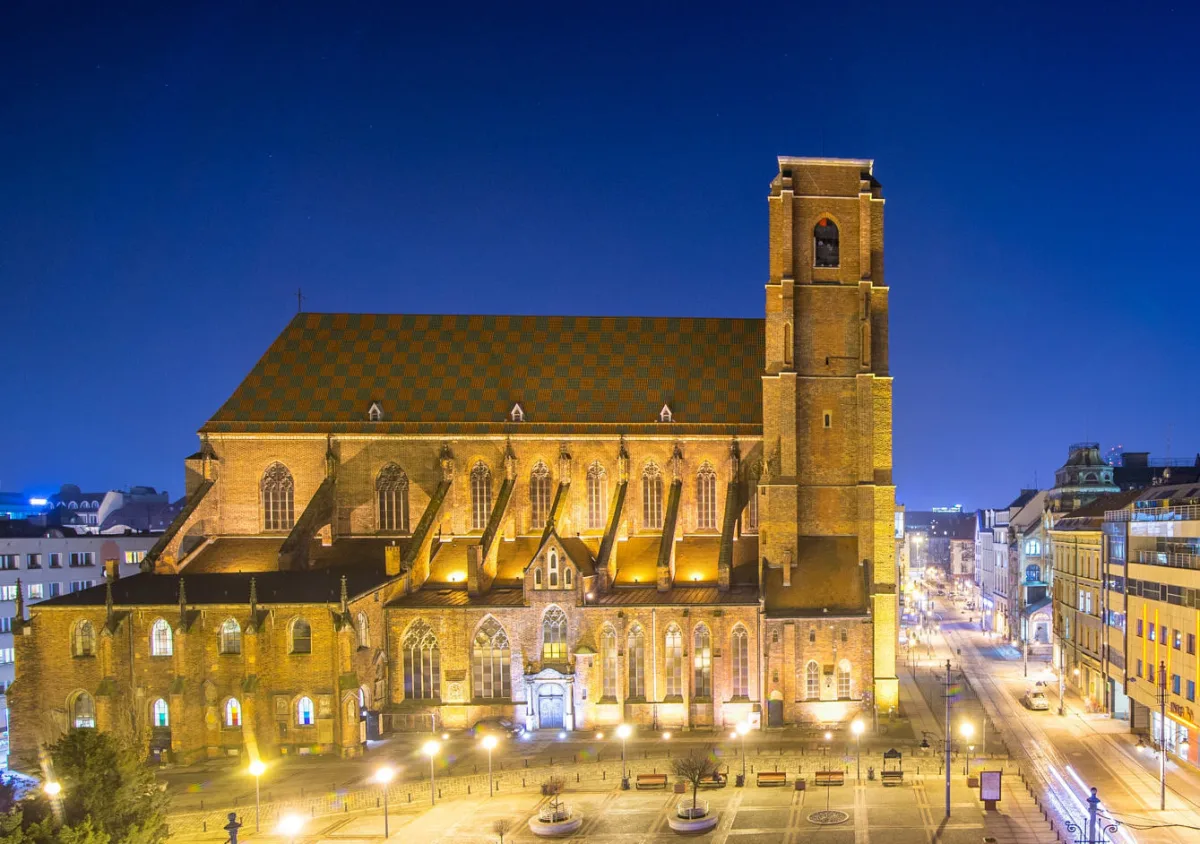
The bridge between the towers of St Mary Magdalene's Cathedral
On the fifth level of St Mary Magdalene's Cathedral, at a height of around 45 metres, hangs a narrow walkway linking the church's two towers. It is called the Penitents' Bridge, and local tradition knows two different stories explaining the name.
In the first version, the bridge was said to be a place of punishment for a girl named Tekla, condemned by her father for vanity and a reckless life to eternally sweep the walkway until the end of the world. A second version, circulating alongside it, treats crossing the narrow bridge as a test for witchcraft: a woman who crossed without falling was said to be a witch, while one who fell and died was only recognised as innocent after death. None of the available sources states who first wrote down these stories or when, both function as oral tradition, repeated today mainly in materials for tourists.
The bridge itself is very much an architectural fact, mentioned as early as 1459, shortly after the towers were completed. The legends only grew up around it later, as a way of explaining an unusual, curiosity-inducing structure that today is crossed by tourists visiting the cathedral towers, not condemned prisoners.
A stone head trapped in the wall
Set into the south tower of St John the Baptist's Archcathedral is a sculpture depicting a human face. Legend gives it the name Henryk: a poor journeyman in love with a wealthy goldsmith's daughter, rejected by her father, is said to have joined a band of robbers and returned to the city a rich man. When he was disappointed again even then, in an act of revenge he set fire to the master's house, and climbed the cathedral tower himself to watch the fire. According to the story, the wall then "swallowed" his head, turning him to stone for the rest of time.
Art historians propose two other, far less dramatic explanations. According to one, the stone head is a fragment of an older building, reused during the cathedral's reconstruction in the 14th century. According to the other, it is a self-portrait of one of the builders, a kind of signature left in stone. Which of these explanations is closer to the truth cannot be settled today, historical sources are simply silent on the circumstances of the sculpture's creation, and the legend of Henryk filled that gap with its own story of love, crime and punishment.
The Dumpling Gate on Ostrów Tumski
On Ostrów Tumski (Cathedral Island), in the Gothic wall that once linked the church grounds with the chapter's buildings, a stone arch has survived with an unassuming, rounded element on top. Local tradition calls it the dumpling and explains its presence with a story about a widower named Konrad, who after the death of his wife Agnieszka was said to receive a bowl of dumplings from her every day in his dreams, on condition that he always leave one on the plate. When one day he broke this rule and ate everything, the last dumpling was said to run away, roll across the city, jump over the Oder and turn to stone on top of the gate as a warning.
The gate itself is considerably older than any specific date allows to establish on the basis of the available descriptions. Architectural researchers point out that it is kept in a plain, functional Gothic style and that some of its stonework details may have been reused from earlier, already demolished, sacred buildings. The stone "dumpling" is therefore most likely simply a decorative element of the arch, but it is precisely its unusual shape that in time provoked the creation of a story that explains it in a far more interesting way than architecture does.
A walled-up couple in the Town Hall
The Town Hall standing in the middle of Wrocław's Market Square grew for nearly two and a half centuries, extended with successive wings from the turn of the 13th and 14th centuries right up to the rebuilding of the tower in the mid-16th century. To this long, well-documented building history, local tradition adds one more, far less confirmed story: of a nun and a monk who broke their vows of chastity and, as punishment, were walled up alive in the walls of the building then under construction.
This is a story worth recalling with a caveat, because it lacks solid sources: it is not known who wrote it down or when it first appeared, and confidence in its authenticity as an old legend, rather than a later, folk elaboration, remains low. The motif of a walled-up couple punished for breaking their vows is, however, well known from stories circulating around many medieval buildings in Europe, so it could equally well have been transplanted onto Wrocław's Town Hall from a completely different place.
What in these stories is legend, and what is a trace in stone
Four places, four stories and one shared mechanism: in each case the starting point is a real, unusual architectural detail, a narrow walkway between towers, a strange face in a wall, a rounded shape on top of a gate, the Town Hall's long building history, and legend adds an explanation to it that is easier to remember than the dry facts of construction or rebuilding.
None of these stories has an established author or a date of first record, all of them circulate today mainly as oral tradition and tourist anecdote. That does not mean they are worthless: they show how townspeople, over the centuries, made their own city familiar, giving meaning to what they could not otherwise explain. The details that started them can still be seen with your own eyes, you just need to look up while passing the cathedral towers by the Market Square or walking towards Ostrów Tumski.
Be the first! Add a comment.
You need to log in to add a comment.
Log in