
How a glacial cirque forms
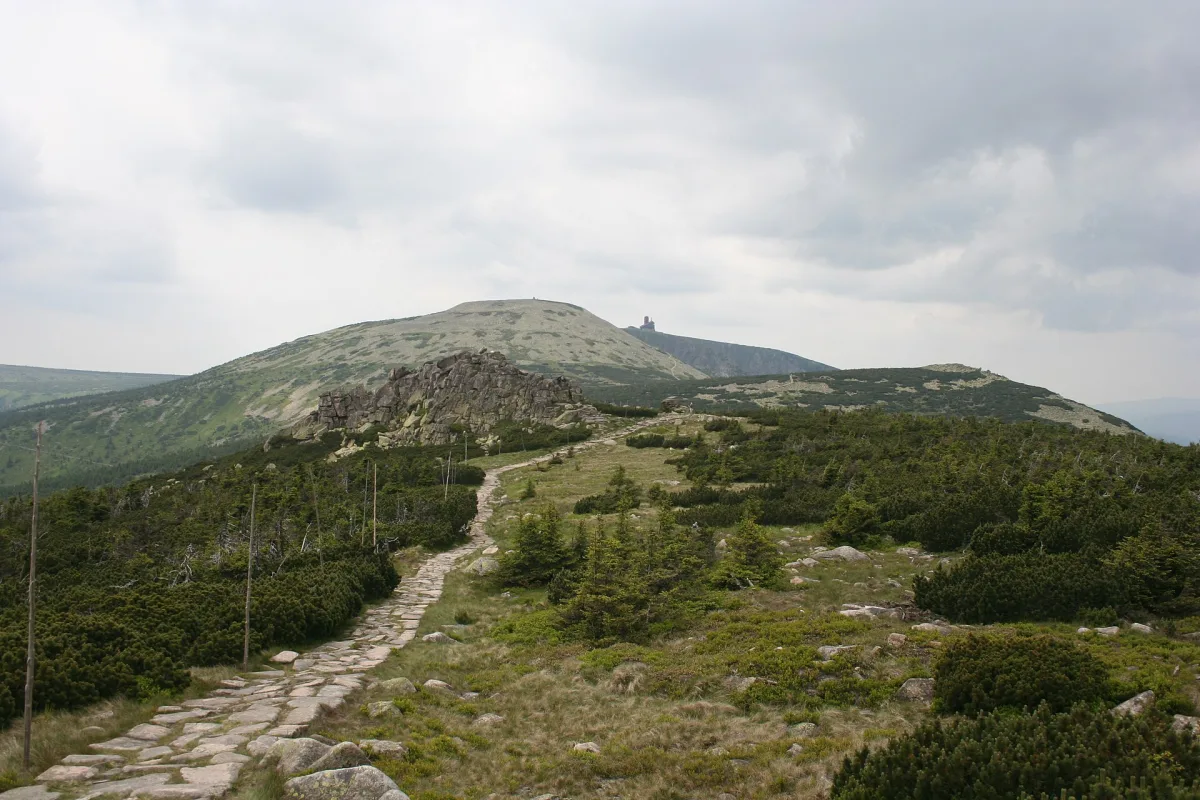
Śnieżne Kotły are two neighbouring glacial cirques cut into the slopes of the main ridge of the Karkonosze (Giant Mountains), between Wielki Szyszak and Łabski Szczyt. These forms took shape during the Ice Age, most likely during the last glaciation - ice settling in the upper parts of the mountains gouged the rock walls until it had carved out two deep niches with vertical, rocky sides. The Small Śnieżny Kocioł is around 300 metres deep, with walls reaching 100 metres, and its floor lies at an altitude of about 1,175 metres above sea level. The Large Śnieżny Kocioł is somewhat shallower - around 250 metres - but its walls are higher, up to 150 metres, and its floor lies higher too, at 1,245 metres. The Large Kocioł measures 800 metres in length and 600 metres in width, making it the deepest glacial cirque in the entire Karkonosze.
The fact that the cirques formed on this particular side of the ridge is no accident. Glacial cirques in the Karkonosze, as in other Central European mountains, formed almost exclusively on north- and north-east-facing slopes. It was there that snow lay longest, did not fully melt over the summer, and over time turned into firn and then into ice, which began to gouge the ground beneath it. South-facing slopes, exposed to longer sunshine, did not develop such forms on a comparable scale.
Two cirques and a basalt vein
Both cirques are closed at the bottom by a massive moraine wall, piled up from rock material carried by the ice sheet that once descended here. The Śnieżne Stawki lie on the floor of the cirques - small post-glacial ponds, a remnant of a former meltwater reservoir. In the western wall of the Small Kocioł, geologists point to a basalt vein, a trace of volcanic activity much older than the glaciation. It is precisely here, on this particular rock substrate, that plant life becomes richest across the whole of the cirques.
Plants that survived from the Ice Age
Śnieżne Kotły are one of the most important sites of relict vegetation in the Sudetes, meaning species that colonised these areas during the glaciation and have survived here to this day, even though the region's climate warmed long ago. They owe this to the cool, humid microclimate inside the cirques - the northern exposure, altitude and shelter provided by the rock walls, which together create conditions similar to those of thousands of years ago. Species of arctic-alpine character grow here, typical rather of the far north or high mountains than of the Sudetes. A subspecies of saxifrage growing on the aforementioned basalt vein has also been described within the cirques - a site cited as the only one of its kind in the world - and one of the ferns growing here is said to be recorded in Poland, outside the Tatras, only at this location. It is precisely because of this flora that Śnieżne Kotły are protected with particular rigour - picking even a single plant could mean the loss of the last, or one of the last, sites of a species in the country.
A shelter and a station on the edge of the cirques
On the edge of the cirques, where the Radio and Television Broadcasting Centre stands today, a mountain shelter operated for more than a hundred years. The first building, regarded as the first genuine shelter in the whole of the Karkonosze, was erected in 1837 by Count Schaffgotsch. After further rebuildings and renovations, it operated until May 1961, when it was replaced by the broadcasting station. Beside it, on the other side of the ridge edge, rises a group of rock formations known as the Devil's Pulpit. The red Main Sudetes Trail leads along the ridge above the cirques, with blue and green trails branching off from it down into their interior.
A strict reserve and the boundaries of protection
Śnieżne Kotły have been protected as a nature reserve since 1933, and today the site lies within the Karkonosze National Park, with the status of a strict reserve - the most rigorous form of nature protection provided for in Polish law. In practice this means a ban on leaving the marked trails, picking plants and disturbing animals, and the interior of the cirques itself remains closed to tourist traffic. Visitors may move only along the designated trails running along the edge and towards the viewpoints, without entering the floor of the cirques or their steep walls.
Where to view Śnieżne Kotły from
The best views of both cirques stretch out from their edges, where several viewpoints have been set up along the Main Sudetes Trail. Access usually leads from Szrenica - a summit reachable by cable car, from which the trail continues along the ridge towards the cirques - or from the Karkonoska Pass. From the edge you can see both the interior of the two cirques, with the Śnieżne Stawki lying on their floor, and a wide panorama of the Karkonosze reaching, on a clear day, as far as distant Mount Ślęża. This is the only way to see these formations up close - entering the interior of the cirques itself is closed to tourists because of its status as a strict reserve.
Be the first! Add a comment.
You need to log in to add a comment.
Log in