

The dome and organ of the Centennial Hall - two records from a hundred years ago
The Centennial Hall was built in 1911-1913 to the design of the city architect Max Berg, and was breaking records from the moment it opened. Its reinforced-concrete dome has a diameter of 67 metres and, at the time it was built, was the reinforced-concrete covering of the greatest span in the world. A qualification needs to be added straight away here, without which this record would be misleading: greater spans were being achieved at the time by individual steel structures. The record therefore concerns specifically reinforced concrete, not wide-span construction in general.
The hall's second record is hidden in its organ. The instrument, designed and built specially for this interior by the Sauer firm of Frankfurt an der Oder, had 222 registers and 16,706 pipes, which in 1913 made it the largest organ in the world. Today that title has long belonged to other instruments, but at the moment the hall was built it was a confirmed fact, not a tour guide's legend.
Ten Nobel laureates from one university
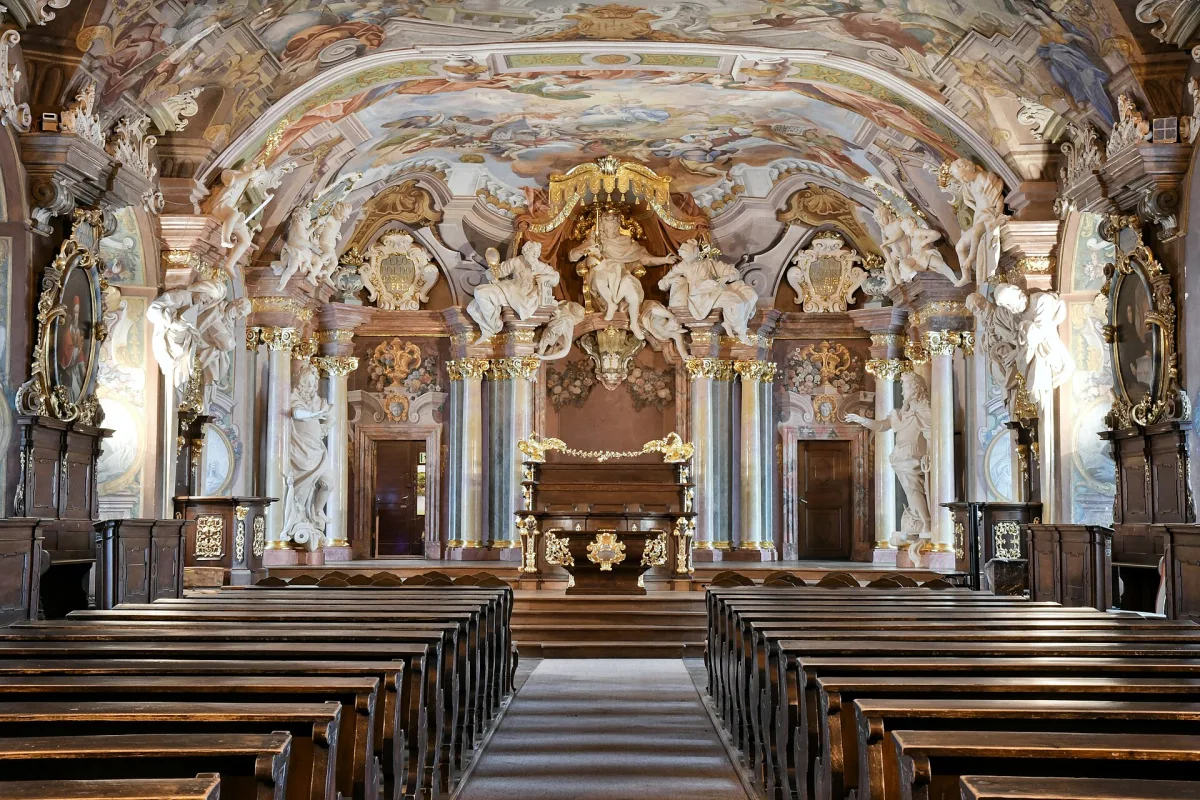
Ten Nobel Prize laureates are connected with the University of Wrocław, which for a single university is a rarely seen number in this part of Europe. Among them are the physicists Max Born and Erwin Schrödinger, but also Otto Stern, Hans Georg Dehmelt, the chemists Fritz Haber, Eduard Buchner and Friedrich Bergius, the physicist Philipp Lenard, the physician Paul Ehrlich, and the historian and classical philologist Theodor Mommsen. Their connection with the university reaches back to the time when it operated under its German name as the University of Breslau within the borders of Prussia, and later the German Reich, before the institution began operating anew within Polish structures after 1945.
This number requires one clarification: it refers to people who studied or worked academically at this very university at any point in its centuries-long history, not to scholars connected solely with the present-day, postwar University of Wrocław. This distinction tends to be left out of popular lists of trivia, even though it changes how the record itself should be understood.
Oldest of their kind - a zoo and an English-style park
Wrocław Zoo opened on 10 July 1865 and is still regarded today as the oldest large, publicly accessible zoological garden on the territory of present-day Poland. A qualification that appears in historical studies is worth adding straight away: small, private menageries with a very limited stock of animals existed on Polish lands as early as the 17th and 18th centuries, but these were not public institutions in today's sense of the word. The record held by Wrocław Zoo therefore concerns specifically large, publicly accessible zoological gardens, not the oldest animal collection on Polish lands in general.
Another record in its category belongs to Szczytnicki Park. In 1783 the garrison commander Friedrich Ludwig zu Hohenlohe-Ingelfingen bought a wooded area here and founded one of the first English-style parks on the European continent, at a time when the landscape garden style was only beginning to spread beyond the British Isles. Earlier, the same area, then the village of Stare Szczytniki, had from the mid-18th century attracted the people of Wrocław as a popular place for walks, so the park formally organised something the residents had already taken a liking to.
Numbers that surprise
Wrocław recorded the largest population in its history on 30 June 2020 - 675,446 people. This is the peak value against which subsequent demographic data for the city is compared, though the very fact that it is this particular moment that marks the current maximum tends to surprise people used to thinking of the city as constantly growing.
The Market Square in Wrocław, in its present shape measuring between 204 and 206 metres by 169 to 170 metres, giving an area of around 3.64 hectares, is one of the largest old-town market squares in Europe. Originally, at the time of the city's foundation, the square was somewhat smaller, measuring, together with the adjoining streets, around 660 by 540 feet. Today's dimensions are the result of successive spatial adjustments the square underwent as the city developed around it.
Be the first! Add a comment.
You need to log in to add a comment.
Log in