
Why narrow-gauge track was built
Railways with a narrow gauge, narrower than the standard-gauge track, were at the turn of the 19th and 20th centuries a cheaper way of bringing people and goods to places where a large, standard-gauge main line did not pay off. The narrower track allowed for sharper curves and smaller turning radii, so it coped better with difficult terrain, and building embankments and bridges cost less. In Silesia, networks of this kind mainly served local traffic: bringing coal from small mines, transporting agricultural produce and timber, and connecting towns that the main railway line did not reach.
The Owl Mountains Railway: a neighbour of the phenomenon
Close to the topic, though formally outside it, lies the Owl Mountains Railway - a 62-kilometre line from Dzierżoniów through Pieszyce, Bielawa and Srebrna Góra to Ścinawka Średnia, built in stages between 1900 and 1903 by the Eulengebirgsbahn AG company. It was not a narrow-gauge railway but a standard-gauge one, though on the steep section between Srebrna Góra and Wolibórz a rack rail of the Abt system, rarely found in Poland, was used, overcoming a gradient of up to six per cent. The line carried passengers and coal from the mines in Słupiec and Nowa Ruda to Dzierżoniów. Financial difficulties after the First World War hastened its decline: traffic on the steepest section was halted in 1931, and by 1934 the tracks had been dismantled along the whole route. Two brick viaducts, almost twenty-three and twenty-eight metres high, have survived to this day near Żdanów and Srebrna Góra, along with some of the former station buildings.
The Krośnice Narrow-Gauge Railway
The genuinely narrow-gauge attraction that can be ridden today in Lower Silesia was created in Krośnice in the Barycz Valley, on the grounds of the local palace and park complex. The line, with a gauge of 750 millimetres, was built between 2011 and 2013 with the support of EU funds, and the rails were provided by the Lower Silesian regional government. Opened on 25 May 2013, the route is just under three kilometres long and runs along two connected loops. At weekends a train here is pulled by a historic steam locomotive, on weekdays by a diesel locomotive. The project references a former local railway network which, according to unconfirmed accounts, once served the area around the Milicz Ponds, although the details of this historical line require further checking.
Museums and open-air collections of rolling stock
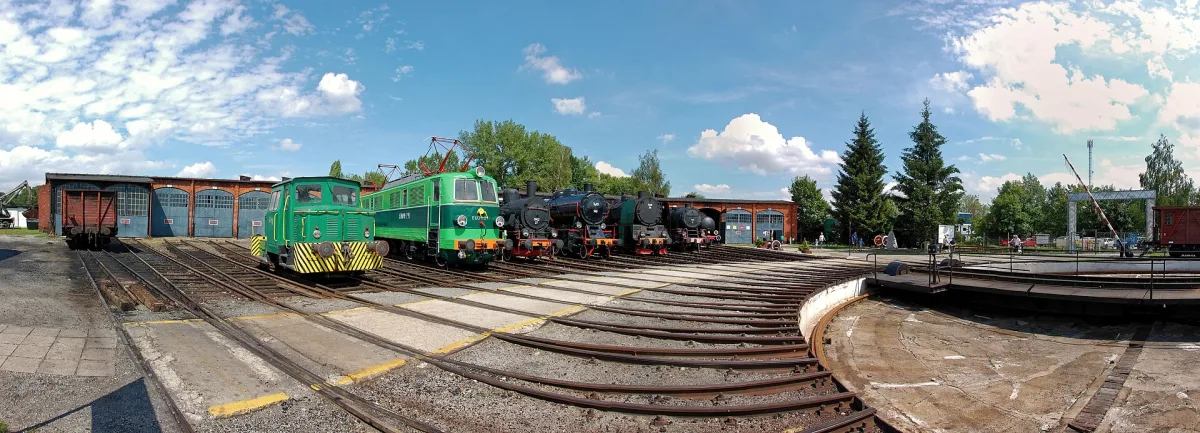
The largest place in Lower Silesia to see historic railway rolling stock is the Museum of Railways in Silesia in Jaworzyna Śląska. It occupies a nineteen-stall roundhouse, built between 1906 and 1907 at the oldest railway junction in Lower Silesia. The collection began to be gathered in 1992 by PKP employees together with the Wrocław Railway Enthusiasts' Club, and the museum officially opened in 2004. Today it looks after more than 150 historic railway vehicles, including around 50 steam, diesel and electric locomotives and over 100 carriages. This is a collection of standard-gauge rather than narrow-gauge rolling stock, but it is here that the region keeps its most valuable railway monuments, among them a Deutz diesel locomotive from 1940, described as the oldest operating diesel locomotive in Poland. Since 2014 the museum has organised rides on historic rolling stock at weekends, and since 2011 it has hosted an annual Steam Locomotive Gala, bringing together historic engines from Poland, Germany and the Czech Republic.
The real network of narrow-gauge industrial and agricultural lines that once operated in Lower Silesia, along the lines of those known from Greater Poland or Upper Silesia, has not yet been given a full treatment in the available sources, with specific routes and dates of closure - a topic the portal should return to once more source material becomes available.
Be the first! Add a comment.
You need to log in to add a comment.
Log in