
Where the White Lady comes from in the first place
The White Lady is one of the most repeated motifs in stories about European castles and manor houses: a female ghost in a pale dress, wandering at night through corridors, cloisters or the walls of an old stronghold. In Lower Silesia, where almost every major castle has several centuries of history behind it, several changes of owner and more than one tragedy, such a figure crops up in stories surprisingly often. Three examples that are easy to compare are the University of Wrocław, Książ Castle in Wałbrzych and Czocha Castle near Leśna. Each has its own White Lady, but each time it is a different story, documented differently and resting on facts to a different degree.
Elżbieta of the walls of the University of Wrocław
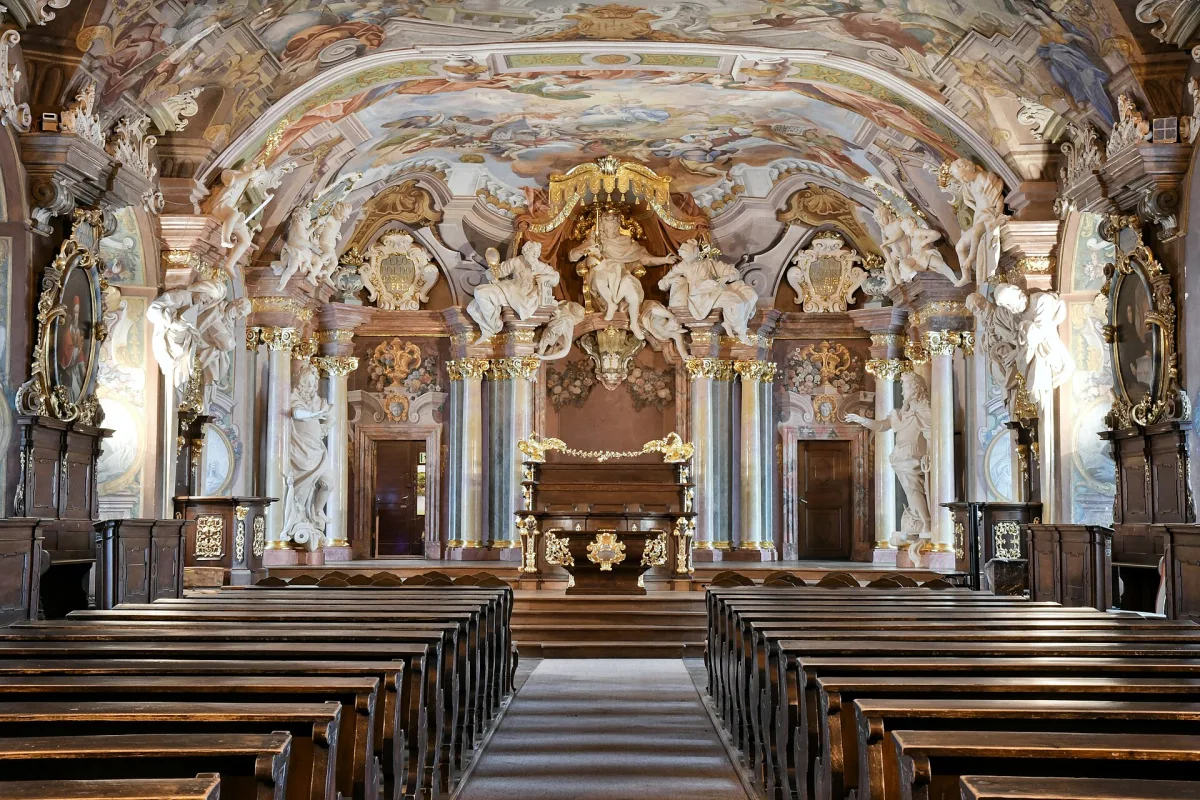
The most fully recorded legend is the one associated with the main building of the University of Wrocław. The place where the university now stands was once occupied by a Piast castle. According to the account, it was home to a stern castellan, who ruled the place with a firm hand and was known for his cruel treatment of prisoners. His daughter Elżbieta fell in love with a young man of whom her father did not approve. When the castellan discovered their secret meetings, he sentenced his daughter's chosen one to torture in a device called an iron maiden, a chest lined on the inside with spikes.
In one version of the legend, described on the website kochamwroclaw.pl, it is the castellan himself who dies in his own torture device during a struggle with his daughter, who was trying to free her beloved, and before dying he curses Elżbieta, condemning her to wander the walls forever. A second version, recorded on miejscawewroclawiu.pl, gives the castellan the name Henryk and adds the detail that Elżbieta first steals the keys to the dungeon, trying to free her beloved, before the confrontation with her father takes place. Both versions agree on the heart of the story: the dying father curses his daughter, and she, according to student tradition, is said to haunt the university's corridors to this day as the White Lady. Neither source states who first wrote down this legend, or when - it is a typical oral account, circulating today mainly among students.
The ghosts of Książ Castle - the White Lady and hunchbacked Janek
Książ Castle in Wałbrzych, the third largest castle in Poland, has a reputation as one of the most haunted places in the region. In local stories, a White Lady wanders its corridors, identified by some guides with Princess Daisy von Pless, one of the castle's most famous owners. Alongside her there also circulates a story about hunchbacked Janek, who tries in vain to light a fireplace.
It is actually the story of Janek that has the most specific, though still only legendary, source. According to an account described on the website walbrzych.dlawas.info, information about the castle's ghosts comes from the autobiographical notes of Prince Hansel (Jan Henryk XVII), published in Michael Luke's book "Hansel of Pless - prisoner of history" in London in 2002. The prince's mother is said to have regularly seen the figure of a hunchbacked man by the fireplace. During renovation of the castle in 1909-1923, a deformed skeleton with a visible hunch was found under the floor of one of the rooms. After it was buried in a Catholic rite, the apparition reportedly stopped appearing. The same notes also mention two similar stories - a ghost connected with a walled-up chamber and a skeleton chained to a wall, and a figure haunting the terraces, whose remains were also said to have been found during rebuilding work.
The White Lady herself, identified with Princess Daisy, appears in guides' stories and online lists of trivia about Książ, but not in the same recorded notes by Prince Hansel, which describe three other, clearly named figures. This is a good example of how, over time, local tradition attaches the popular White Lady motif to a place that already has its own documented, though equally legendary, ghost stories.
Gertruda of Czocha Castle, who betrayed her brother
Czocha Castle by the Leśniański reservoir is a border stronghold whose origins go back to the 13th century. Among the stories circulating around the castle is a legend about a White Lady identified with Gertruda, who during the Hussite wars is said to have betrayed her own brother and brought Hussite troops down on the stronghold. As punishment for this betrayal, a curse is said to have condemned her to eternal penance within the castle walls.
This is one of many stories that have grown up around Czocha over the centuries - others speak, for example, of a well into which unfaithful wives were thrown, and of an echo of their fate, said to be heard after dark. The castle's real history is just as turbulent: over the centuries it changed owners many times, and during the Second World War it housed a post of German military intelligence. It was precisely these documented facts, rather than the legend of Gertruda, that inspired some contemporary references to the castle in popular culture, including the TV series "The Fortress of Ciphers" (Polish: "Twierdza szyfrów").
What in these stories is legend, and what is fact
The three White Ladies of Lower Silesian castles and academic buildings show how differently the same motif can appear. The story from the University of Wrocław is the most consistent between versions, though both remain an oral account with no established author or date of first record. The ghosts of Książ have a rare quality for this type of story: they are recorded directly in the memoirs of the last owner of the family, though these do not include the figure identified today as the White Lady at all, only three other, separate apparitions. Gertruda of Czocha, in turn, is an example of a legend that is hard to verify beyond a single source, alongside other, equally unconfirmed stories circulating around the same stronghold.
In all three cases, the historical facts, such as building dates, the names of owners or wartime events, are well documented independently of the legends. The White Ladies themselves remain what they have been for generations: stories passed on by word of mouth, which give old walls an extra, immeasurable layer of meaning.
Be the first! Add a comment.
You need to log in to add a comment.
Log in