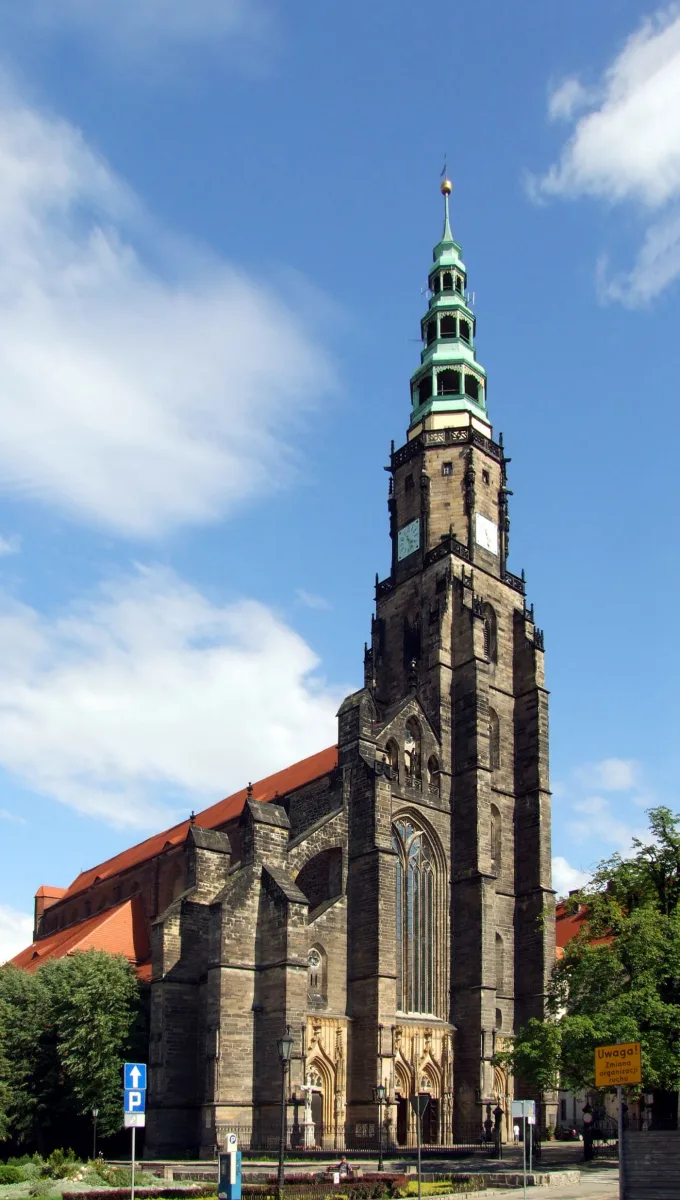
A 14th-century Gothic cathedral in Świdnica, with the tallest tower in Silesia and Baroque furnishings by Johann Riedel.
The Cathedral of St Stanislaus and St Wenceslaus in Świdnica is a Gothic church on Jana Pawła II square, one of the city's most important monuments. The building originally served as a parish church, and since 25 March 2004 it has been the cathedral of the Diocese of Świdnica.
Construction of the present church began in 1330 on the orders of Duke Bolko II of Świdnica, after a fire destroyed the earlier wooden church. According to tradition, the duke himself laid the foundation stone. The church was extended around 1400-1410, and after another fire in 1532 the rebuilding was completed in 1546.
Between 1561 and 1629 the church was used by Protestants. From 1662 the building was taken over by the Jesuits, who rebuilt the interior in Baroque style at the turn of the 17th and 18th centuries. After the suppression of the Jesuit order the building served as a grain store from 1757 to 1772. A further renovation carried out between 1893 and 1895 cost the building some of its original architectural elements.
By the bull "Totus Tuus Poloniae Populus" of Pope John Paul II of 25 March 2004, the Diocese of Świdnica was established and the church was raised to the rank of cathedral. By a decree of the President of Poland of 2017, the cathedral was entered on the list of Heritage Monuments.
The late Gothic, three-nave basilica has a dominant tower 101.21 metres high, now the tallest in the whole of Silesia and the sixth largest in Poland. The tower has five storeys, and its octagonal top is crowned with figures of the patron saints. The west facade has four portals with sandstone sculptures depicting Mary with the Child, the twelve apostles, and Saints Stanislaus and Wenceslaus, made in 1427, flanked by symbols of the evangelists.
The main nave is 71 metres long, 10 metres wide and 25 metres high, and the whole three-nave building is 27 metres wide. Six chapels stand by the side aisles, and beneath the chancel is a twelve-sided chapel that raises the level of the main altar, a solution rare in Gothic churches. The star vault rests on a round pillar where the ribs converge. The walls of the main nave are decorated with 17th-century oil paintings and sculptures of saints in niches.
Most of the Baroque sculptures and altars, created between 1644 and 1776, were made by Johann Riedel. His work includes the main altar with a figure of Mary with the Child under a canopy supported by seven columns, as well as the pulpit from 1698. From the medieval period, a Gothic polyptych from 1492 with a scene of the Dormition of Mary, attributed to a pupil of Veit Stoss, has survived, along with a Pietà from around 1420. The great organ is decorated with the carved "Heavenly Orchestra" by Georg Leonhard Weber from 1704-1710. In the church courtyard stands a column of St Florian from 1684.

Be the first! Add a comment.
You need to log in to add a comment.
Log in