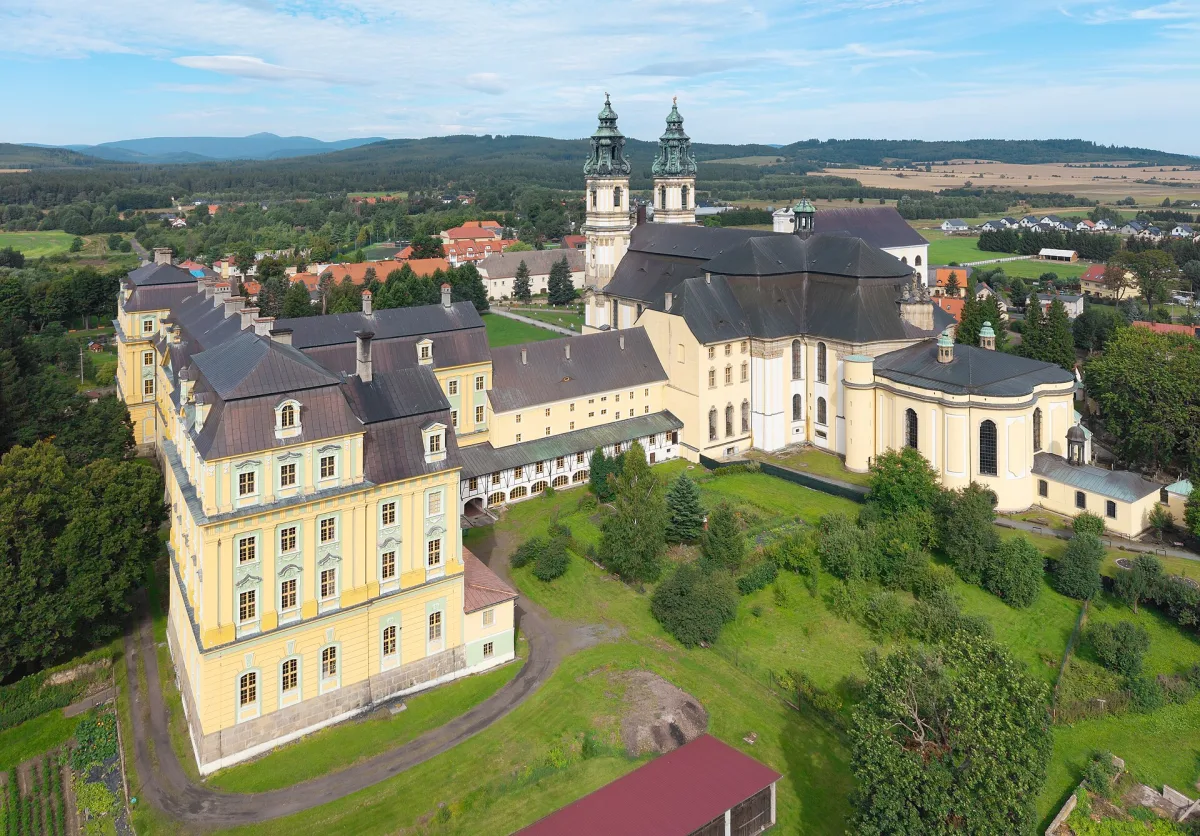
A Baroque Cistercian monastic complex in Krzeszów, one of the most important sacred monuments in Poland and a Monument of History.
The former Cistercian abbey in Krzeszów is one of the most important sacred monuments in Poland, a monumental monastic complex called a European pearl of the Baroque. It belongs to the Diocese of Legnica, is entered in the register of historic monuments and recognised as a Monument of History, and is also on the list of candidates for the UNESCO World Heritage List.
The monastery in Krzeszów was founded in 1242 by Anna of Bohemia, widow of Duke Henry II the Pious, who brought Czech Benedictines from Opatovice. The foundation was confirmed by Pope Innocent IV in 1249. The Benedictines left Krzeszów in 1289, and Duke Bolko I the Strict brought Cistercians from Henryków in their place. Twelve monks under Abbot Theodoric arrived on 9 August 1292, and the monastery was dedicated as Gratia Sanctae Mariae. The Cistercians developed agriculture, livestock farming, weaving and trade in the area, managing, among other things, about twenty mills.
The number of monks in the monastery fell from 60 in 1520 to 12 in 1600. The Hussite Wars destroyed the buildings in 1426, and an icon of the Mother of God hidden under the floor at that time was not found again until 18 December 1622. The Thirty Years' War brought further losses: in 1633 the Swedes burned the church and the monastery library.
The rebuilding and flourishing of the abbey were begun by Abbot Bernard Rosa, who from 1660 led the Counter-Reformation, turning Krzeszów into a centre known as the New Jerusalem. A Calvary (1674-1680) and the Church of St Joseph (1690-1696) were built during this period. The abbot worked with the poet Angelus Silesius and the painter Michael Leopold Willmann, who decorated the abbey's interiors.
The present Baroque basilica was built between 1728 and 1735 on the initiative of Abbot Innocent Fritsch. 41 masons, 12 stonemasons and 10 sculptors brought in from across Europe worked on the construction. The sculptures were made by the Prague artist Ferdinand Maximilian Brokoff, and the frescoes were painted by Georg Wilhelm Neunhertz between 1733 and 1735. A bell named Emmanuel was cast by the Wrocław bellfounder Jan Jakub Krumpfert, and the organ was completed by Michael Engler the Younger in 1737. In 1998 the church was granted the dignity of a minor basilica. It is described in a separate entry, the Basilica of the Assumption of the Blessed Virgin Mary in Krzeszów.
The founder of the Cistercian monastery, Bolko I the Strict, was laid to rest in the presbytery in 1301, and around 1350 his sarcophagus was placed there. The site became the centre of dynastic memory for the Piasts of Świdnica, and his son Bolko the Elder and other dukes were also buried there.
After Prussia's annexation of Silesia in 1740, on 30 October 1810 King Frederick William III ordered the secularisation of the order, and the last convent was dissolved on 23 November 1810. After the Second World War pastoral care was provided in turn by Benedictines from Tyniec, diocesan priests and Cistercians from Wąchock. Since 1992 Krzeszów has been the main sanctuary of the Diocese of Legnica, and in 2004 the abbey was recognised as a Monument of History.
In the range of hills surrounding Krzeszów lies the Dwarfs' Boulders Nature Reserve.
A little further on, among the rocks, you can reach the Devil's Club - Czarcia Skała.
Lovers of views can also head to Krucza Skała.

Be the first! Add a comment.
You need to log in to add a comment.
Log in