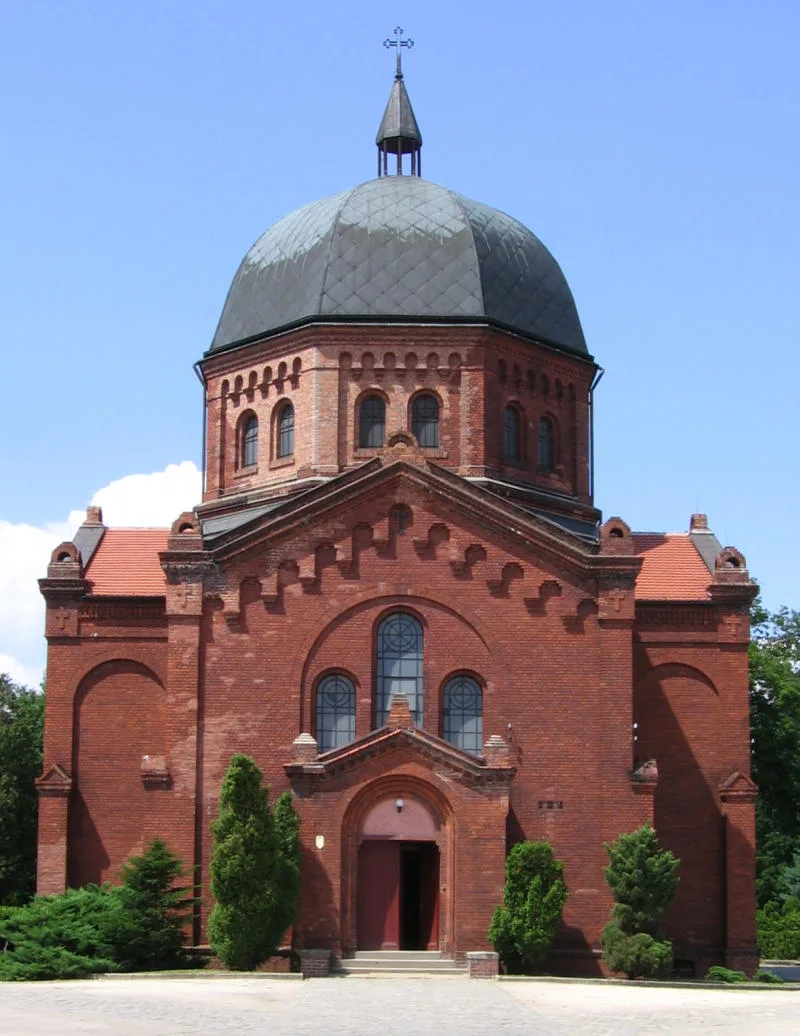
One of the largest cemeteries in Wrocław, part of a former three-part 19th- and 20th-century necropolis complex, resting place of well-known figures from science and culture.
Grabiszyński Cemetery is, alongside Osobowice Cemetery, the Holy Family Cemetery and St Lawrence's Cemetery, one of the largest cemeteries in Wrocław. What is known today as Grabiszynek is only a fragment of a much larger complex, which in the first half of the twentieth century comprised three separate parts.
The first part, established in 1867 between the present-day streets of Hallera, Romera and Grabiszyńska, had a chapel in the Italian Renaissance style, designed by architect Zimmermann. This complex was destroyed during the siege of Wrocław in 1945, and in 1963 a decision was made to close this necropolis. Its site was turned into Grabiszyński Park. The third part, established from 1916 on the eastern side of Grabiszyńska Street, also stopped functioning as a cemetery in 1963 and today is likewise mostly part of the park. Here there was a crematorium from 1926, designed by Konwiarz, and, from 1927, a cemetery for Italian soldiers.
The only part of the complex that still functions as a cemetery is the second part, established from 1881. In 1882 a neo-Romanesque chapel known as the Karolina Gierth Chapel was built here, designed by architect Kessler. It contains burial fields, urn plots, a columbarium, and plots for the Orthodox deceased.
Originally the dead from Wrocław's southern parishes were buried here: the Protestant parishes of St Elisabeth and Holy Trinity, the Catholic parishes of St Charles Borromeo and St Elisabeth of Hungary, as well as friars from the Brothers Hospitallers monastery. Over time the cemetery became a municipal necropolis, open to residents of the whole city regardless of parish.
People connected with the history and culture of Wrocław are buried at Grabiszynek. From before 1945, those interred include the dramatic actress Vilma Illing, the violinist and conductor Rafał Ludwik Maszkowski, and the painter and graphic artist Otto Mueller. After the war, the cemetery became the resting place of, among others, linguist Stanisław Rospond, mathematician Czesław Ryll-Nardzewski, historian Wojciech Wrzesiński, actor Zygmunt Molik, director Sylwester Chęciński, geologist Andrzej Karol Teisseyre, microbiologist Stefan Ślopek, and democratic opposition activist Piotr Bednarz.

Be the first! Add a comment.
You need to log in to add a comment.
Log in