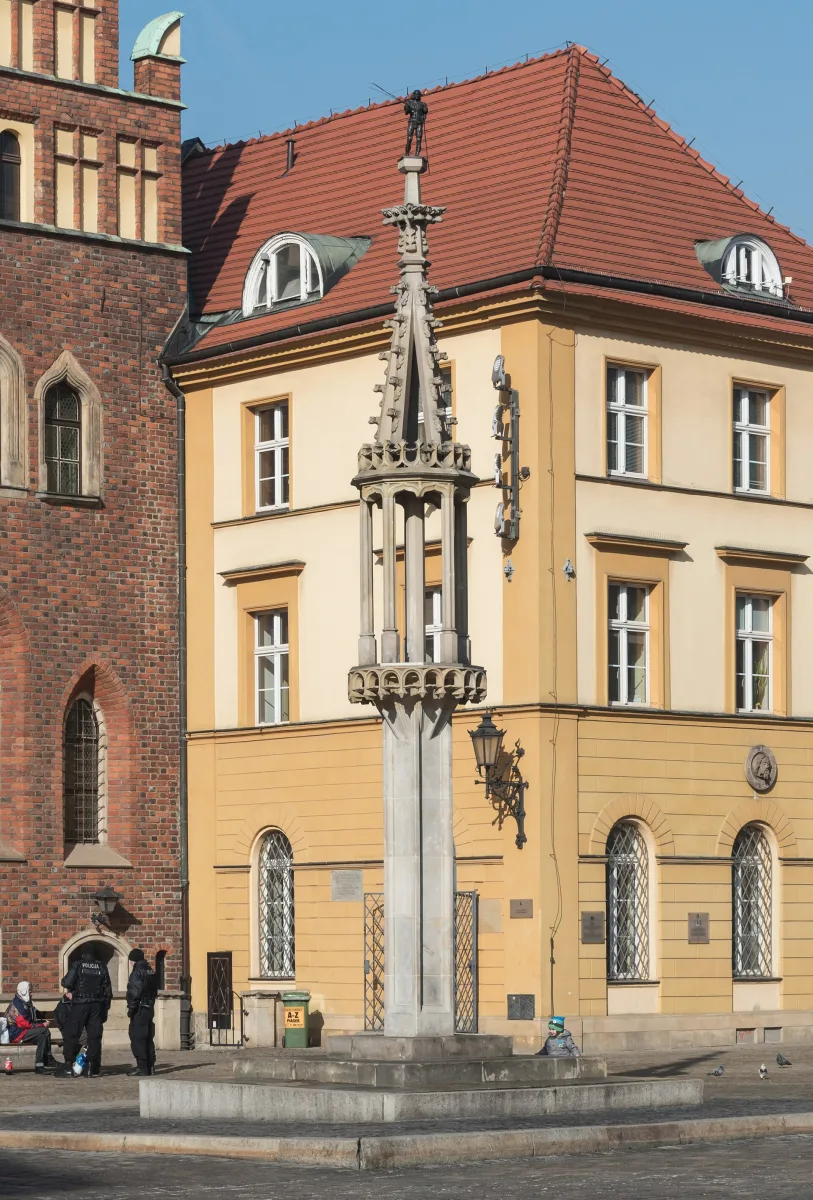
A reconstruction of the historic 1492 pillory in Wrocław's Market Square, with a figure of the executioner known as Roland.
The pillory standing in Wrocław's Market Square, in front of the windows of the Town Hall's Court Chamber, is a faithful reconstruction of the historic pillory from 1492. The original stood on the site of an earlier, wooden pillory from the early 14th century.
The pillory takes the form of a four-sided sandstone pillar set on a three-step plinth. The pillar supports a five-sided, openwork lantern that tapers conically towards the top. At the top, where the lantern's ribs converge, stands a seventy-centimetre figure of an executioner with a sword and a bundle of switches, called Roland, modelled on Dürer's drawings. Above the figure is a metal weathervane bearing the letter W. Metal fittings once fixed to the lower part of the pillar were used to tie condemned prisoners to it.
The original pillory was built in the stonemasons' workshop of Gauske and Preusse. Ernst Preusse, an architect, stonemason and bricklayer from Saxony, is also the author of the facade and decoration of the Town Hall's south nave.
Public executions and floggings were carried out at the pillory. The last public execution took place in the mid-18th century, and the last flogging at the end of the 19th century, though these dates are not certain. According to legend, those flogged there included Veit Stoss, who was found to have forged a promissory note.
The metal fittings for tying condemned prisoners were removed in 1848, and four years later there was an attempt to demolish the whole pillory, which King Frederick William IV of Prussia opposed. On 10 February 1925 the wind toppled the executioner's figure and damaged the pillory itself, after which the structure was restored at the city's expense, and a new figure was made by the sculptor Reinhard Hilger. A copper container with documentation of the restoration was placed inside the renovated pillory's shaft at that time. Further damage came with the fighting for Wrocław in February 1945, and in April 1947 the pillory was dismantled, with the surviving fragments moved to the Museum of Architecture. A reconstruction, designed by Bogdan Jackiewicz based on sketches, photographs and documentation from the 1925 restoration, was officially unveiled on 30 December 1985. The executioner's figure was put back in place in 2002.

Be the first! Add a comment.
You need to log in to add a comment.
Log in