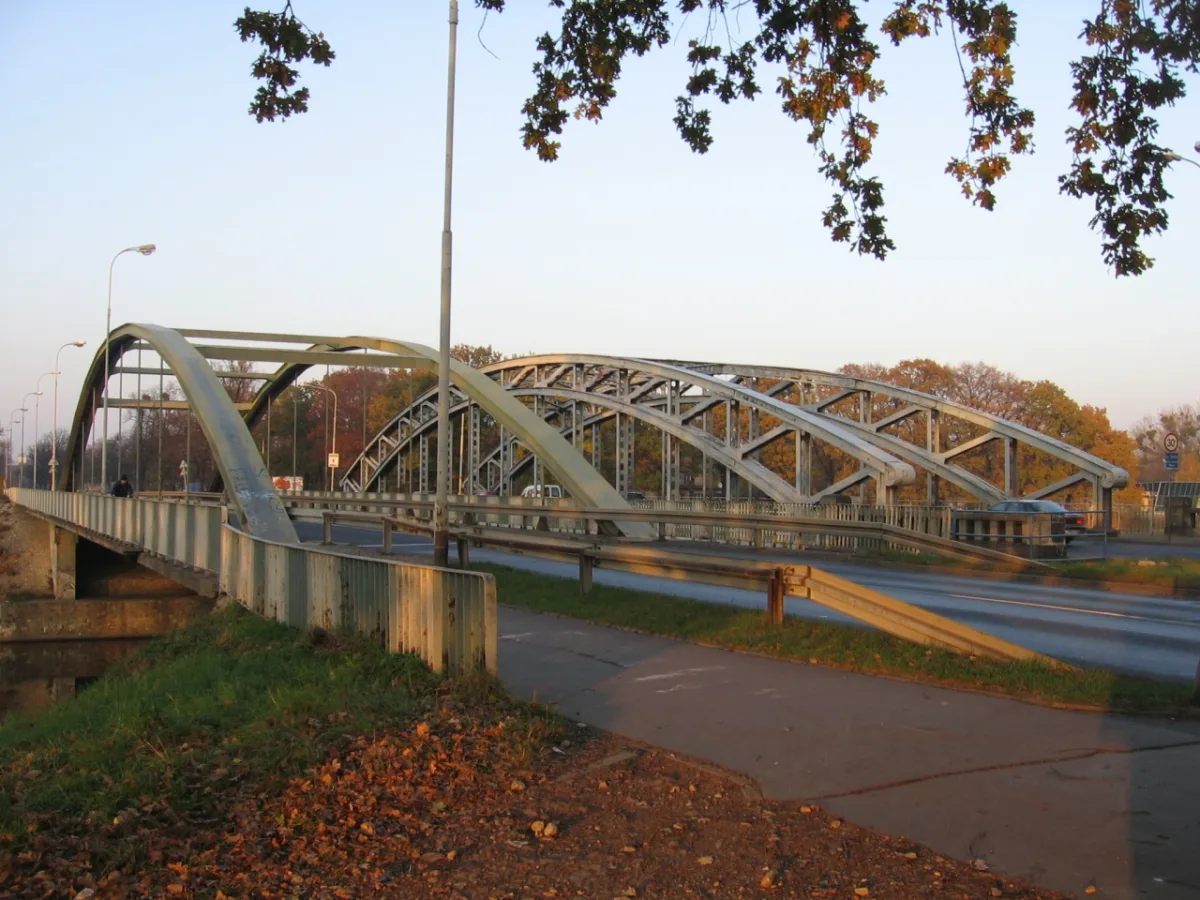
A group of four road bridges over the Navigation Canal and the Flood Canal, two from 1916-1917 and two parallel ones from 1984.
Jagiellonian Bridges are a group of four single-span road bridges in Wrocław, crossing the Navigation Canal (Kanał Żeglugowy) and the Flood Canal (Kanał Powodziowy) of the Oder and connecting the Zacisze and Mirowiec estates.
The two older bridges were built in 1916-1917, as part of a major project to improve road transport and navigation within the city and to build flood defences, over canals freshly dug at the time. The southern bridge over the Flood Canal was designed by engineer Christian Nakonz - it had a steel deck suspended on rigid hangers, supported by two-hinged arched lattice girders. After the designer's name, the bridge was called "Nakonz's bridge", and after the Second World War this name, through a phonetic association with its peripheral location, turned into "the bridge at the end" (most Na Końcu). The shorter northern bridge, built in 1917 over the Navigation Canal, has a frame-and-beam structure of reinforced concrete beams, and the base of its frame rests on the structure of the Zacisze lock.
The official, modern name Jagiellonian Bridges was given to the group only in the 1970s.
On 22 July 1984 new bridges were opened, almost identical twins of the old ones, built parallel to them on the western side. They were designed by Krystyna Angerman, and built by the Wrocław branch of Mostostal. The three-hundred-tonne southern bridge is 60.70 metres long (the old southern bridge - 60.49 m), and the northern bridge, weighing 170 tonnes, is 39 metres long (the old one - 21.65 m).
Close to the bridges lie Szczytnicki Park and Centennial Hall, and at a similar distance the Botanical Garden of the University of Wrocław and Tumski Bridge.

Be the first! Add a comment.
You need to log in to add a comment.
Log in