The third-largest castle in Poland, in the Wałbrzych district of Książ, with more than seven hundred years of history and tunnels from the Second World War.
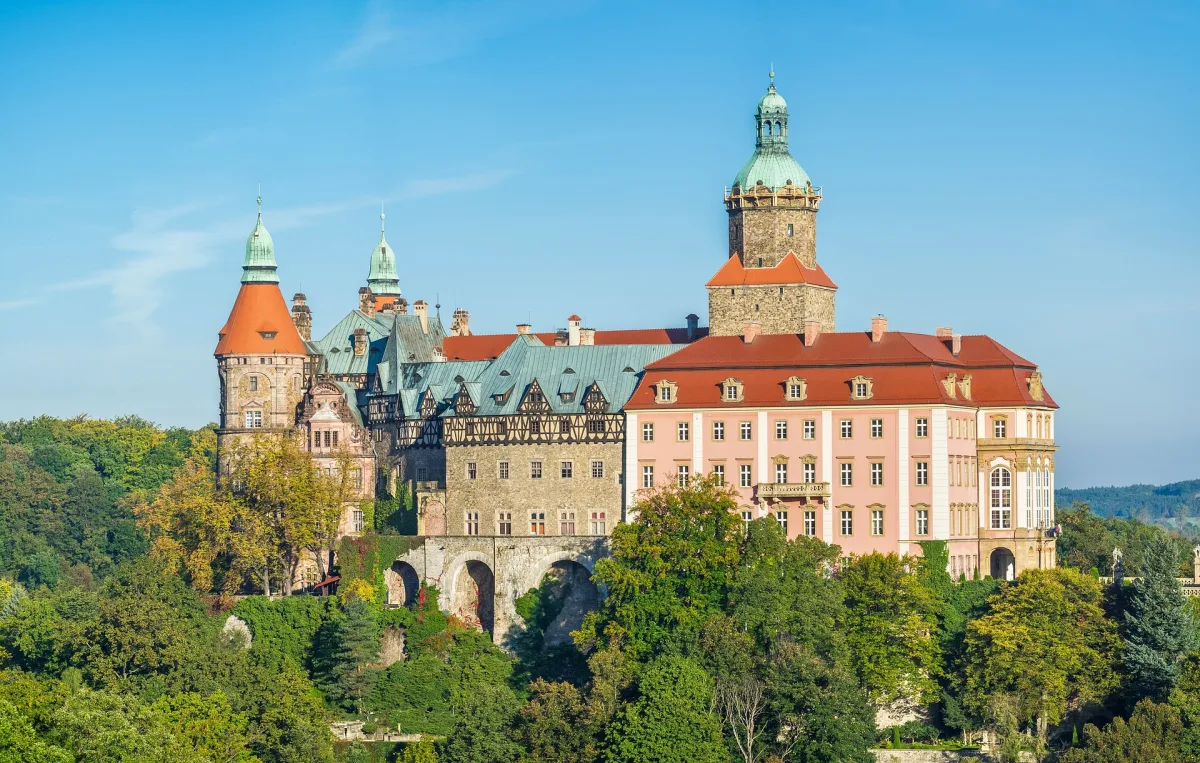
Książ is a castle in the Wałbrzych district of the same name, built above the gorge of the Pełcznica River. It is the third-largest castle in Poland, after Malbork and Wawel, covering an area of around 42,840 square metres. It stands on the Route of Piast Castles and forms part of the Książ Landscape Park.
The castle was built between 1288 and 1292 on the site of an earlier wooden stronghold, and the first mention of it dates from 1293, when it appeared in the title of Duke Bolko I the Strict. The stronghold, known as Prince's Mountain, was treated as a strategic key to Silesia. Bolko II expanded the castle, and after his death in 1368 it passed under the rule of the Bohemian king Charles IV of Luxembourg, then Wenceslaus IV, who made it the seat of the starosts. Subsequent owners changed throughout the fifteenth century, until one of the starosts, Georg von Stein, turned the fortress into a residence, raising what became known as Maciej's Wing.
In 1509 the castle was bought by Kunz von Hochberg, beginning the family's rule, which lasted for the next four centuries. Between 1548 and 1555 the Hochbergs rebuilt the castle in Renaissance style, and in 1605 Emperor Rudolf II granted Konrad III von Hochberg hereditary rights to the estate. After the Swedish destruction of the Thirty Years' War, the grounds were turned in 1648 into garden terraces in the French style. The largest Baroque rebuilding, with the Court of Honour, was carried out between 1705 and 1732 by Konrad Ernest Maximilian von Hochberg to a design by Felix Anton Hammerschmidt. Johann Heinrich VI developed the surrounding park between 1789 and 1833 to a design by Christian Wilhelm Tischbein, including the romantic ruins of the former castle known as Old Książ. The second major rebuilding, carried out between 1909 and 1923 by Johann Heinrich XV, added a new main tower 47 metres high and an eclectic facade with two towers; a palm house was also built at that time in Lubiechów, along with a Japanese garden. During the time of Johann Heinrich XV and his wife, known as Princess Daisy, the castle hosted European elites between 1896 and 1914.
The last member of the Hochberg family to live at the castle was Maria Hochberg von Pless, who left Książ in 1940. In 1943 the property was bought by the Third Reich authorities, and a year later it began to be converted into one of Adolf Hitler's quarters. In May 1944 a subcamp of the Groß-Rosen concentration camp was set up for prisoners working on the conversion, during which a network of tunnels and a lift shaft reaching 40 metres deep were dug beneath the castle. Part of the collection of the Berlin State Library was stored at the castle at the time. Between 1945 and 1946 Soviet troops stationed at Książ devastated the building and plundered the collection of the Książ Fee-Tail Library, which numbered more than 64,000 volumes. The abandoned castle fell into ruin until the mid-1960s, plundered by local people.
Since 1971 the Lower Silesian Geophysical Observatory has operated in the castle's cellars, and in 1974 restoration of the Baroque halls began. In 1991 the municipality of Wałbrzych became the owner of the property and entrusted its management to the Zamek Książ w Wałbrzychu company. From 2005 further restoration was carried out with EU funding, and in 2013 the third floor was converted into a Congress and Culture Centre. In December 2014 a fire damaged the roof in the eastern part of the attic. In 2018 the Underground Tourist Route through tunnels from the Second World War period was opened to visitors, and in August 2025 the Książ castle and park complex was declared a Historic Monument.
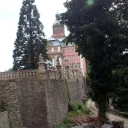
The castle stands in the gorge of the Pełcznica River, at an altitude of 395 metres above sea level, about 80 metres above the valley floor. The upper castle was built on an oval plan around a square medieval tower, but today's Baroque and Neo-Renaissance form largely conceals the original medieval appearance. The building has more than 400 rooms, or about 600 counting the outbuildings.



Be the first! Add a comment.
You need to log in to add a comment.
Log in