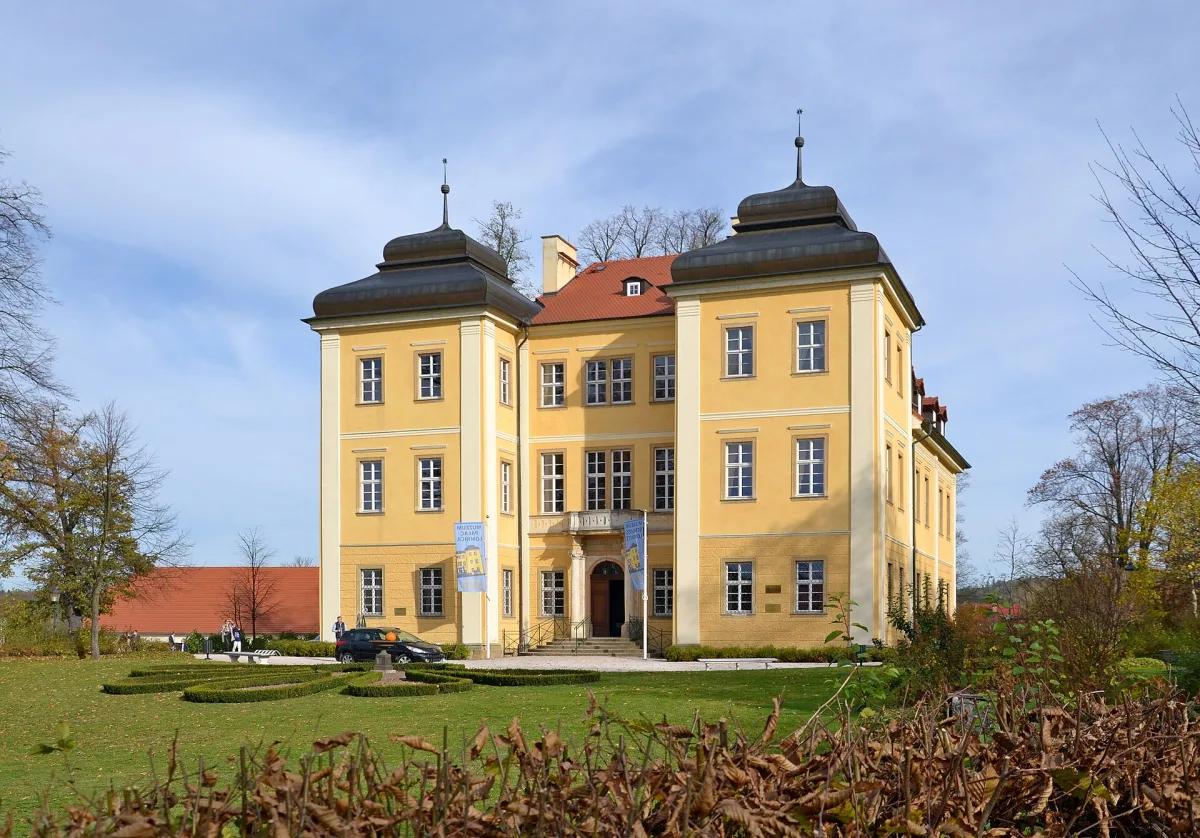
A baroque 17th-century palace in Łomnica together with the Widow's House and a former farmyard, restored after devastation and today functioning as a museum of interiors and a hotel.
The Łomnica Palace is a baroque, historic 17th-century palace together with a residential building called the Widow's House, located in the northern part of the village of Łomnica in Karkonoski County, at the fork of the roads to Karpniki and Wojanów, about five kilometres from Jelenia Góra.
The Łomnica estate belonged to the Zedlitz family from 1475 to 1654, then to the Tomagnini family (1654-1737), and afterwards to the Menzel family, who managed the estate from the third quarter of the 17th century until 1811. Later the estate passed through the hands of the Flach and von Roth families, until in 1835 Carl Gustaw von Küster bought the estate. The von Küster family managed the property until 1945.
The early baroque manor house with a main body and two corner turrets was built in the second half of the 17th century. In the 1720s the facades and interiors were altered. The largest modernisation was carried out in 1838-1844 by the architect Albert Tollberg, who changed the layout of the rooms, built a representative staircase, added a storey and enlarged the windows. Today the palace has three storeys on a square plan, with corner turrets covered by flattened spires and a hip roof over the main body, and on the axis of the facade a balcony portal can be seen. The original spatial layout has survived inside, and on the ground floor there are fragments of wall paintings from the turn of the 18th and 19th centuries.
The classicist Widow's House was built in 1803-1804 by Christian Gottfried Mentzel as a residence for an elder member of the von Menzel family. It is a two-storey building on a rectangular plan, with a hip roof and pseudo-avant-corps on the north and south sides. After the Second World War it was converted for residential and commercial use, today it houses a hotel, a restaurant and a café. The buildings of the former farmyard by the palace today serve a commercial and catering function, they house a shop selling linen goods, a sale of regional products, a bakery, a restaurant and a forge.
After the war the palace became state property, and until 1977 it housed a school. From the late 1970s onwards the building deteriorated, until in 1992 a Polish-German company bought it and began renovation. Today the palace functions as a museum of interiors. Listed in the heritage register are the palace itself (number 653/J of 27 August 1980), the Widow's House (896/J of 14 August 1987) and the surrounding park (A/5379/501/J of 1 December 1977).

Be the first! Add a comment.
You need to log in to add a comment.
Log in