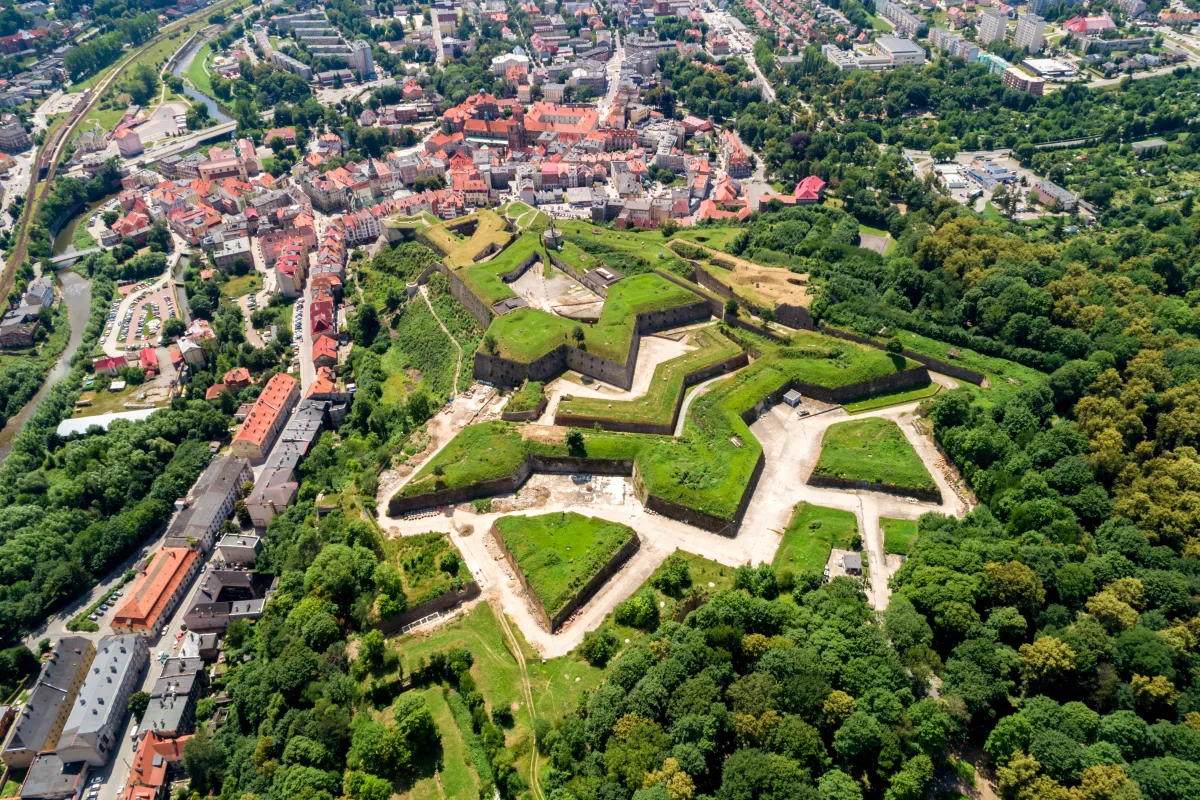
A preserved system of fortifications from the 17th and 18th centuries in Kłodzko, with above-ground routes and underground counter-mine corridors.
Kłodzko Fortress is an extensive system of fortifications on a hill above the town, built in stages from the Middle Ages through to the 18th century. Today it is a museum where visitors can explore both the above-ground bastions and kilometres of underground corridors.
The first wooden fortifications on this site already existed before 1114, and the stronghold was rebuilt in 1129 by Duke Sobiesław. In the 13th and 14th centuries it was rebuilt into a masonry castle, probably on the initiative of Duke Henry IV. Between 1557 and 1560 the architect Ernest Lorenz Kirschke added the middle and lower castle, creating a single integrated defensive system. Between 1690 and 1702, under the direction of Jacopo Carove, the medieval walls were replaced with modern curtain walls and bastions, given the names Jabłonki, Ludmiła, Wacław, Alarmowy and Dzwonnik.
After the First Silesian War, in 1742, the fortress came under Prussian rule, and a year later General Gerhard Cornelius de Walrave drew up new plans for expanding the fortifications. In 1770, after the Silesian Wars ended, the remains of the old residential castle were demolished, and under the direction of Colonel Ludwig Wilhelm von Regler an imposing donjon was built, which still stands today as the complex's main building. Between 1806 and 1807, during the Napoleonic Wars, the fortress, with a garrison of around 4,070 soldiers, played an important role in the Prussian defence of Silesia. After an assault in which losses reached about a thousand wounded and killed, it capitulated on 24 June 1807. In 1867 the Prussian authorities declared the fortifications obsolete and formally decommissioned them.
The complex covers over 30 hectares and includes the main fortress, the auxiliary fort at Owcza Góra, fragments of the former town fortifications and field works. Underground, already in the 18th century, a system of casemates and mine galleries was dug, designed to detect enemy tunnelling. In 2022 a previously unknown network of 18th-century counter-mine galleries was discovered, and today an underground route about a kilometre long is open to visitors.
The above-ground Upper Route is 2.5 km long, while the Labyrinth running underground through the counter-mine corridors is 1.2 km. In the tunnels the temperature stays at 8-10 degrees Celsius all year round, which is worth bearing in mind when choosing what to wear. A full visit, covering both the above-ground and underground routes, takes between an hour and a half and three hours. The donjon, the casemates and the Alarm Bastion house exhibitions on the history of the fortress.
Between 1940 and 1943 a subcamp of the Groß-Rosen concentration camp operated on the fortress grounds, and the site also served as a prison for prisoners of war and political prisoners. In 1944 factories of the AEG concern were evacuated here. In 1960 the fortress was declared a heritage monument and opened to visitors, and the whole complex was entered on the register of immovable heritage monuments under numbers 691 of 10 May 1960 and A/4346/691 of 16 November 2010. In 2018 an educational trail was created on the fortification grounds, and today the site is also used by historical re-enactment groups.
Right by the fortress, about 200 metres away, is the Underground Tourist Route, and within half a kilometre are the Museum of the Kłodzko Land and the Franciscan monastery complex. In the town centre it is also worth visiting Bolesław Chrobry Square and the Iron Bridge, while Forteczna Góra hill directly borders the fortress walls.


Be the first! Add a comment.
You need to log in to add a comment.
Log in