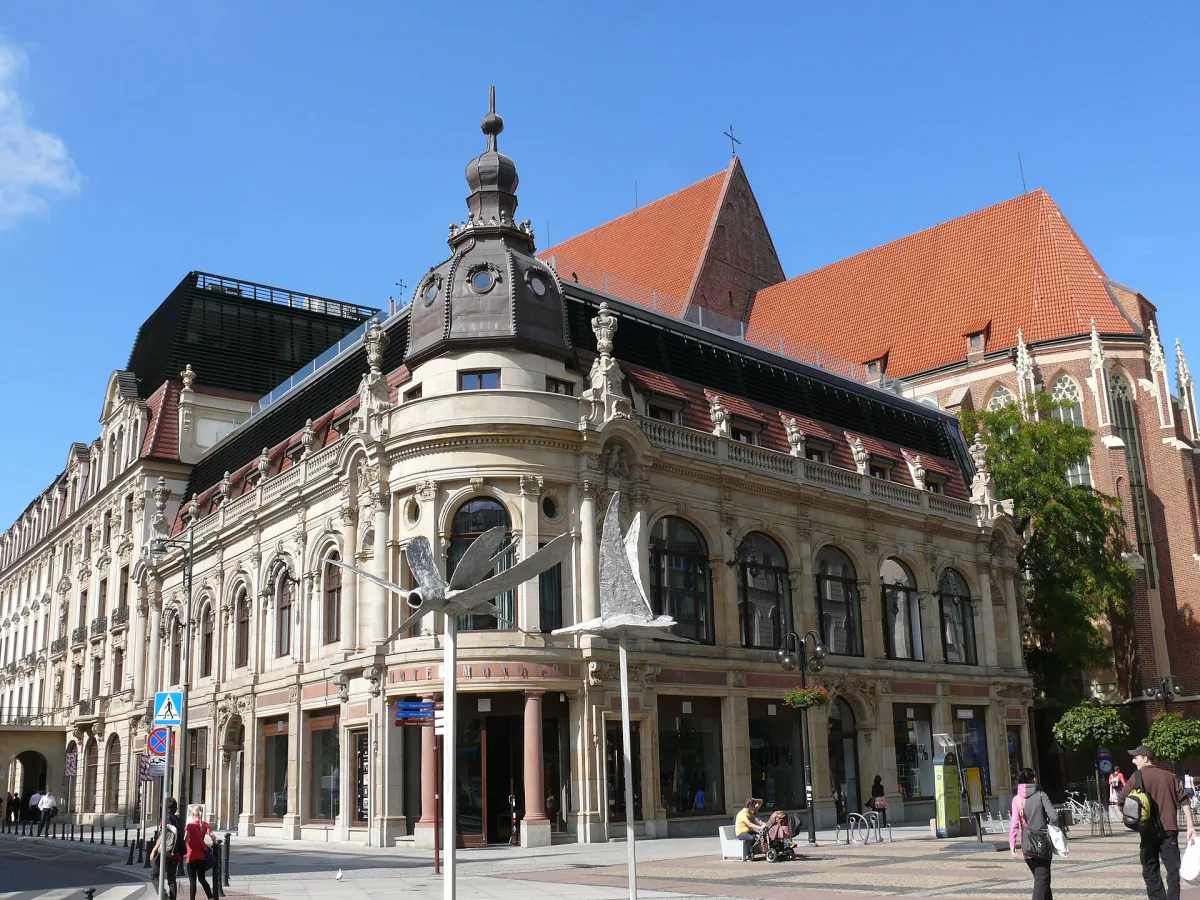
An Art Nouveau hotel from 1892 in the centre of Wrocław, a witness to historic 20th-century events and the film set of Andrzej Wajda's "Ashes and Diamonds".
The Monopol Hotel stands on ulica Świdnicka right in the centre of Wrocław. It is a historic building from 1892, one of the city's most recognisable Art Nouveau buildings, linked to many events in the history of Wrocław and Polish cinema.
The building was erected on the site of a former churchyard cemetery and monastery. It was designed by architect Karl Grosser in the Art Nouveau style, with Grosser himself and Wallenberg Pachaly as the investors. It originally held 69 rooms, considered luxurious for their time.
In 1937, a distinctive portico with a balcony was added to the building. In 1958, the singer Jan Kiepura addressed crowds from that same balcony. The commercial part of the building was badly damaged during the Second World War and was rebuilt in 1961, when an exclusive café was fitted out inside.
The Monopol Hotel served as the film set for several well-known Polish films. The most famous scenes were shot here in 1958 by Andrzej Wajda in "Ashes and Diamonds" ("Popiół i diament"), including the scene of burning glasses of spirit and the morning polonaise in the hotel restaurant. Scenes for the films "The Doll" ("Lalka") and "The Consul" ("Konsul") were also filmed in the building.
The hotel section, which survived the war, passed after the war to the Orbis company. The building was entered in the register of heritage monuments in 1984. After 2007, under new ownership, it underwent a thorough renovation and was reopened.
The Monopol Hotel stands right next to the Wrocław Opera and not far from the National Forum of Music. A few hundred metres away lies Wrocław's Market Square with the Town Hall, and a little further on, on Ostrów Tumski, stands the Tumski Bridge.

Be the first! Add a comment.
You need to log in to add a comment.
Log in