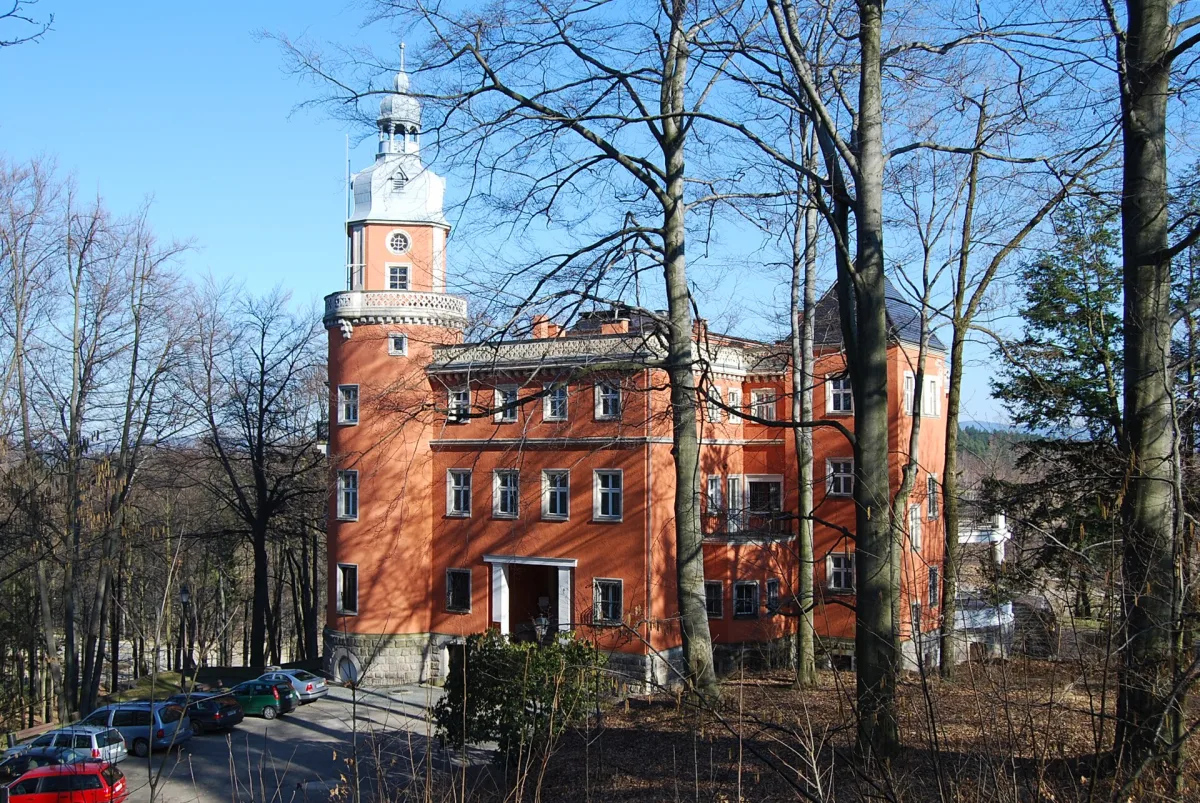
A historic palace on the outskirts of Jelenia Góra, with a history going back to Jesuits and industrialists, today a hotel with a restaurant.
Paulinum Palace stands on the outskirts of Jelenia Góra, right by the road out to Karpacz. It has a history stretching back several centuries, taking in Jesuits, industrialists and occupation authorities, and today operates as a hotel with a restaurant.
The first mention of this place is linked to the arrival of Jesuits in Jelenia Góra in 1655, from whom the German name Paulinenhof derives. In the mid-19th century the land was acquired by Richard von Kramsta, a factory owner, who in 1855 commissioned the gardener Siebenhaar to lay out a landscape park on Góra Krzyżowa (Cross Hill).
At the end of the 19th century the estate was bought by Oscar Caro, an industrialist from Gliwice. In 1905 the palace was rebuilt by the architect Karol Grosser, who gave it an eclectic style. Oscar Caro moved into the palace in 1909.
After Oscar Caro's death, in 1931 the building was bought by the German Labour Front, which set up an NSDAP training centre there. In September 1945 the palace was turned into a storage facility for works of art left behind by the Germans. Since 2002 it has been privately owned and operates as a hotel with a restaurant.
The building stands on Paulinum Hill and has three storeys. Its form is enlivened by numerous turrets, bay windows, a loggia and irregularly arranged windows, while the facade is decorated with rich stone architectural detail. The entrance leads through a recessed portico with columns, and an extensive park surrounds the building. The palace is entered in the heritage register and is part of the Jelenia Góra Valley Cultural Park.
Jelenia Góra and its surroundings have more palaces from this era, including the Palace in Łomnica. Close to the city centre are also the Cyprian Kamil Norwid Theatre and the Castle Gate Tower.

Be the first! Add a comment.
You need to log in to add a comment.
Log in