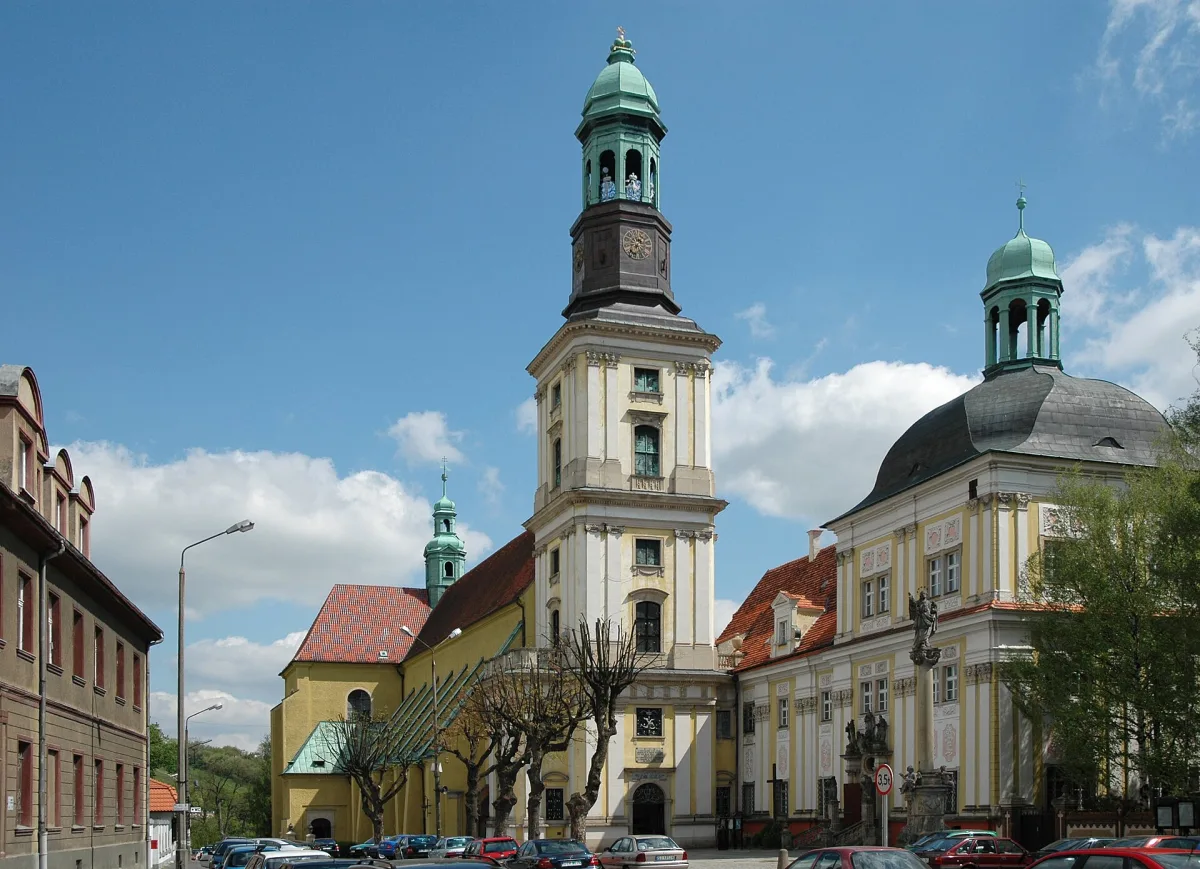
A monastery complex with the basilica of St Hedwig and St Bartholomew in Trzebnica, a sanctuary with the tomb of St Hedwig and a Gothic chapel from the 13th century, open to visitors.
The Sanctuary of St Hedwig in Trzebnica is a monastery complex with a basilica dedicated to St Hedwig and St Bartholomew. The place has been a sanctuary at least since the early 14th century, owing to the presence of St Hedwig's tomb in the basilica.
The monastery was founded in 1202 by Duke Henry the Bearded, creating the first female religious community in Poland. Pope Innocent III confirmed the foundation with a bull of 22 November 1202, and Benedictine nuns from Bamberg arrived in Trzebnica on 13 January 1203. In 1218 the community adopted the Cistercian rule.
The Romanesque, three-nave brick church was built between 1208 and 1219. Between 1268 and 1269 the Chapel of St Hedwig was added - the first building in Poland built entirely in Gothic style - with an early Gothic portal and a Romanesque tympanum. In the chapel stands the saint's Baroque sarcophagus of marble and alabaster under a canopy. The interior of the basilica also features a Rococo altar by Franz Mangoldt from 1739-1745, an organ built in the early 20th century by the Schlag company of Świdnica, and paintings by Michael Willmann and Christian Bentum.
The monastery complex was repeatedly destroyed by raids and fires - the Hussites attacked in 1432-1433, Hungarian troops in 1475, and fires consumed part of the buildings in 1464, 1486, 1505 and 1595. Reconstruction gathered pace after the end of the Thirty Years' War in 1648. The first stage of the Baroque rebuilding fell in 1680-1685, after St Hedwig's canonisation as a universal patron saint in 1680, the second in 1730-1760, and in 1780-1785 a 68-metre church tower was added.
Beneath the basilica lies the three-nave, Romanesque Crypt of St Bartholomew from 1214, rebuilt in the 17th and 20th centuries, which houses the tomb of Duke Conrad II and today serves as a lapidarium. The sanctuary was the burial place of 22 members of the Silesian Piast dynasty, including Henry the Bearded, who died in 1238, and St Hedwig herself, who died in 1267. The reliquary containing her skull dates from 1553. In 1810, under Prussian rule, the monastery was secularised, and after 1945 the Borromean Sisters have run care homes and educational activities here. In July 2014, by presidential decree, the monastery complex was recognised as a heritage monument.

Be the first! Add a comment.
You need to log in to add a comment.
Log in