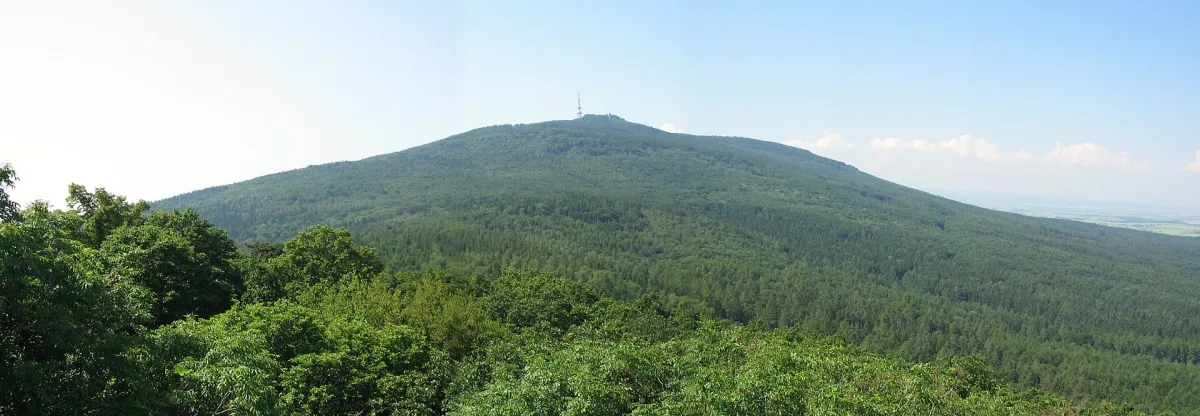
The highest peak of the Sudeten Foreland above Sobótka, a former centre of pagan worship with surviving stone sculptures.
Mount Ślęża is the highest peak of the Ślęża Massif and of the whole Sudeten Foreland, rising to a height of 717.5 metres above sea level near Sobótka. Despite its modest absolute height, it makes an impressive impact thanks to a relative height of over 500 metres. The mountain belongs to the Crown of Polish Mountains, the Crown of the Polish Sudetes and the Crown of the Mountains of Lower Silesia.
The massif is built mainly of granite and gabbro, and its geological structure bears traces of an ancient ocean floor from around 350 million years ago. The rocks of Mount Ślęża include, among others, radiolarite, amphibolite, gabbro and peridotite altered into serpentinite.
From the Bronze Age until Christianisation in the 10th and 11th centuries, Mount Ślęża was a centre of solar worship for the surrounding tribes. Stone sculptures survive on its slopes and summit, including the Bear, the Maiden with a Fish, the Monk and the Mushroom, which some researchers link to Celtic influences. The medieval chronicler Thietmar wrote that the mountain was venerated by all the surrounding inhabitants for its size and significance, as pagan rites were performed on it.
In 1110 Piotr Włostowic founded an Augustinian monastery on Mount Ślęża, later moved, by the mid-12th century, to Wrocław. Between 1813 and 1914 German student gatherings were held on the summit to commemorate volunteers who fought against Napoleon. Between 1851 and 1852 an Alpine-style mountain hostel was built here, and in 1908, to a design by architect Karl Klimm and financed by brewer Georg Haase, the present PTTK Tourist House was built.
On the summit stand the Church of the Visitation of the Blessed Virgin Mary, rebuilt in 1851-1852, a concrete viewing tower from the 20th century, the PTTK Tourist House building, and the remains of a medieval stronghold.
Five marked trails lead to the summit, including red, yellow and blue ones, starting from Sobótka. In addition, two archaeological paths have been marked out, signposted with the symbol of the Ślęża bear. Because of its pagan heritage, the mountain also draws pilgrims of Slavic neopaganism. Since February 1954 the area has been protected as a landscape and nature reserve covering 141.4 hectares.
The Ślęża Massif is surrounded by the Ślęża Landscape Park, and the Mount Ślęża nature reserve lies directly on its slope. In the same range it is also worth climbing Wieżyca or Radunia, and in Sobótka itself visiting the Stanisław Dunajewski Ślęża Museum.

Be the first! Add a comment.
You need to log in to add a comment.
Log in