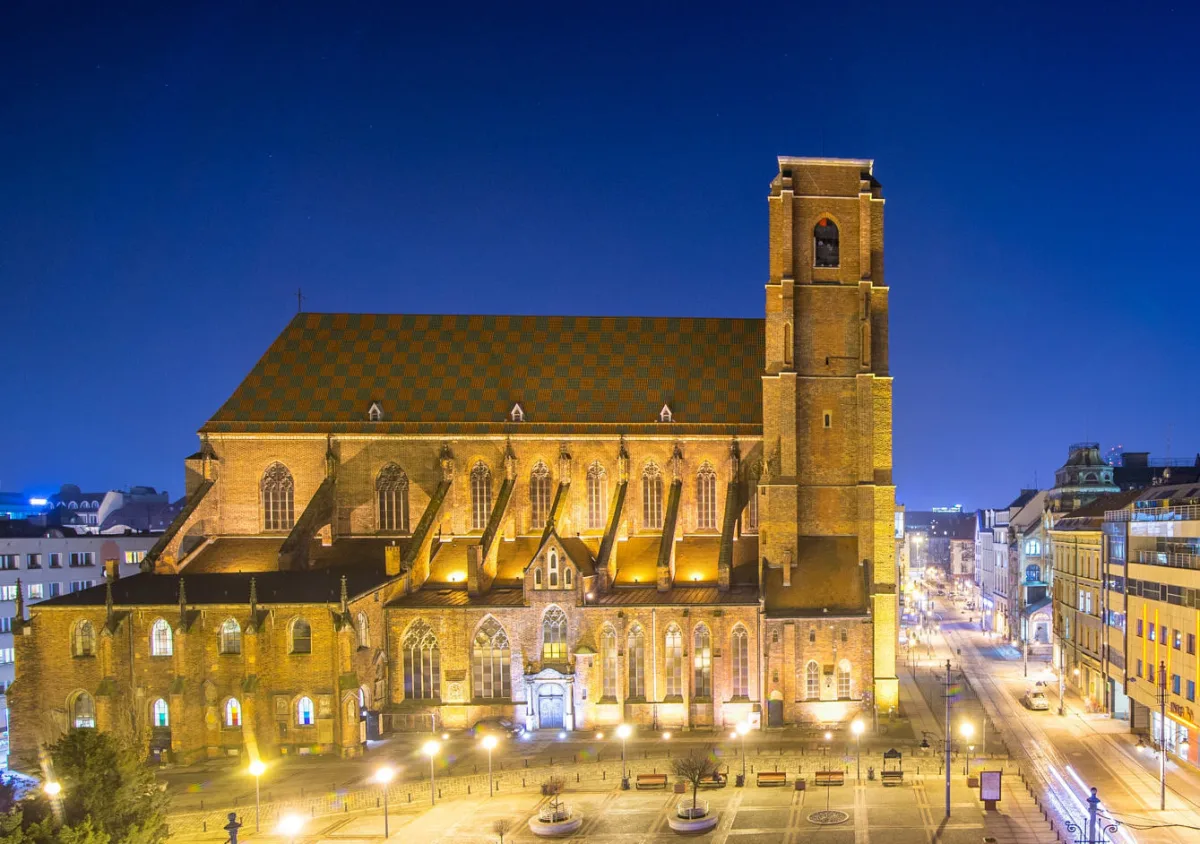
A Gothic cathedral from the 14th century by the Market Square in Wrocław, today the seat of the Polish Catholic Church in Poland.
St Mary Magdalene's Cathedral stands between Szewska and Łaciarska streets, right next to the Market Square in Wrocław. It is a Gothic church from the 14th century, formerly one of Wrocław's two municipal parish churches, today the cathedral of the Polish Catholic Church in Poland.
The first church on this site was built at the end of the 11th century. It was raised to parish status by the Bishop of Wrocław, Lawrence, in 1226. According to some sources, a Romanesque church was built from the ground up at this time, completed in 1232, which was destroyed as early as 1241 by the Mongol invasion. A further church, in the transitional Romanesque-Gothic style, was built between 1242 and 1248. After a fire in May 1342, it was decided to build a new, larger, late Gothic church using older fragments. It was built between 1342 and 1362 and, apart from the upper storeys of the towers, has kept its present-day shape since then. The church is 62.8 metres long and 32.1 metres wide, with the walls of the nave 22.9 metres high.
The towers were completed in the 15th century. In 1459 the Penitents' Bridge (Mostek Pokutnic), linking the two towers at the level of the top storey, was mentioned for the first time, and in 1481 they were covered with conical spires of lead sheeting. From 1386 the Sinner's Bell (Dzwon Grzesznika), cast by Michael Wilde, hung in the south tower, the largest bell in Silesia, with a circumference of 6.3 metres. It took 37 seconds to set it swinging, and it was used only for the greatest feasts. In the main portal a sculpture of the church's patron saint from 1440 was placed, and in 1447 a further one, depicting Christ and Mary.
On 23 October 1523, Johannes Heß delivered the first Evangelical sermon in Silesia in this church, and soon, despite the opposition of the cathedral chapter, became its parish priest. From then on the church, belonging to the city council, was a Protestant place of worship. In the last days of the Second World War, in May 1945, an explosion of ammunition stored in the church by the Soviet Army tore off the south tower, its northern half collapsed, destroying the bridge between the towers, the gable wall and the main portal with its valuable sculptures. The vaults were also destroyed, along with the historic Sinner's Bell and the organ. The church was given provisional protection in 1947, and full reconstruction was carried out between 1960 and 1970. In 1972 it was formally handed over to the Polish Catholic Church.
Inside, a Renaissance pulpit of 1579-1581 has survived. At the turn of the 20th and 21st centuries the roof was renovated, restoring the traditional red and green chequerboard tiling, and the Penitents' Bridge was rebuilt. Renovation work is currently under way on the external facades, epitaphs and interior of the church. The cathedral functions as a parish church, with Sunday Masses.
A few hundred metres away stands the Wrocław Town Hall, right on the Wrocław Market Square.
Not far away is also the Wrocław Opera.
A walk around the Old Town can also easily take in the Tumski Bridge and Wrocław's Archcathedral of St John the Baptist.

Be the first! Add a comment.
You need to log in to add a comment.
Log in