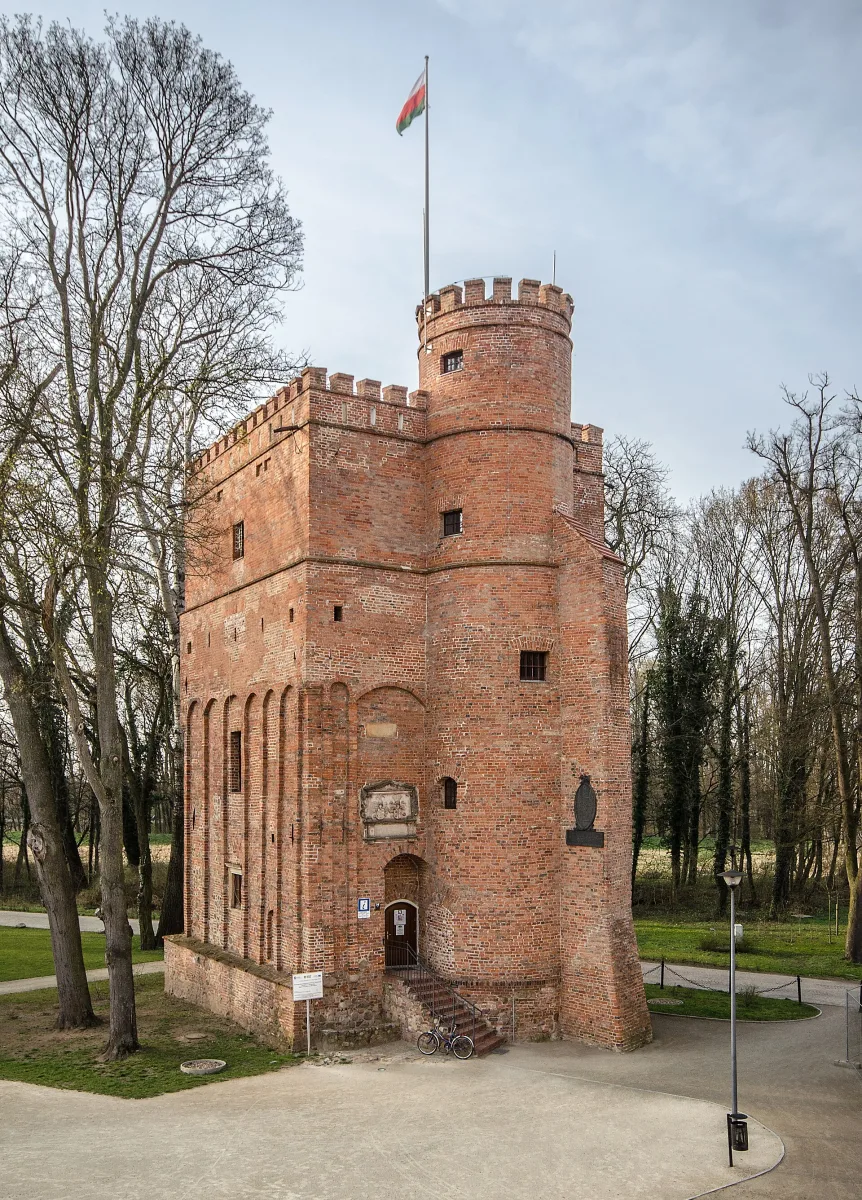
The ruins of a Baroque palace and a preserved Gothic residential tower in a park by the Barycz river, the site of a meeting of rulers in 1813.
The Żmigród Castle comprises the ruins of a Baroque palace and a well-preserved Gothic residential tower, standing in a park by the Barycz river, in Trzebnica County in Lower Silesia. The original stronghold was made of wood, and today's remains are the result of several centuries of rebuilding.
The first mention of the castle dates from 1296, when it was still a wooden structure. In 1375, when it belonged to the Duke of Oleśnica, it already had an irregular plan with a tower on the north side and an entrance gate to the south. After the death of the last Piast of Oleśnica in 1492, the castle passed to the Czech king Wladislaus Jagiellon, who handed it to the Polish nobleman Sigismund Korzbok. In 1560 Wilhelm Kurzbach built a second, square, four-storey tower of a residential-defensive character, the one that has survived to this day. At the turn of the 16th and 17th centuries the castle was twice destroyed by fire. During the Thirty Years' War it withstood attacks by Swedish troops, but in 1642 it was captured and for eight years served the Swedes as a base for raids into Silesia.
The castle's owners were, in succession, the Dukes of Oleśnica until 1492, the Kurzbach family until 1592, Adam Schaffgotsch, and from the mid-17th century until the end of the Second World War the von Hatzfeld family. It was Melchior von Hatzfeldt, an Austrian field marshal, who rebuilt the old castle at the turn of the 17th and 18th centuries into a grand Baroque palace, demolishing the medieval buildings apart from the tower in the process. In the 18th century the palace was modernised, and the architect of the new, Neoclassical wing was Carl Gotthard Langhans. In the 19th century the hipped roof was removed from the tower and upper sections with Neo-Gothic crenellation were added. The tower that survives today bears the coats of arms of the von Kurzbach and von Maltzahn families above the entrance, along with the date 1560.
On 9 July 1813, Tsar Alexander I of Russia and King Frederick William III of Prussia met at the Żmigród palace to agree a joint plan for defeating Napoleon. The agreements from this meeting went down in history as the Trachenberg Protocol, also called the Żmigród Protocol.
The palace was destroyed in 1945 and was never rebuilt in its original form. The tower was restored from the outside, but in the 1970s most of the remaining palace ruins were demolished. Since 2007 restoration work has been carried out, and since 2008 the castle grounds have been developed for tourism. Both the tower and the palace ruins are entered in the heritage register. In the park surrounding the castle grows a natural monument, a pedunculate oak with a trunk circumference of 631 centimetres, measured in 2010.

Be the first! Add a comment.
You need to log in to add a comment.
Log in