
Why the Sudetes
The foothill and mountain areas of the Sudetes were not suited to growing grain on a commercial scale - steep slopes, poorer soil and a shorter growing season did not give yields comparable to the lowlands. Flax, however, grew well here, and the region's cool, damp climate also suited linen yarn: fibre soaked and dried on the spot kept the moisture level needed for spinning more easily. Farms too small to live off the land alone looked for extra income, and weaving provided it without the need to own a large plot. In Kamienna Góra, flax weaving and the production of wool blended with flax had already developed by the 16th century, together with large-scale trade in linen cloth - the town was known at the time for its four annual fairs and weekly linen market. Chełmsko Śląskie went a similar way, where cloth-making and linen-weaving developed from the 16th century, with cottage-industry weaving growing intensively in the second half of the 17th century.
The Work of the Cottage Weaver and the Putting-Out System
Linen weaving in the Sudetes was for centuries domestic work, not factory work. The cottage weaver kept a loom in his room and worked on it in his own household, often together with the whole family - children spun the thread, adults wove the cloth. The raw material and orders were usually supplied by a merchant middleman: he bought the flax or the yarn, handed it out to the weavers to take home, and then collected the finished cloth and sold it on, keeping his own margin. The weaver was thus not an independent craftsman selling his own goods at the market, but a link in a chain that had no influence over the price of the raw material or the price paid on collection. This arrangement - convenient for the merchants, since it required neither building a factory nor employing staff on a payroll - also determined how dependent the weavers were on market conditions and on the middleman's honesty.
The Linen Trade and the Wealth It Produced
Linen from the Sudetes was sold not only in Silesia. From Chełmsko Śląskie the goods made by cottage weavers reached markets across Europe and even overseas, to America. It was this trade that gave the region's towns the old prosperity still visible today in their architecture - the town houses on the market squares of Kamienna Góra or Chełmsko Śląskie, built with money earned from linen, not from farming. In Chełmsko Śląskie, a trace of wealthy craftsmen from this trade was even left by emigrants from Germany, weaver-women producing expensive damask - a luxury silk fabric - for whom a separate complex of seven wooden houses was built at the start of the 18th century.
Crisis: Machines and Cotton
The 19th century turned this arrangement on its head. In Kamienna Góra the first mechanical spinning mill opened in 1841, and the first mechanical weaving mill in 1852 - from that point one factory could do in a shorter time what dozens of cottage-weaving rooms had previously done. On top of this came the import of cheap cotton, which pushed flax out of the textile market. Cottage weavers had no chance of competing on price with machines, and the merchant middlemen, who had previously handed out orders to them, increasingly moved production into their own factories. The result was a crisis of cottage linen weaving that grew across the decades throughout the whole of the Sudetes - with sharp falls in the price of cloth, mass layoffs and starvation wages for those who still remained at the looms.
The Turning Point: 1844
This crisis led, in June 1844, to a violent outbreak of discontent among weavers in Pieszyce and Bielawa, known as the Silesian weavers' uprising - suppressed by the Prussian army within a few days, with fatalities on both sides. This event has its own separate article on the portal, so here it is enough to note its importance: for the Europe of the time it was one of the first mass protests by industrial workers, and for literature it was the subject of Gerhart Hauptmann's play The Weavers, for which the author, who had ties to the region, was awarded the Nobel Prize in Literature in 1912.
Weavers' Houses as a Trace in Architecture
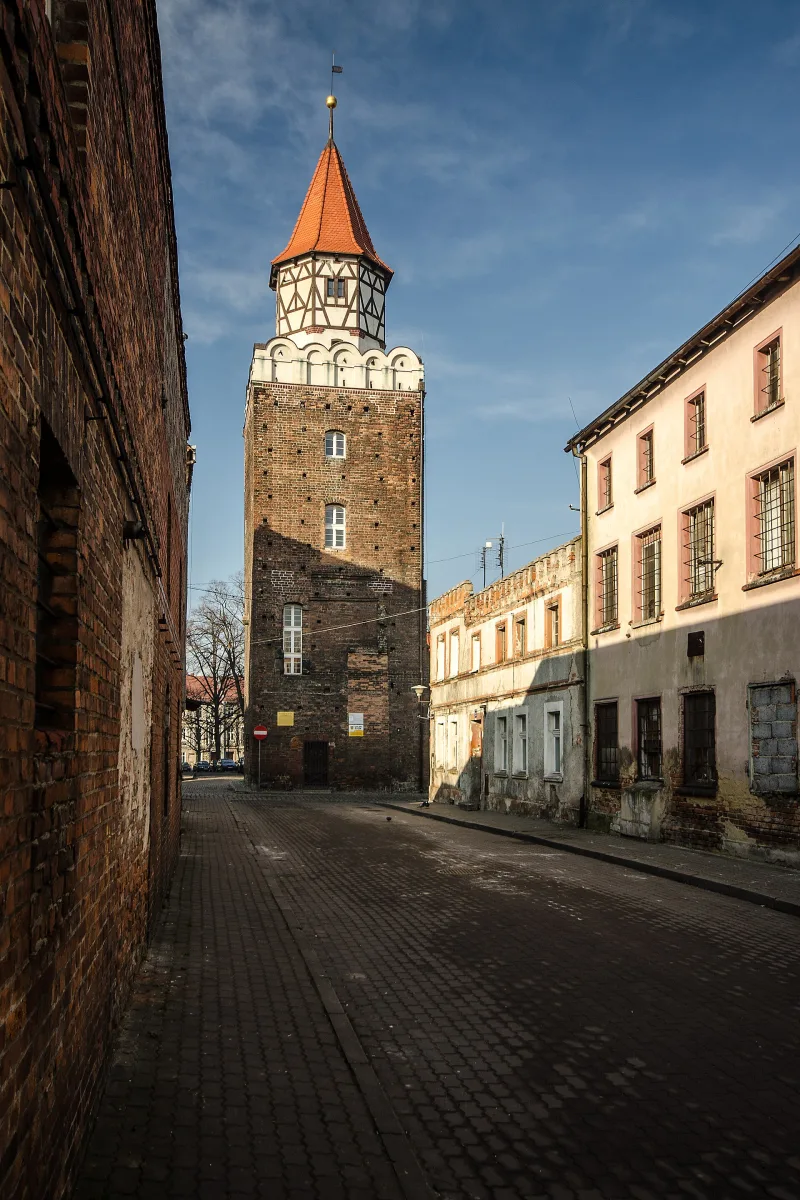
The building form characteristic of the Sudetes, the Umgebinde (Upper Lusatian) house, most likely emerged specifically with weaving work in mind. A loom set up in the main room caused considerable vibration during work, which is why the upper floor of such houses does not rest on internal walls but on a separate, external post-and-frame structure - the Umgebinde frame. This meant the vibrations of weaving work were not transmitted to the whole structure of the building. These Umgebinde houses spread from medieval Upper Lusatia into northern Bohemia and south-western Poland; today an estimated 17,000 such buildings survive across this whole borderland, of which about 400 are in Poland, mainly around Bogatynia. In Chełmsko Śląskie itself, one of the original set of seven houses built for the damask weaver-women still stands today, now known as part of the "Twelve Apostles" complex. Another trace of the old craft is the Weavers' Tower in Chojnów, a Gothic tower from the 15th century on the former Tkacka (Weavers') Street, and the Weaver's Fountain standing on the town's market square there, with a figure showing a craftsman at work.
What Remains of This Craft Today
Industrial weaving, which grew out of the cottage trade, survived in the region far longer than the cottage weavers' work itself - as late as the 20th century, large textile plants were still operating, among other places, in Bielawa, where a factory was founded in 1805 by Christian Dierig, though over time production shifted mainly to cotton. This industry, too, eventually passed: the Bielawa plant, a symbol of the factory age, was finally closed in 2008, and its former halls today house a museum. The craft of weaving itself, in its handmade, linen form, is documented by the Museum of Weaving in Kamienna Góra, housed in an 18th-century town house that once belonged to a merchant. It runs permanent and temporary exhibitions devoted to folk and industrial weaving, workshops for groups and a conservation studio - the place where it is easiest today to see a loom up close and understand the work that for centuries kept whole towns of the Sudetes going.

Be the first! Add a comment.
You need to log in to add a comment.
Log in