
What a parish fair is, and where its secular side came from
In its church sense, an odpust (parish fair) is a celebration linked to a parish's patron saint's day or a Marian feast, held at a specific church, often combined with a pilgrimage of the faithful. For centuries, however, a second, secular layer has built up around such celebrations: stalls selling food and trinkets, craftsmen's stands and, later, carousels and fairground attractions. Merchants and travelling craftsmen went wherever crowds of pilgrims gathered on a given day, since the fair was an earning opportunity much like a market or trade fair. This commercial custom became so entrenched that in many regions of Poland the word odpust came, in everyday speech, to mean precisely this festival of carousels and stalls rather than the church service itself, although formally an odpust remains a religious act, and the funfair is merely its old secular wrapping.
The region's pilgrimage tradition
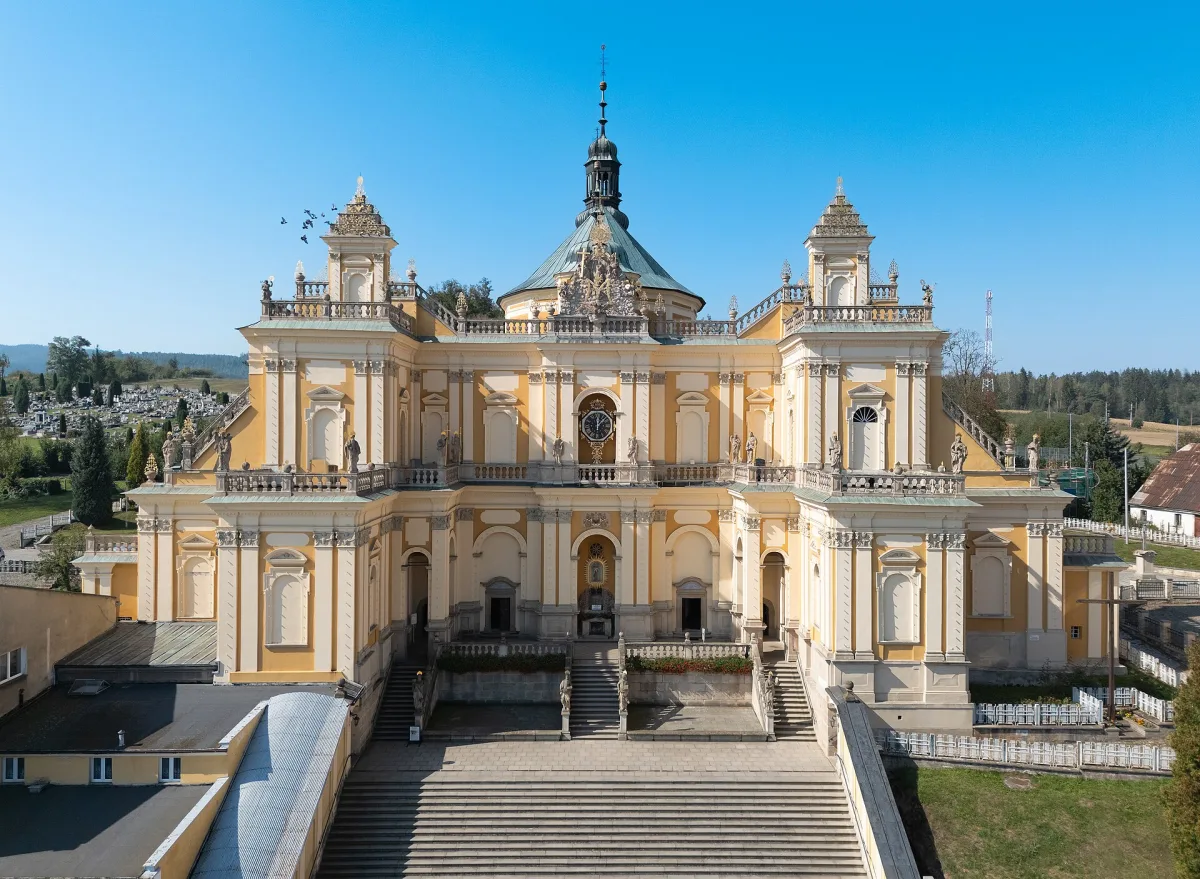
Lower Silesia has several centres of Marian and saintly veneration with a centuries-old pilgrimage tradition. The oldest is the Sanctuary of St Hedwig in Trzebnica, a pilgrimage destination since at least the early 14th century, associated with the tomb of Duchess Hedwig of Silesia in the basilica there. The cult received a boost in 1680 with the decision of Pope Innocent XI, who declared Hedwig a saint venerated throughout the whole Church; from then on the order invested in infrastructure for pilgrims, including building a calvary encircling the hills, completed in 1734. The second important centre is the so-called Silesian Jerusalem, meaning the sanctuary in Wambierzyce with its extensive calvary, and the third is Bardo, with the oldest Marian figure in Lower Silesia. Their fuller history is covered in a separate article on the Marian sanctuaries of the Kłodzko Land; here we focus on what unites them as pilgrimage destinations, not on the history of each individual site.
Walking pilgrimages and their routes
Alongside pilgrimages made by car or coach, the region also has a tradition of walking pilgrimages, leading through hills and forests to a specific sanctuary. Among the oldest forms of such a route is the Trzebnica Calvary: sixteen Baroque Stations of the Cross chapels, funded in 1734 by the Cistercian nuns of the Trzebnica convent and set out along a forest path in the Trzebnica Beech Forest. The Bardo Calvary on Bardo Mountain has a similar character, where thirteen Redemptorist chapels stand along two pilgrimage routes totalling 1,740 metres, leading to the summit from the Bardo side and from Janowiec. The Sudetes also retain the Lubawka Calvary on Holy Mountain near Lubawka: six chapels from the turn of the 18th and 19th centuries, although the tradition of pilgrimage to this hill itself dates back to the 18th century. Today this complex is falling into ruin, which in itself shows how uneven the post-war fate of Lower Silesian pilgrimage sites has been; some kept up a living stream of the faithful, while others emptied out over time.
How these customs changed after 1945
The region's post-war history left a deeper mark on its pilgrimage tradition than anywhere else in Poland, because it involved an almost complete replacement of the population. From the territories attached to Poland after 1945, including Lower Silesia, a total of around 3.5 million Germans were expelled by the end of 1950, and a further 3.6 million had already left these areas earlier, in a panicked flight from the front at the start of 1945. In place of the former residents, for whom sanctuaries such as Trzebnica, Bardo and Wambierzyce had been familiar places for generations, came settlers from central Poland and the Eastern Borderlands, bringing their own, different pilgrimage customs. The Marian cults survived this exchange, but their congregation changed almost completely; today's pilgrims to Lower Silesian sanctuaries mostly have no family continuity with these places from before 1945, unlike sanctuaries in other regions of the country, where the pilgrimage tradition passed from generation to generation without such a break.
The parish fair as an event for the whole area
The largest parish fair celebration in the region, the Main Feast of the Visitation of the Blessed Virgin Mary in Wambierzyce, draws thousands of pilgrims to the village every year on the first Sunday of July; according to local accounts, it is the biggest event of its kind at the sanctuary there. For a small place like Wambierzyce, such an influx of people in a single day means mobilising the whole surrounding area: access roads, parking spaces and temporary trade all have to cope with traffic many times greater than usual. The same is true of the celebrations in Trzebnica and Bardo; a parish fair in a small town or village with a sanctuary is an event that briefly changes the rhythm of the whole area, and one that has combined prayer with a fair, a carousel and a chance to meet neighbours from nearby villages for centuries.

Be the first! Add a comment.
You need to log in to add a comment.
Log in