
Why There Are So Many Empty Spaces beneath Lower Silesia
Lower Silesia stands out across all of Poland for the number of underground sites open to tourists. This is the result of three independent waves of digging into the earth, which overlapped over the centuries. The first was ore mining: gold, silver, tin and arsenic extracted since the Middle Ages in the Sudetes and the Sudeten Foothills, mainly in the areas of Złoty Stok, Złotoryja and the Izera Mountains. The second was 19th- and 20th-century industry, namely hard coal in the Wałbrzych coal basin and the extraction of metal ores, fluorite and industrial minerals across the whole region. The third wave was structures from the Second World War, when in the Owl Mountains the Germans dug kilometres of tunnels as part of the secret Riese project, and after the war Soviet teams searched for uranium in Kowary and near Kletno for the needs of the atomic programme. Each of these layers left behind a different type of underground site: narrow ore adits, extensive industrial mines, and concrete tunnels built in haste, under the pressure of war.
Gold and Silver from Centuries Past
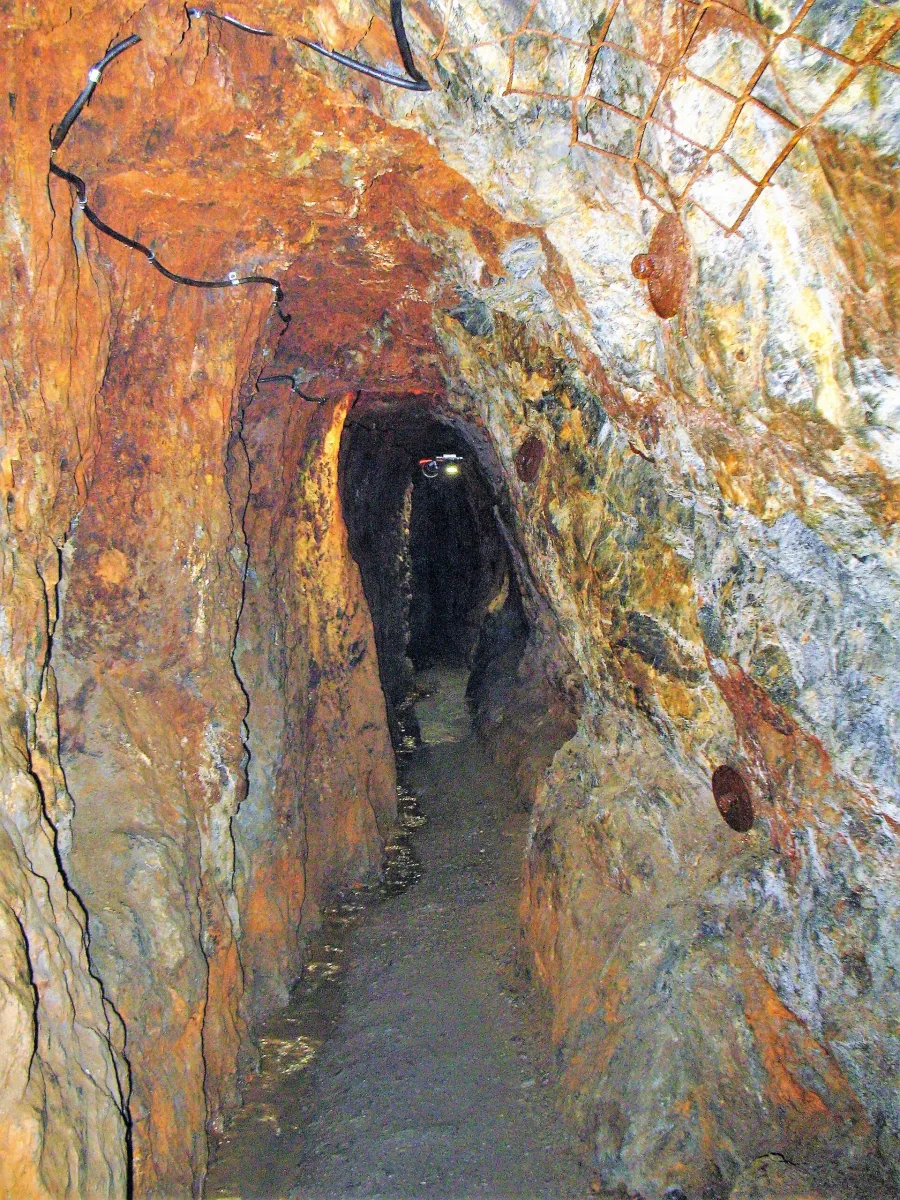
The oldest layer of the underground is linked to ore extraction. In the Gold Mine in Złoty Stok, miners extracted gold and arsenic for centuries, and the tourist routes today run through adits still in use as late as the 1960s. One of the corridors of this complex is the Black Adit, known as the Corridor of Death, on whose route lies Poland's only underground waterfall. Next to it runs the Ochre Adit, known for the unusual colours of the rock in the corridor. In Złotoryja, the Aurelia Gold Mine has survived, where the first mentions of the workings date back to the 17th century, and mining activity here probably began in the 12th century. It has been open to tourists since the 1970s and shows the basins used for panning gold. The scale of this mining was no accident: Lower Silesia lies at the junction of the geological structures of the Sudetes rich in ore veins, which is why mines of this type also appear in the Izera Mountains, where, among others, the Fryderyk Wilhelm Adit near Gierczyn once operated.
Coal and the Industry of Wałbrzych
The second layer consists of industrial mining, concentrated mainly around Wałbrzych. The Stara Kopalnia Science and Art Centre was built on the site of the former Julia Hard Coal Mine, whose roots go back to workings operating since the 16th century; the Julia shaft was put into use in 1867 and reached 611 metres into the ground. Extraction ended here in 1996. The Teresa Hard Coal Mine has a similar history, operating from 1864 to 1991, its historic buildings now serving as a private museum of mining and motor sports. Both mines show the same pattern: when extraction stopped being profitable, cultural institutions grew up on the sites of the shafts and corridors, because the underground infrastructure was already there.
Uranium, Secrecy and the Cold War
The third layer consists of underground sites built or exploited in the shadow of politics. In Kowary, after the Second World War, the Podgórze Mine was built, the only one in the town built entirely after 1945, operating from 1950 to 1958 as a secret uranium ore mine whose existence was a strict state secret during the communist period. In the same town operated the Liczyrzepa Mine, originally a fluorite mine, where uranium ore was encountered as early as the 19th century, and was extracted on a large scale from the late 1940s. A third trace of this period is Kopaliny near Kletno, the code name of a secret Soviet uranium mine run from 1948 to 1953 by the R-1 Industrial Works under an agreement between the USSR and Poland. Unlike the mines in Kowary, the workings at Kopaliny are closed today and not open for visiting.
Riese: Concrete Tunnels from the War
The most disturbing layer of the Lower Silesian underground consists of the facilities of the Riese project, the largest mining and construction undertaking of Nazi Germany from 1943 to 1945. Work began when intensifying Allied air raids forced Germany to move part of its strategic production to the safer area of the Sudetes. The largest facility of the complex open to tourists today is the underground Riese Włodarz complex in the Owl Mountains, where visitors pass through a dense network of corridors crossing at right angles, more than 3 kilometres in total, partly by boat through flooded sections. The second accessible fragment of the project is the Osówka Underground City in Sierpnica, built by the hands of prisoners, most of them Jews, including survivors of the Łódź ghetto and people brought from Auschwitz-Birkenau. Mortality during this work was high. Both facilities show the same story from two sides of a complex whose remaining fragments are, for the most part, not open to visitors.
The Underground City beneath Kłodzko
Not all of Lower Silesia's underground sites are linked to mining. Beneath the old town of Kłodzko, from the 13th century onwards, townspeople systematically extended private cellars, until a dense network of interconnected rooms was formed, reaching far beyond the outline of individual plots. Today a fragment of this network, about 700 metres long, is visited as the Underground Tourist Route, with over a dozen themed rooms on old crafts and the life of the townspeople. This is proof that in a region with such a building history, underground spaces could come into being without a single spade ever being used to extract ore or coal.
A Cave next to the Mines
Alongside underground sites created by people, Lower Silesia also has natural karst systems, formed without any involvement of mining. The largest and longest in the whole Sudetes is the Bear Cave in Kletno, discovered by chance in 1966 during the exploitation of a nearby marble quarry, about 4,500 metres long, of which the middle section, 700 metres long, has been made accessible for visiting. This is a reminder that not every hole in the rock was created by extraction: some of the region's caves existed long before the first miner.
What Is Closed and Why
Not every underground site in the region can be visited today. Some facilities have been permanently closed for safety reasons or because the site has been put to a different use. The Golden Adit in the Orlické Mountains, open to tourists since 1841, today has its entrance completely buried after a landslide. The Psi Grzbiet Mine in the Izera Mountains, a former tin ore mine worked from the late 16th century, is today filled in and considered unsafe to visit on one's own: without safety measures, lighting or knowledge of the layout of the workings, it is easy to get lost in it or come across a collapsed section of a corridor. Similarly closed are the secret Soviet workings at Kopaliny near Kletno, described earlier in connection with the underground sites from the uranium-mining period. Before setting off for the lesser-known adits in the region, it is worth checking the current status of the site, because such a long history of mining also means a great many unsecured, abandoned workings that are not worth entering on one's own.
Be the first! Add a comment.
You need to log in to add a comment.
Log in