
Trade built into the town plan since the Middle Ages
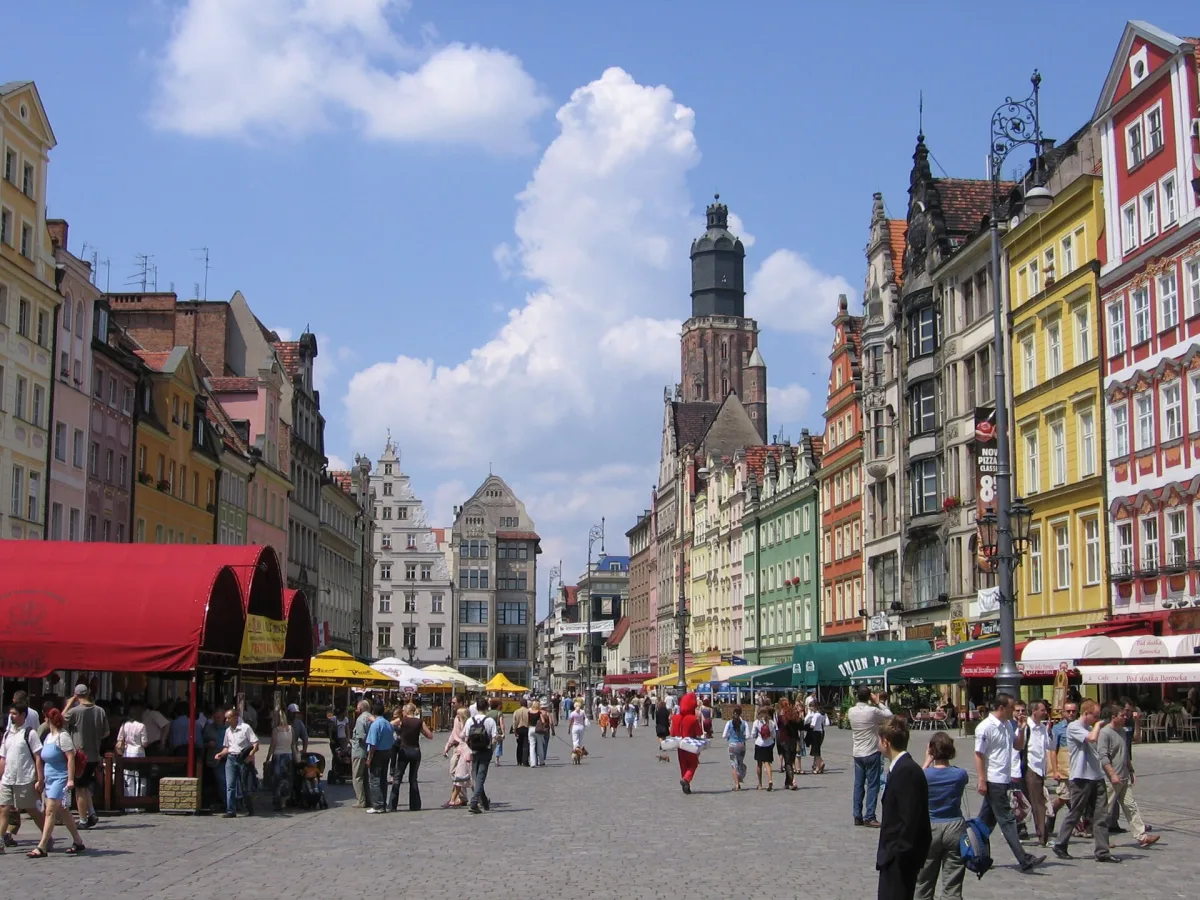
Wrocław's Market Square was from the outset a place of trade, not merely a ceremonial square. As early as 1273, Duke Henry IV granted the townspeople the right of weighing and the right of "szrot", which required goods to be weighed on the town scales before sale. Three large trading buildings stood on the square - the Cloth Hall (Sukiennice), where cloth was sold and cut in forty merchants' chambers, the Kramy Bogate (Rich Stalls), mentioned as early as 1242 and offering metal goods and spices imported from the east, and the Smatruz, a wooden hall with thirty-two stalls selling bread and footwear. Individual trades had their own fixed locations - goldsmiths on Wita Stwosza street, armourers in the Kuźnicza area, linen weavers in their own designated stalls.
This trading character of the square survived through the following centuries and is reflected today, among other things, in a cycle of seasonal fairs that return to the Market Square and the neighbouring Plac Solny every year.
A market that is five hundred years old
The oldest documented trace of Wrocław's Christmas market comes from the town's account books from 1566 - the town recorded income that year from stall rent amounting to 45 silver groschen. Historians do not rule out that the market may have been held earlier, though the exact date of its first edition remains uncertain. At first it traded mainly in devotional items, and in time fruit, cakes and roasted seeds were added. Gingerbread was for centuries an exclusive good, and the so-called Legnica bomba - a combination of gingerbread and honey cake, known in the region as a high-calorie treat for the winter season - enjoyed particular fame.
In the 17th century, thanks to Duchess Dorothea Sibylle, the custom of decorating Christmas tree branches spread, and the glassworks of the Karkonosze developed a technique for blowing thin glass baubles, which quickly became a popular decoration. Silver tinsel and candles were added to these. Wooden, wax or paper Nativity scenes with local motifs were also brought in from the Karkonosze area and the Kłodzko Valley, and after 1835 sugar Nativity scenes imported from Berlin confectioners became fashionable as well.
From decline to the revival of a tradition
The continuity of this centuries-old tradition was not guaranteed. A fire in 1897 destroyed around forty stalls, and two world wars interrupted the organisation of the market for long years. After 1945, along with the population exchange in the town described in other pieces on the portal, the Christmas market in its old form disappeared. The modern edition only got under way in 2008, starting from a modest thirty wooden huts on the Market Square. Since then the market has grown to several hundred stalls, occupying not only the Market Square but also Plac Solny and Świdnicka and Oławska streets.
Every year, during Advent and before Christmas, the wooden stalls return to the same spot, repeating the pattern of centuries past - combining trade with a festive atmosphere, music and time spent together outdoors. Lower Silesia, in fact, has a separate, longer list of Christmas markets in smaller towns, which the portal describes in a separate piece.
Plac Solny - a salt market, today a flower market
The neighbouring Plac Solny, laid out in 1242, bore several trade-related names in its history - Polnischer Markt, meaning the Polish Market, as well as Salzring and Salzplatz, from which its present-day Polish name derives. The salt trade that gave the square its name gave way long ago to a different range of goods - today the square is associated above all with a year-round flower market, one of the most recognisable trading spots in the town. During the Christmas market season, the flower stalls stand alongside the festive stalls, which shows how flexibly this part of town has adapted its trading function over the centuries, while retaining the constant character of a marketplace.
Every year, not only in winter
Seasonal trade on Wrocław's squares does not end with Christmas. The town also runs a network of permanent and cyclical marketplaces, where, in step with the seasons, fresh farm produce, organic products from local producers and food straight from nearby orchards and fields appear - at the marketplaces on Ptasia and Jemiołowa streets trading goes on all year round, but it is in spring and summer that the stalls fill up the most, in line with the harvest season. This rhythm of trading, dependent on the time of year, is a natural continuation of the same municipal tradition that lies behind the winter market on the Market Square - it differs only in range of goods and scale.
The exact shape of spring and summer festive or themed fairs, separate from the year-round food marketplaces, is not described in detail in this piece - the available sources focus above all on the Christmas market as the main, longest-documented event of this kind in the town.
Be the first! Add a comment.
You need to log in to add a comment.
Log in