
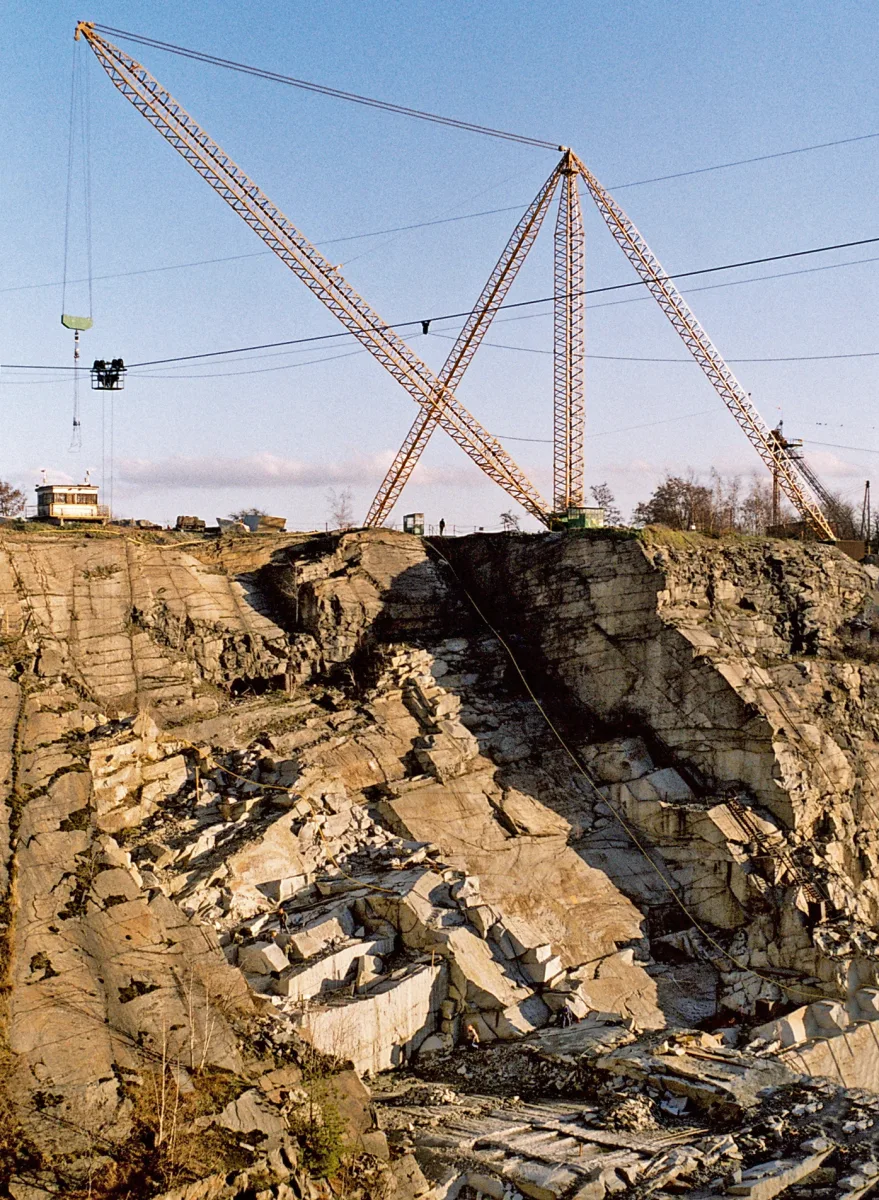
Stone 300 million years old, on which half the region stands
Strzelin granite formed in the earth's crust around 303 million years ago, still in the Carboniferous period. It is light grey to white, with visible flecks of biotite and muscovite, has a uniform texture and great hardness - it is precisely these features that made it one of the most prized building stones in this part of Europe. It polishes well, takes on an almost mirror-like shine and, unlike many other rocks, withstands decades in a changeable climate without major signs of weathering.
Stone extraction around Strzelin has a very long history - the first mentions of a stonemasons' guild in the town date back to the granting of town rights in 1292. Extraction on an industrial scale began in the mid-19th century, and by the early 20th century Strzelin granite was already known throughout Germany at the time. Since then extraction has continued here, with interruptions linked to war and changes of ownership, for close to two hundred years.
Where this stone ended up
Strzelin granite was used to build many recognisable places. In Warsaw it was used for the Poniatowski Bridge, the foundations of the Palace of Culture and Science, and the pedestal of the Nike Monument. It also reached Berlin - the Red Town Hall and, according to some sources, the floors and stairs of the Reichstag, though this fact is not equally well confirmed across all materials. Closer to home, stone from these quarries was used to build the bridge over the Vistula in Toruń, the runway surfaces of the airports in Szymany, Balice and Pyrzowice, and sections of motorways and expressways linking the country's major cities. Ordinary paving stone has a separate, much longer history of its own - setts of Strzelin granite have for decades lined the streets of many Lower Silesian towns, as a material too durable to be easily replaced with anything else.
Excavations deeper than a skyscraper
The scale of extraction in Strzelin is impressive in itself. The main, still-operating excavation goes about 123 metres below ground level, is about 650 metres long and 300 metres wide - almost 20 hectares in total. This is a quarry deep and large enough that it is sometimes described as the deepest active granite quarry in Europe. The older part of the mine, no longer worked today, has over time filled with water - since 2011 a lake of more than 5 million cubic metres of water has gathered there, considerably deeper than most natural bodies of water in the region.
Work in the quarry: from the pick to machines
For most of its history, granite extraction in Strzelin was physical work on a huge scale - as late as the era of People's Poland the mine employed as many as several hundred miners a day, extracting and processing the stone by hand and with the help of simple machines. Today the process is largely mechanised: rock blocks are separated using blasting methods or modern cutting techniques, and machines, which have replaced most of the former physical labour, are used for transport and processing. Even so, extracting and processing granite still demands great precision - cracks or a poorly guided cut can ruin a block of stone worth many hours of work.
Open day: the only chance to enter the site
The quarry in Strzelin is an active industrial plant, not a tourist attraction with open access - on ordinary days entry to the excavation site is forbidden because of blasting work and heavy equipment traffic. The exception is the open day, held once a year, in September, on the occasion of the town's festival. Then the operator opens the site to visitors in organised groups, with a requirement for prior sign-up and a mandatory safety helmet - it is the only time of year when the inside of the excavation can be seen up close, rather than viewed from afar, from the viewpoint by the road. On ordinary days, the view of the excavation is offered by a publicly accessible viewpoint on Mikoszowska Street, open all year round without booking.
What else to see in Strzelin
Anyone already in the town because of the granite should also visit the Romanesque rotunda of St Gothard - the oldest surviving building in Strzelin, built of broken granite most probably as early as the 12th century, though the first written mentions of it date only from the 13th century. The building survived the destruction of the town during the Second World War and today belongs to the nearby parish. Unfortunately the rotunda is not open to visitors despite lying on the Romanesque Trail, so it can only be viewed from the outside - but the structure itself, with preserved Romanesque walls in the lower part of the tower and an original portal, is worth a short stop when visiting the town.
Be the first! Add a comment.
You need to log in to add a comment.
Log in