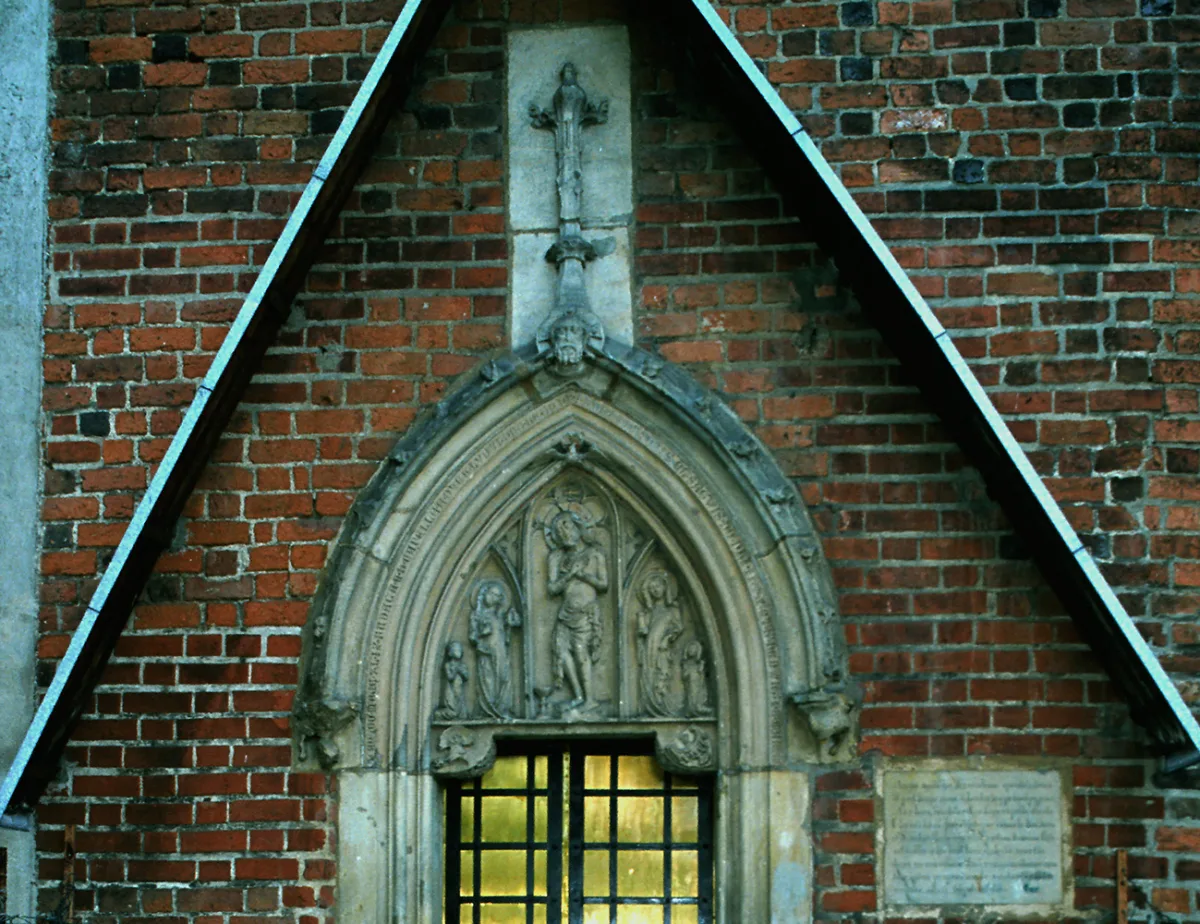
The only surviving fragment of the medieval castle in Lubin, a Gothic chapel with a tympanum from 1349, today the Castle Gallery.
The castle chapel in Lubin is the only element that has survived from the medieval castle buildings on Castle Hill. It originally stood next to the gate leading onto the castle courtyard; today it is a separate building serving as an art gallery.
The date of construction is given by an inscription in the tympanum above the north portal: the year 1349. The chapel was founded by Duke Ludwik, ruler of Legnica, in honour of the Body and Blood of Christ and of St Hedwig and St Mary Magdalene, as confirmed by the Latin foundation inscription running along the arch of the archivolt. In the fourteenth century the interior had three altars.
The chapel was destroyed during the Thirty Years' War and rebuilt in the eighteenth century. It later fell into ruin again, and a further rebuilding in the mid-nineteenth century allowed it to serve Catholics until 1908. Later it housed a diocesan library. In 1945 the building was set on fire, and, left without a roof, it decayed for many years after the war. Renovation was not carried out until the late 1970s, and further restoration work took place between 2005 and 2009.
The building measures 13.5 by 8.1 metres, with walls 1.2 metres thick. It originally had a flat roof and the main entrance on the north side. The Baroque rebuilding extended the chapel with extensions on the chancel side and enlarged the windows, and the building was covered with plaster and a tall, gabled roof.
The most valuable element is the Gothic tympanum of 1349 above the north portal. It shows the Man of Sorrows in the centre, with St Hedwig and St Mary Magdalene at his sides, and, at their feet, on a smaller scale, the kneeling founders: Duke Ludwik and his wife, Duchess Agnieszka of Żagań. The tympanum sculpture is regarded as an example of the soft style of Silesian Gothic sculpture.
After building renovation in 1990, the building was converted into the Castle Gallery and has since served as an exhibition space rather than an active chapel.

Be the first! Add a comment.
You need to log in to add a comment.
Log in