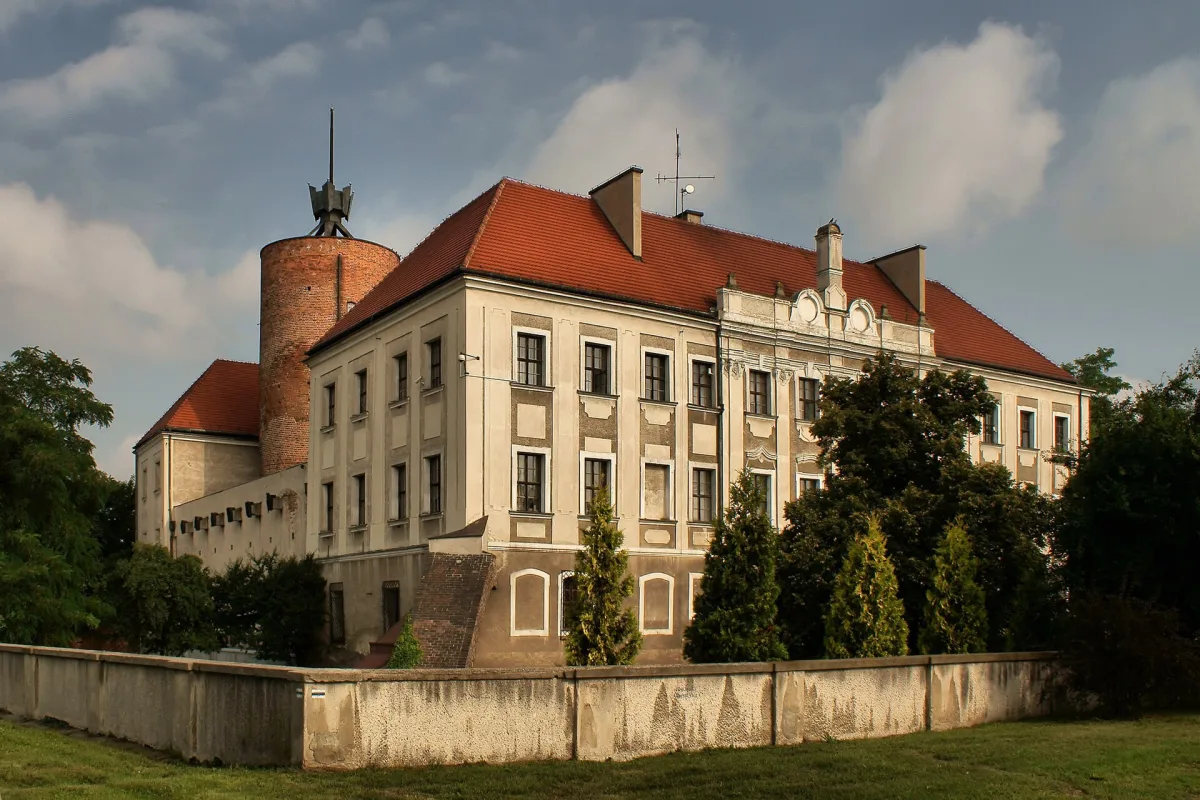
A 13th-century castle in Głogów, residence of Piast and Jagiellonian rulers, today the Archaeological and Historical Museum.
The Castle of the Dukes of Głogów stands in Głogów, on Brama Brzostowska street. Built in the second half of the 13th century as the seat of the rulers of the Duchy of Głogów, it today houses the Archaeological and Historical Museum.
The castle was built by Duke Konrad I of Głogów in the second half of the 13th century. It originally consisted of a brick masonry tower and timber buildings, controlling a ford across the Oder. After a fire in 1291, Konrad's successor, Henryk III, extended the fortification, raising a rectangular wall and three masonry buildings along the shorter sides of the complex.
In 1462 the King of Poland, Kazimierz Jagiellończyk, stayed at the castle. Between 1498 and 1506 it was the residence of Prince Zygmunt Jagiellończyk, later King of Poland as Zygmunt I the Old.
In 1652 reconstruction began on the ruined medieval castle, a process that lasted over a decade. During this work a southern wing and further storeys were added. After the Silesian Wars, from 1742, the castle was the seat of Prussian officials.
The oldest element of the castle is a Gothic cylindrical tower, probably built in the second half of the 13th century. It is 24 metres high and 8.9 metres in diameter, with the wall at its base 2.75 metres thick.
In 1945 the castle was seriously damaged during fighting between German forces and the Red Army. Reconstruction began in 1971, and the remaining wings were rebuilt by 1983. The castle was built of brick, and because of its successive extensions it combines several architectural styles.
The castle is today home to the Archaeological and Historical Museum and the Głogów Land Society. The collections include archaeological, historical and numismatic exhibits as well as an art collection. The building is entered in the register of immovable monuments.

Be the first! Add a comment.
You need to log in to add a comment.
Log in