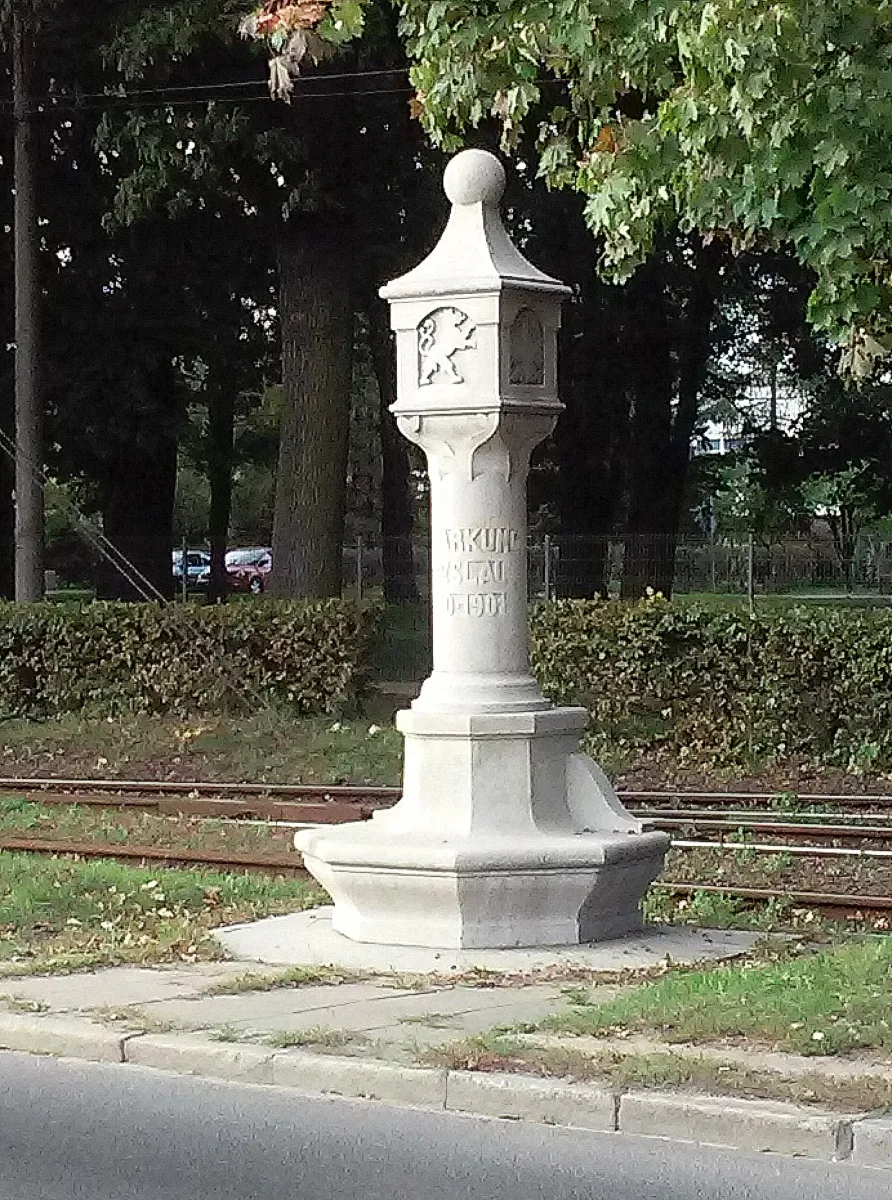
Six granite boundary pillars erected in 1900-1901 beside the former roads leading out of Wrocław, three of which survive today.
The Century Stones are six granite pillars, erected in 1900-1901 beside the roads then leading out of Wrocław. They were purely symbolic in character, marking the approaching 20th century.
The pillars were most likely designed by Karl Klimm and funded by the Wrocław city authorities. Their form echoes Silesian boundary markers and roadside pillar shrines, including a now-lost 16th-century shrine known as the "Wrocław Cockerel." On the four-sided capital, beneath the sphere crowning the pillar, are four elements of the Wrocław coat of arms: the letter W, the Silesian eagle, the Bohemian lion and the head of St John the Evangelist.
The six stones were placed along the roads towards Trzebnica, Świdnica, Jelcz, Psie Pole, Oława and Legnica, marking the city's boundaries at the time. Only the first three of them survive today. Fragments of the fourth pillar, which had previously stood on Kromera Avenue, were found during earthworks on Kłokoczycka Street in early 2012, and fragments of the fifth stone were found in 2021 on Krakowska Street.
The round columns originally bore the German name of the city and the date 1900-1901. After 1945, as part of the removal of German traces, the inscription "Gemarkung Breslau" was chiselled off, and on the pillar on Karkonoska Street the word "Wrocław" was carved in its place. During renovation in September 2003, the original German inscriptions were restored on the pillars on Mickiewicza Street and by the Trzebnickie Bridges.
One of the surviving stones stands next to the tram loop in front of the Chrobrego Bridges, near Szczytnicki Park and the Centennial Hall. In this part of the city it is also worth visiting the Japanese Garden and the grounds of the Wrocław Zoo with its Afrykarium.

Be the first! Add a comment.
You need to log in to add a comment.
Log in