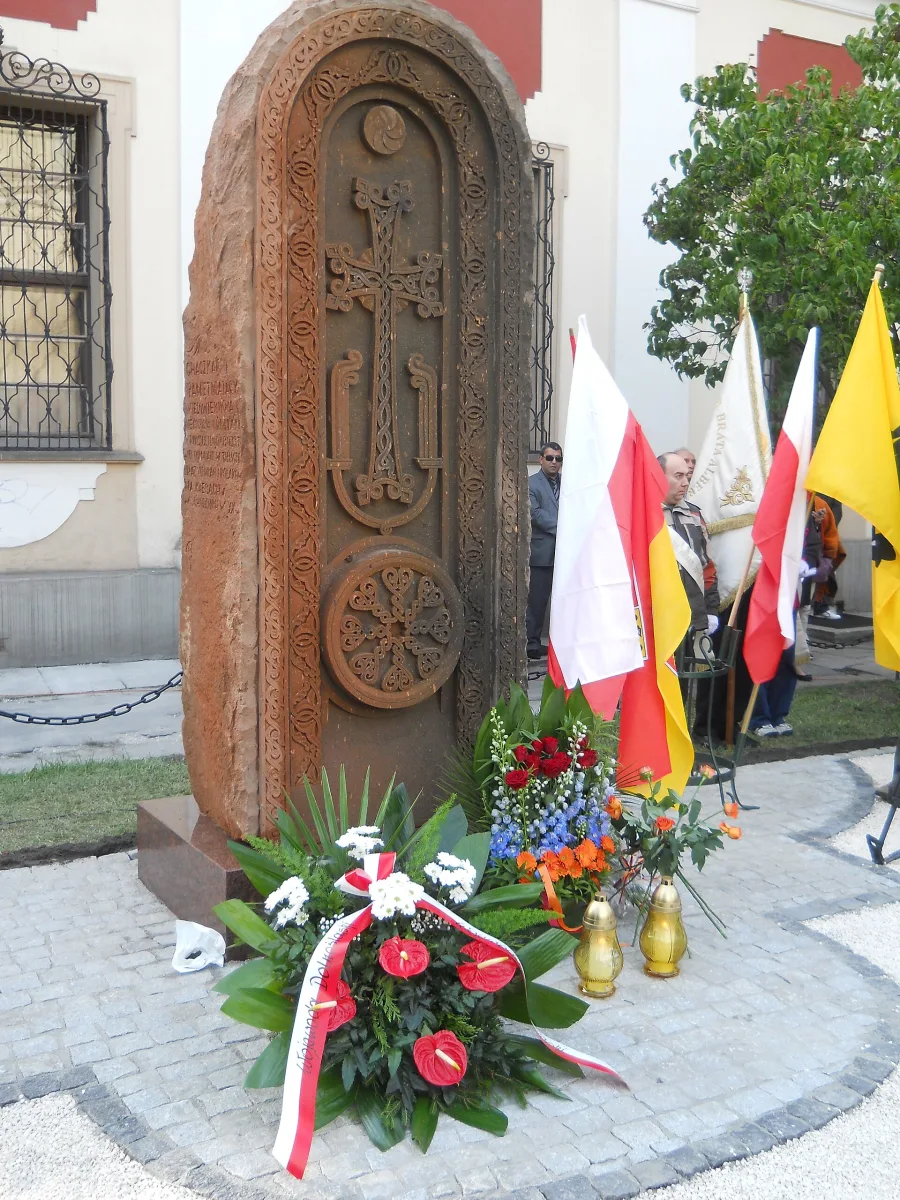
An Armenian stone stele from 2012 on Janickiego Street in Wrocław, commemorating the Armenian genocide and the centuries-long presence of Armenians in Poland.
The Khachkar in Wrocław is an Armenian stone stele standing on a square on Janickiego Street, next to the Dominican monastery near Dominican Square. It was unveiled on 21 September 2012 during the Second Armenian Days in Wrocław.
A khachkar is an Armenian stone stele or votive slab commemorating important events or people. It is traditionally decorated with an Armenian cross and rich plant ornamentation, and such steles are found on the walls of temples, at the entrances to tombs, along roads and in cemeteries.
The Wrocław khachkar was donated by the World Union of Armenian Painters. It was made in Armenia from volcanic tuff by sculptors Taron Martirosyan and Bagrat Balabekyan. The surroundings of the monument were designed by Halina Krajewska, and the cross was consecrated by priests Tadeusz Isakowicz-Zaleski and Jakub Kraska OP.
The inscription on the khachkar speaks of the centuries-long presence of Armenians in Poland and of the Armenian genocide carried out in Turkey, as well as of the Armenians and Poles murdered in the Eastern Borderlands (Kresy) during the Second World War. The monument thus combines the memory of the genocide of 1915-1917 with the memory of the crimes in the Kresy and of the centuries-long history of the Armenian minority in Poland.

Be the first! Add a comment.
You need to log in to add a comment.
Log in