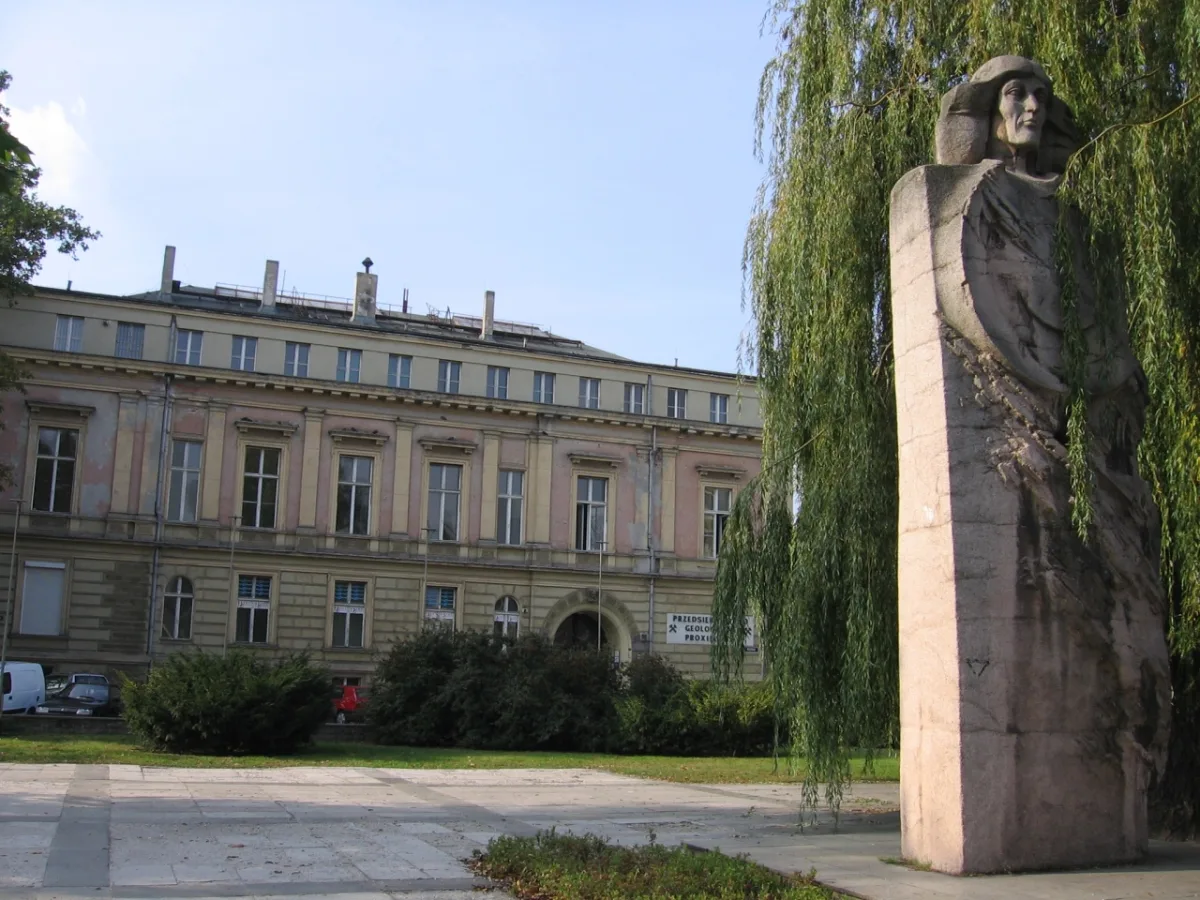
A monument to Nicolaus Copernicus from 1974 in the form of a stylised heliocentric system, on a square by the City Moat in central Wrocław.
The monument by the City Moat in the centre of Wrocław depicts Nicolaus Copernicus in an unusual form: instead of a classical figure in a toga, it shows a stylised body with a heliocentric system, topped with a bust of the astronomer. It stands on a square a few minutes' walk from the Market Square.
The monument was unveiled in 1974, a year after the celebrations of the 500th anniversary of Copernicus's birth, which fell in 1973. The initiative to build it was undertaken jointly by the Society of the Friends of Wrocław and the Society of Friends of Astronomy. The sculpture's author is Professor Leon Podsiadły. In 1977 a plaque was mounted on the monument with the inscription "Wrocławianie Mikołajowi Kopernikowi 1473-1543" ("The people of Wrocław to Nicolaus Copernicus 1473-1543").
The statue is made of artificial stone. It takes the form of a body with a stylised heliocentric system, topped with a bust of the astronomer, referring directly to Copernicus's discovery that the Sun, not the Earth, is the centre of the planetary system.
The monument occupies a square bounded by Piotra Skargi Street to the east, the City Moat to the south, Wierzbowa Street to the west and Teatralna Street to the north. Beyond Piotra Skargi Street stretches Wzgórze Partyzantów, and beyond Wierzbowa, on the site of the former Leipziger palace, begins the park named after Copernicus. The Old Town Promenade runs along the moat, so the monument is passed almost on every walk between the Wrocław Opera and the Old Town. In the 2018 study of conditions and directions of spatial development of Wrocław, the monument was recognised as an asset of contemporary culture.

Be the first! Add a comment.
You need to log in to add a comment.
Log in