
A museum of contemporary art in an above-ground air-raid shelter from 1942, the only such venue in Poland.
Wrocław Contemporary Museum is a museum of contemporary art, operating as a municipal cultural institution under the direct supervision of the mayor of Wrocław. The institution was formally founded on 10 February 2011 and opened on 2 September 2011 in the Szczepin neighbourhood, on Plac Strzegomski.
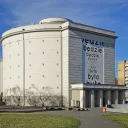
The museum is the only institution in Poland housed in an above-ground air-raid shelter, hence its popular name "shelter for art". The shelter itself was built in 1942 to a design by architect Richard Konwiarz, intended for the civilian population in case of air raids. The building has six storeys, walls thicker than a metre and a ceiling 1.5 metres thick, and was the largest of the five shelters built in Wrocław at the time. During the siege of the city in 1945 it housed a field hospital, and after the war it served as a warehouse, before shops operated there prior to 2011.
The conversion for the museum's needs was designed by the studios CH plus Architekci and VROA Architekci. Partition walls were demolished and the raw concrete was exposed, while added lattice structures opened up the interior. The exhibition space covers 3,500 square metres. On the building's façade is the mural "Klepsydra" ("Hourglass") by Stanisław Dróżdż from 1967. On the roof there is a terrace with a cylindrical glazed pavilion, where film screenings and meetings take place in summer, and a café operates on site.
The institution exhibits, promotes and collects works of contemporary art and Wrocław art from the second half of the 20th century, also focusing on education and social programmes for the residents of Wrocław. The collection numbered 318 objects, including works by Carolee Schneemann, Karol Radziszewski, Anna Molska and Alicja Kwade, as well as the archive of Jerzy Ludwiński and works on deposit from the Lower Silesian Society for the Encouragement of Fine Arts. Part of the collection is also available online through a separate virtual museum service. The museum runs an educational programme for groups, including family workshops and activities for seniors and people with intellectual disabilities.
The museum had planned a new headquarters on ulica Purkyniego, designed by architect Mirosław Nizio as a minimalist form of black stone covering 4,500 square metres. The building was never built, and in September 2020 Skwer Wrocławianek was opened on the site instead.
On Plac Strzegomski, right next to the museum, stands an installation by Andrzej Jarodzki entitled "Pociąg do nieba" ("Train to Heaven") from 2010, considered the largest sculpture in Poland. It consists of tracks, railway sleepers and a Ty2-1035 steam locomotive from 1944, positioned as if racing towards the sky.

Be the first! Add a comment.
You need to log in to add a comment.
Log in