
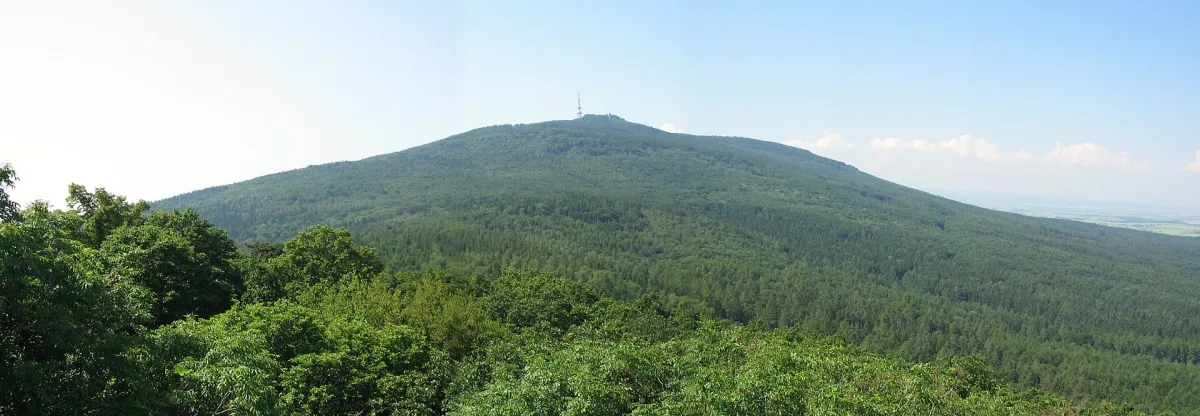
Ślęża - the Nearest Peak, Good for a Warm-up
Ślęża is the highest peak of the Ślęża Massif and of the whole Sudeten Foreland, rising to 717.5 metres above sea level right above Sobótka. Despite its modest absolute height, it is impressive thanks to a relative height of over 500 metres - it stands alone, with no neighbouring ranges, so it is visible from a distance, and from its summit there is a wide panorama over the Sudeten Foreland and, in good visibility, over the Sudetes chain itself. The route consists of well-marked trails through beech woodland, and the climb itself usually takes no more than two to three hours one way, which makes Ślęża the easiest point on the list - a good choice for the first trip of the season or for going out with children.
Chojnik - Castle Ruins above the Jelenia Góra Valley
Chojnik is a hill 627 metres above sea level in the Karkonosze Foothills, right above Sobieszów, part of Jelenia Góra. On its summit stand the ruins of a Gothic stronghold, first mentioned in writing in 1364, which from 1418 belonged for centuries to the Schaffgotsch family. The climb passes through beech, pine and spruce forest, past rock formations and caves, including Dziurawy Kamień (Holey Rock) and Jaskinia Zbójecka (Robbers' Cave), and on the south-western side the slope ends in a cliff several dozen metres high, dropping into the Piekielna Dolina (Hell's Valley). The whole route to the summit and back usually takes half a day, including time to visit the ruins of Chojnik Castle itself, which lies within the strict protection zone of the Karkonosze National Park.
Wielka Sowa - the Highest Point of the Owl Mountains
Wielka Sowa is the highest elevation of the Owl Mountains, reaching 1015 metres above sea level, and on its summit stands an observation tower built of concrete blocks in 1905-1906. Several trails from different directions lead to it, which makes it possible to plan a loop instead of returning by the same route - in practice a one-day trip can be stretched into several hours of walking through remnants of the old primeval forest of the Sudetes of beech, sycamore and spruce, typical of the whole Owl Mountains Landscape Park. The tower itself, over a hundred years old, still serves as a viewpoint and is the natural destination of most routes in this part of the Sudetes.
Szczeliniec Wielki - the Rock Labyrinth of the Table Mountains
Szczeliniec Wielki, the highest peak of the Table Mountains, is 922 metres above sea level and lies within the Table Mountains National Park, near Karłów. It is built of fractured sandstone, which erosion has carved into shapes with their own names - the Camel, the Mammoth, the Elephant, the Hen, the Monkey, the Dog, the Turtle and the Owl, and among the more interesting spots are the Great-Grandfather's Armchair, the Little Hell and the Devil's Kitchen. The Tourist Trail on the summit is a loop laid out among these rock formations, reached by climbing steps from the side of the PTTK "Na Szczelińcu" mountain hostel. The whole climb and descent, together with the walk along the trail itself, is a trip of a few hours, good for a single day including travel there and back.
Szrenica via the Kamieńczyk Waterfall - a Longer Karkonosze Route
Szrenica is a peak in the western part of the Karkonosze, 1362 metres above sea level, right by the border with the Czech Republic, south of Szklarska Poręba. One of the more popular routes leads there from Szklarska Poręba itself, passing on the way the Kamieńczyk Waterfall - the highest waterfall in the Polish Sudetes, cascading down from a height of 27 metres through a narrow rocky ravine. From the summit of Szrenica there is a view over the Jelenia Góra Valley, the Izera Mountains and the Czech part of the Karkonosze. This is already a full-day trip, with a distinct climb past the waterfall and a long ridge section - it is worth planning it with time to spare, especially if you plan a longer stop at the waterfall itself along the way.
Śnieżka - a Full-Day Trip to the Roof of the Sudetes
Śnieżka, the highest peak of the Karkonosze, of the Sudetes and of the whole of Silesia, is 1603.30 metres above sea level and lies exactly on the Polish-Czech border, towering over the Jelenia Góra Valley with a relative height of about 1200 metres. The easiest route to the summit goes via Kopa, a small rise on the Równia pod Śnieżką plateau - from there only a short, clearly marked stretch remains to the top. A trip from below Karpacz, where at the foot of the mountain stands the Wang Temple, brought over from Norway, to the summit and back takes up most of a day, so it is worth setting out early in the morning and leaving time to spare for the descent before it gets dark. For those looking for a longer, full ridge route, a good addition is a walk towards Wysoka Kopa, the highest peak of the neighbouring Izera Mountains, though that is already a separate, many-hour expedition, not an add-on to a single day in the Karkonosze.
Śnieżnik - the Highest Peak of the Eastern Sudetes
Śnieżnik reaches 1425 metres above sea level and is the highest border peak on the Polish side of the Eastern Sudetes, in the Śnieżnik Massif. The massif is built of metamorphic rocks - gneisses, mica schists and marble lenses - and right at the top stands a triangulation point together with a border marker. About 200 metres from the summit a spring rises, a good landmark when planning the final stretch of the climb. The route up Śnieżnik is longer and more demanding than those to Ślęża or Chojnik, but it still fits within a single day's trip from Wrocław, provided you set out early enough.
Be the first! Add a comment.
You need to log in to add a comment.
Log in