
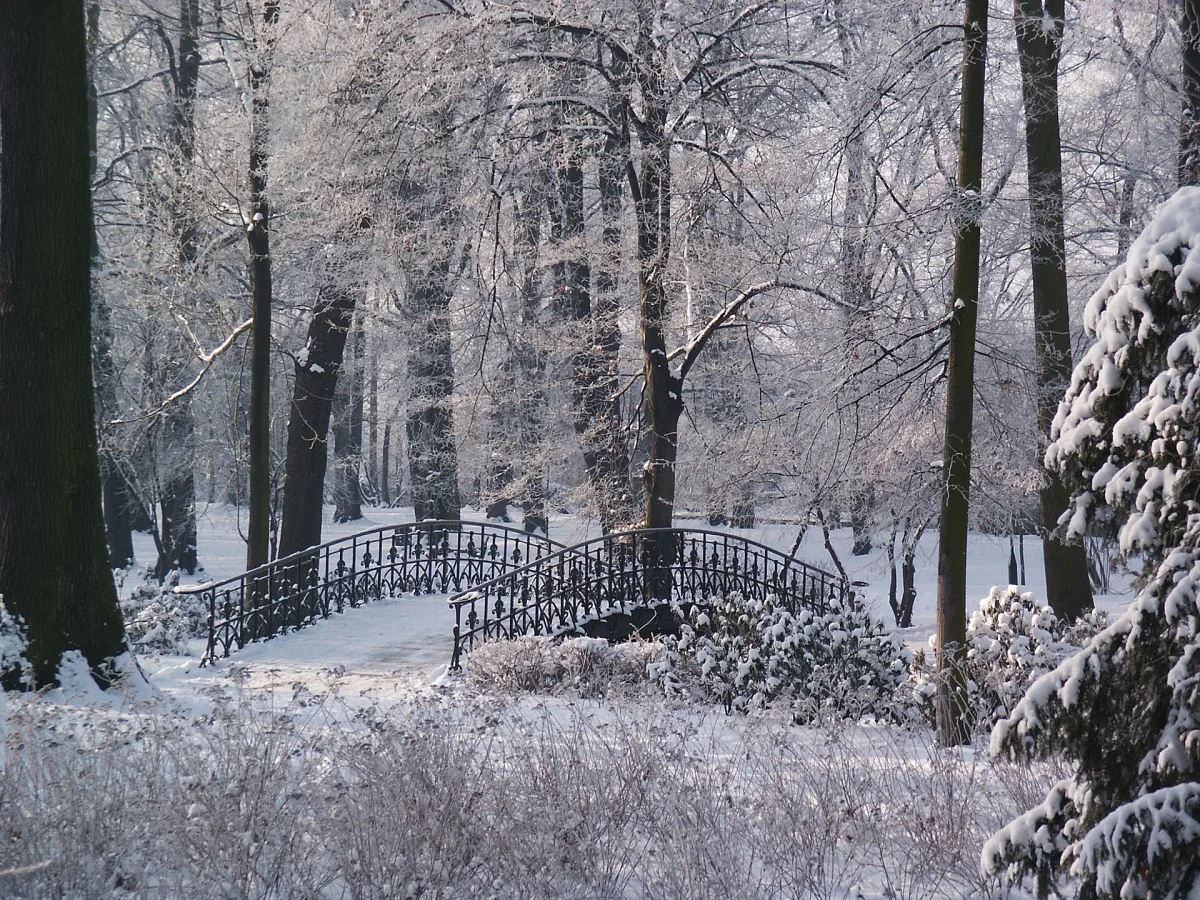
City parks a dog can enter without restrictions
Most of Wrocław's city parks are ordinary municipal green spaces, with no ticket and no regulations banning animals - the only rule that applies is the general requirement to keep a dog on a lead in a public place. This is the case in large, sprawling grounds such as Szczytnicki Park east of the Old Oder, or Grabiszyński Park in the Grabiszyn-Grabiszynek estate, split into a section by Hallera Avenue and a section running along the Ślęza. The same applies to West Park in Wrocław, also known as Bebelpark, to Nicolaus Copernicus Park by the Old Town Promenade, and to Juliusz Słowacki Park next to the Museum of Architecture. A separate case is East Park in the Księże estate - it actually lies on two islands surrounded by branches of the Oława, so a long walk here can be combined with a rest by the water.
It can be different with parks that charge admission, such as the Botanical Garden on Ostrów Tumski or the Japanese Garden in Szczytnicki Park - these are institutions with their own entry regulations, which may treat animals differently to an open municipal park, so it is worth checking the rules on site or on the garden's website before a visit, rather than assuming they will be the same as next door.
The Oder, the moat and the riverside areas
Wrocław is a city of a hundred bridges, and it is precisely along the water that some of the longest walking routes in the city run. The Wrocław Old Town Promenade circles the Old Town along the former fortifications and the City Moat, running for a short stretch right along the Oder itself - it is a loop for pedestrians and cyclists that can be walked at any pace and at any time of day, without planning an entire outing in advance. For a dog that copes better with hard, even ground than with forest paths full of roots, such a route can be easier than a trip to the Sudetes.
The boulevards along the Oder and the green areas around the Exhibition Grounds by the Centennial Hall, with a park and a fountain by the water, are another place where a city walk with a dog can be extended without leaving the city limits.
Mount Ślęża and the landscape parks near Wrocław - a half-day trip
When the city parks start to feel too small, the natural direction is Mount Ślęża, the highest peak of the Ślęża Massif, rising to 717.5 metres above sea level near Sobótka. The mountain itself and the surrounding hills form part of the Ślężański Landscape Park, and a landscape park - unlike a national park - is primarily about protecting the landscape, not a strict nature-protection regime, so the rules on admitting animals are usually the same as on an ordinary forest trail. The exception is the summit area of the mountain, covered by a separate nature reserve - reserves are often marked with their own signs setting out the rules, so it is worth looking out for signage on entering such a place, rather than assuming the rules are identical to those of the park as a whole.
Other landscape parks in Lower Silesia have a similar character, open to dogs on a lead like most of the region's forests and trails: the Barycz Valley Landscape Park with its ponds and bird refuge between Żmigród and Przygodzice, the Rudawski Landscape Park between Jelenia Góra and Kamienna Góra, and the Owl Mountains Landscape Park with fragments of the old forest of the Sudetes. These are good directions for a full-day trip if the main goal is a walk in the woods rather than reaching a specific summit.
Karkonosze National Park: dogs on a lead, but not everywhere
Many tourists assume that dogs cannot go on the trails in a national park at all. In Karkonosze National Park it is different: the park allows walks with a dog on a lead on most of its trail network, totalling 97 kilometres of routes. A dog's owner should also carry a muzzle, in case a situation arises that requires its use.
However, around 34 kilometres of the most ecologically valuable sections remain closed to dogs, marked with a separate sign. The ban covers, among others, the entire Ścieżka nad Reglami (Path Above the Timberline) from the Karkonoska Pass through the slopes of Szrenica to Jakuszyce, sections of trails in the Czarny Kocioł Jagniątkowski and Kocioł Łomniczki cirques, a stretch near the Okraj Pass, and the area right by the Kamieńczyk Waterfall - one of the most popular hiking destinations in the Polish Sudetes. Before setting out on a specific route, it is worth checking the current map of trails closed to dogs on the park's website, as the list is updated from time to time.
Table Mountains National Park: more restrictions than in the Karkonosze
In the neighbouring Table Mountains National Park, the rule works the other way round to the Karkonosze: by default, dogs cannot enter the park, and the exceptions to this ban are listed explicitly, route by route. Dogs are not allowed at all on the Tourist Trail at Błędne Skały (Errant Rocks). At Szczeliniec Wielki, a dog on a lead and in a muzzle may reach the northern terraces and the mountain shelter near the summit, but not the Tourist Trail itself, which only begins beyond the shelter - in that case you have to return the same way you came.
Outside these two places, the park allows walks with a dog on a lead and in a muzzle on a specifically listed set of walking and cycling trails, including routes from Karłów and Pasterka, through the area of Krucze Rocks, Fort Karola, Radkowskie Rocks and the Skalne Grzyby educational trail. The rest of the park's area remains closed to dogs. Anyone planning a family trip with a dog specifically to the Table Mountains should check this list before setting off, not only at the entrance gate.
What to remember when heading into the mountains with a dog
Trails in the Sudetes can be harder on dogs than they look on a map. In summer, especially on the exposed, rocky parts of the Table Mountains or on the plain below Śnieżka, heated sandstone and granite can burn a dog's paws, and shade can be far away - it is best to plan such outings for the cooler hours of the day. The sharp edges of rock labyrinths, such as those at Błędne Skały or Szczeliniec, are uncomfortable even for people in sturdy footwear, and for dogs' paws they can mean cuts, so it is worth watching how the dog is walking and shortening the route if needed. Ticks are a constant issue in the forests and subalpine meadows of the Sudetes, at any time of year except winter - checking the dog's coat after a walk should be just as routine as checking your own legs.
Water for the dog is worth carrying regardless of the route - mountain streams can be shallow in summer or dry up periodically, and dogs are reluctant to drink from puddles or snow. And one last practical point: dog mess has to be cleared up on the trail too, not only in the city - it is one of the conditions under which national parks allow dogs onto part of their territory at all.
Be the first! Add a comment.
You need to log in to add a comment.
Log in