
The Old Town and Ostrów Tumski without a ticket
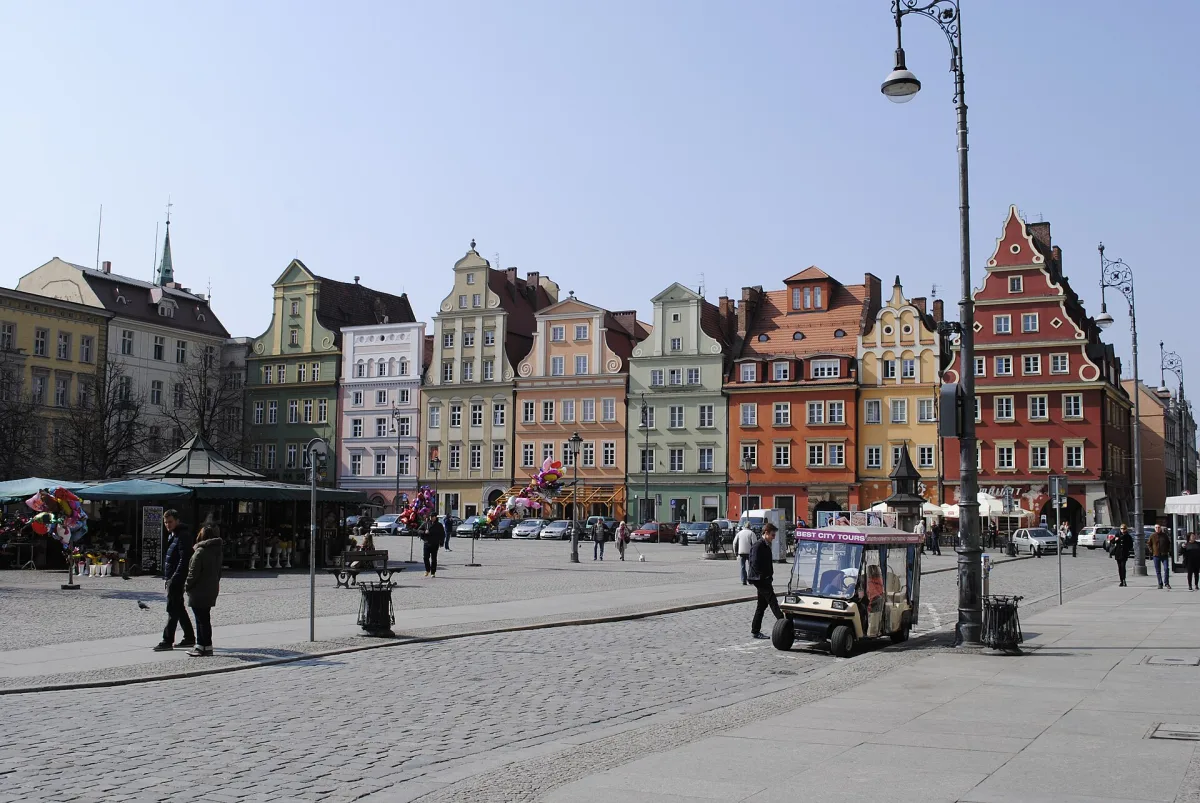
The oldest part of Wrocław is a dense network of squares, streets and small bridges that you can walk around without any restrictions. A good starting point is Solny Square, a square-shaped auxiliary market square laid out in 1242 right next to the main Market Square. Unlike the Market Square, it has remained an open, undeveloped space and today is associated above all with the flower market.
From the centre it is worth heading towards the Oder and crossing Tumski Bridge, a two-span steel bridge from 1889 linking Ostrów Tumski with Wyspa Piasek (Sand Island). Structures have stood in this spot since as early as the 12th century, and they used to mark the boundary between the city's jurisdiction on the island and the church's jurisdiction on Ostrów. Today the bridge is open to pedestrians only, which on its own keeps tourist traffic organised in this part of the city.
From Wyspa Piasek to the neighbouring Wyspa Słodowa (Malt Island) runs Piasek Footbridge, a pedestrian crossing over the Mill Maria Canal built in 2002. Its total length is 109.28 metres. Both islands lie close together, so the whole route from Solny Square through Ostrów Tumski to Wyspa Słodowa takes more like a quarter of an hour than an hour on foot, passing further squares and streets along the way, with no entry gate anywhere.
Bridges and footbridges over the Oder
Wrocław is sometimes called the city of bridges, and it is precisely the bridges that give the best vantage point over the river without needing to go into any building. Kładka Zwierzyniecka (Zwierzyniecka Footbridge) is a crossing for pedestrians and cyclists built in the 1970s, on the site of a former ferry crossing. It has a steel suspension structure 232.4 metres long and links the city bank with Wielka Wyspa (Great Island).
Further towards the centre stands Most Grunwaldzki (Grunwaldzki Bridge), a suspension bridge supported on two masonry pylons faced with granite. A competition for its design was announced in 1904, and the winning concept was called "Gespannt", meaning Taut. The bridge is listed on the heritage register and remains one of the most distinctive silhouettes over the Oder.
A third crossing worth walking across is Most Szczytnicki (Szczytnicki Bridge), a three-span arch bridge over the Old Oder, linking Plac Grunwaldzki with Szczytnicki Park. A bridge already stood at this spot in 1544, and the current structure, built of clinker brick, was erected in 1888-1890.
Wielka Wyspa and the green boulevards
Beyond Most Szczytnicki stretches Szczytnicki Park, one of Wrocław's largest parks, spread over about 100 hectares east of the Old Oder. The land was bought in 1783 by Friedrich Ludwig zu Hohenlohe-Ingelfingen, who established one of the first English-style landscape parks on the continent here. The park has a landscape character, and its value comes chiefly from its rich, multi-species tree stand.
Next to it lies Dąbski Park, situated on Wielka Wyspa, in the area of Wittiga, Wróblewskiego and Grobla Szczytnicko-Bartoszowicka streets, right by the Oder. It is a green section of the Biskupin-Sępolno-Dąbie-Bartoszowice district, surrounded by student halls of residence and adjoining green areas, and it has carried its current name since a resolution of the Wrocław City Council of 9 October 1993.
Anyone who prefers a route that forms a closed loop can choose the Wrocław Old Town Promenade, a green belt surrounding the Old Town along the former fortifications, running along the City Moat and, for a short stretch, along the Oder. The route starts by the General Władysław Sikorski Bridge and passes a succession of squares, small bridges and streets, forming a continuous walking and cycling loop around the historic centre.
District parks worth a longer walk
Beyond the centre, Wrocław has more than a dozen larger district parks that appear less often on postcards but are well suited to a relaxed walk. Grabiszyński Park covers 48 hectares in the Grabiszyn-Grabiszynek estate and is divided into a northern section, bordering Hallera Avenue, and a southern section, running along the Ślęza river. The land was formerly a municipal cemetery, and today the main promenade is given character by an avenue of lime trees.
On the other side of the city lies West Park in Wrocław, also known as Bebelpark, created in 1897-1899 partly on the site of former cemeteries: a municipal one, a Jewish one and one belonging to a Catholic parish. The park borders Lotnicza street to the south, and Pilczycka street and Grobla Kozanowska to the north, so it makes a good starting point for the western estates.
In Huby, on Kamienna street, is General Władysław Anders Park, covering 6.13 hectares. It was created in 1975 through voluntary community labour, on the site of former parish cemeteries, whose fences and gravestones were demolished in 1945. Today, mainly older avenues of trees are a reminder of the land's former purpose.
Monuments and sculptures in the open air
Wrocław's outdoor sculpture is scattered across the whole city and can be viewed just like any other feature of the street. The most recognisable is the Monument to the Anonymous Passerby: fourteen life-size bronze figures placed on both sides of Świdnicka street, at its junction with Piłsudskiego street. It was unveiled during the night of 12-13 December 2005, and its model was the Warsaw installation "Przejście" (Crossing) by Jerzy Kalina from 1977.
At the junction of Rzeźnicza street and Nowy Świat street stands Krzesło (The Chair), a nine-metre concrete sculpture by Tadeusz Kantor in the shape of an enlarged folding garden chair. Kantor designed it in 1970 for the Wrocław '70 Visual Arts Symposium, but it was not realised until 2011, based on his sketch, by architects Tomasz Myczkowski and Dorota Krakowska.
The WUWA estate: modernism to view from the outside
Architecture enthusiasts can detour from the routes along the Oder into the Dąbie district, where WUWA stands, a housing estate built in 1929 as the Werkbund's architectural exhibition, that is the Wohnungs- und Werkraumausstellung (Dwelling and Workspace Exhibition). It was organised by the Silesian branch of the Deutscher Werkbund, with Heinrich Lauterbach and Adolf Rading as artistic directors. The exhibition brought together both avant-garde and more moderate architects, all locally connected with the Werkbund movement.
The estate is today listed on the heritage register as a complex of architectural significance, and its streets can be walked on foot, viewing from the outside the forms of the detached and terraced houses characteristic of interwar European modernism. It is a good final stop for anyone who started the day at the Market Square and ends it away from the crowds, in a quiet part of the city.
Be the first! Add a comment.
You need to log in to add a comment.
Log in