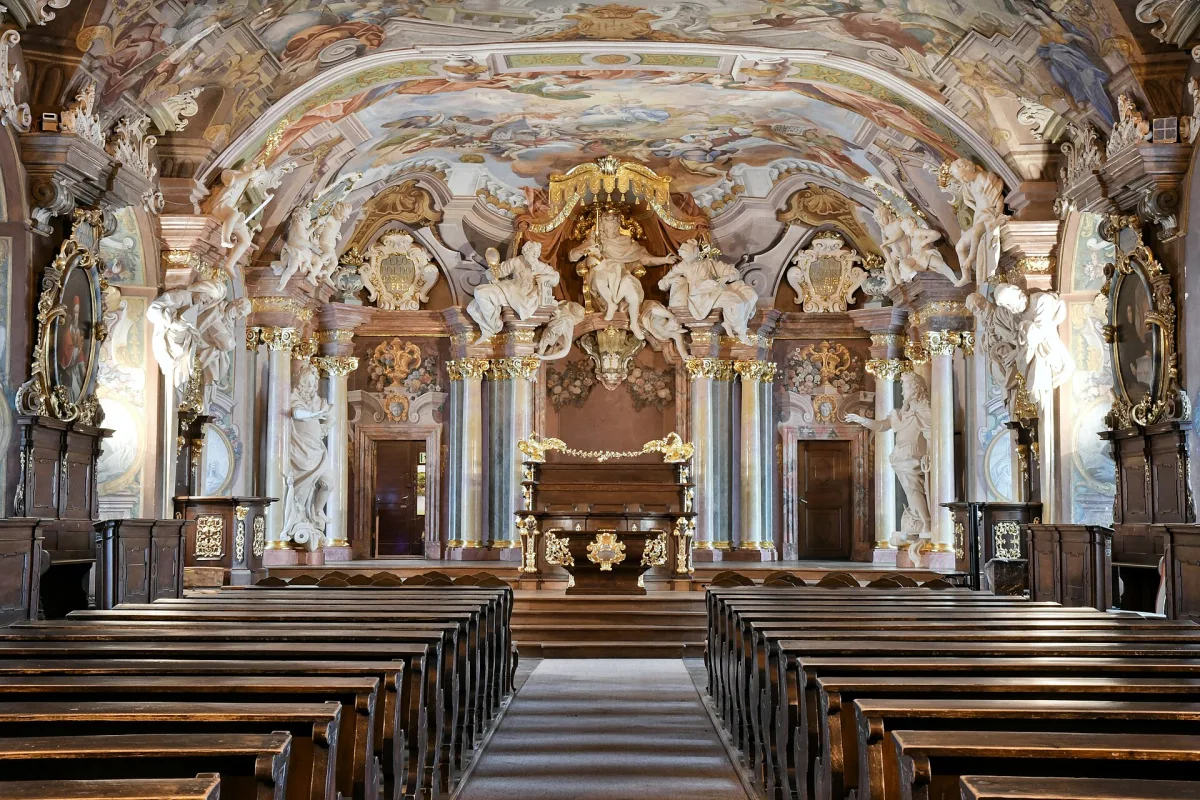
A grand baroque hall from 1728-1732 in the main building of the University of Wrocław, with frescoes by Handke and sculptures by Hollandt.
Aula Leopoldina is a grand baroque hall in the main building of the University of Wrocław, one of the most richly decorated interiors in the city. It is housed in the university building in the Old Town, surrounded by other heritage sites and museums in this part of Wrocław.
The hall was built between 1728 and 1732, funded by the Holy Roman Emperor Leopold I of Habsburg, after whom it is named. The design was prepared by the architect Christophorus Tausch.
The stucco work was made by Albrecht Siegwitz, and the ceiling and wall frescoes were painted by Johann Christoph Handke. One fresco depicts the dedication of the university to the Virgin Mary, while the other, placed above the auditorium, is allegorical in character and illustrates the apotheosis of Divine Wisdom. The wooden sculptures were made by Krzysztof Hollandt, their central motif being a group depicting Leopold I enthroned, surrounded by personifications of Prudence and Providence.
In 1997, eight of the sixteen portraits of people distinguished in service to the university, which hung in the hall, were stolen. Between 2015 and 2018 the interior underwent conservation work, after which the hall reopened on 21 March 2022.
Aula Leopoldina is part of the Museum of the University of Wrocław and serves as a grand ceremonial hall, hosting the university's most important ceremonies, including the matriculation of first-year students.
The university building stands surrounded by other important sites of the Old Town. In the same building and right next door are the Museum of Man in Wrocław and the Museum of the Lubomirski Princes in Wrocław. A few hundred metres away stands the Basilica of St Elizabeth of Hungary, and towards the Oder a route leads to Plac Nowy Targ.

Be the first! Add a comment.
You need to log in to add a comment.
Log in