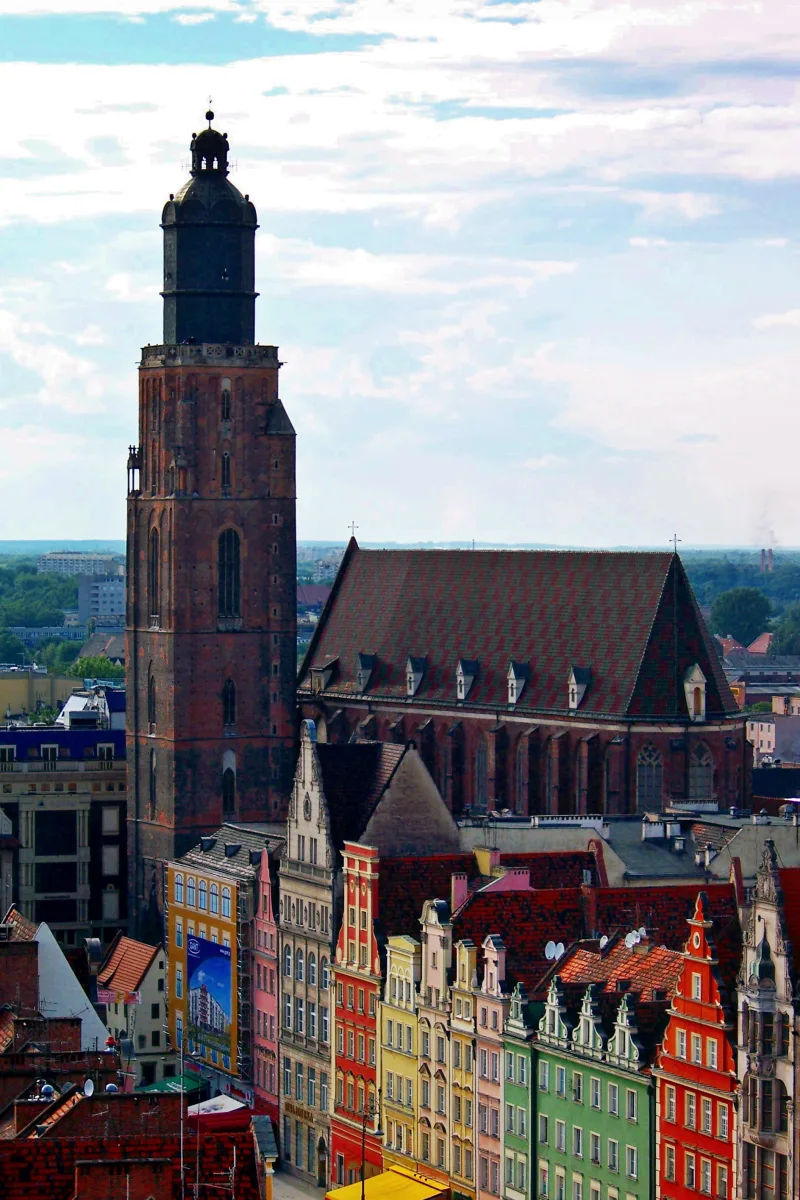
A Gothic church by the Market Square with a 91-metre tower, today a garrison church and minor basilica.
The Basilica of St Elizabeth of Hungary stands at the north-western corner of Wrocław's Market Square, on the square between Kiełbaśnicza, Odrzańska, św. Mikołaja and św. Elżbiety streets. It is a Gothic church with a tower, for centuries one of the city's two parish churches, today serving as a garrison church. Its patron saint is St Elizabeth of Hungary, also known as Elizabeth of Thuringia.
The first temple on this site was probably built at the beginning of the 13th century, and on 19 November 1257 the church was already consecrated under the dedication to St Elizabeth. The current, three-nave body in the reduced Gothic style was funded by Bolesław III the Generous, and it was built in stages: the western naves in 1309-1318, the main nave in 1340, the Chapel of the Blessed Virgin Mary in 1384, and the chancel in 1387. The church is 68.2 metres long and 34.47 metres wide, the main nave reaches 29.7 metres in height, the side naves 13 metres.
Construction of the tower began before 1339. It originally reached 130.5 metres, making it the tallest tower in Silesia. In 1529 its wooden spire collapsed, and in 1531-1535 the tower was rebuilt and given a Renaissance spire. Its height today is 91.46 metres, still large enough that the tower is Wrocław's third-largest building.
The basilica's history is a series of damage and repairs. In 1649 part of the roof truss collapsed, in 1806-1807 the church was damaged during the Napoleonic siege, and on 29 October 1857 two pillars of the south nave collapsed. The most severe were the fires of the 20th century: on 4 June 1960 from a lightning strike, and on 20 September 1975, when the tower caught fire. A further fire, on 9 June 1976, destroyed almost all of the church's wooden furnishings, and the organ also burned down. Reconstruction began in 1981, the tower's spire was recreated in its old forms from reinforced concrete, and the steel roof truss was covered with sheet metal and tiles in a characteristic checkerboard pattern. The church and the viewing terrace on the tower were opened to worshippers in May 1997. On 31 May of that same year John Paul II consecrated the temple, and six years later granted it the status of a minor basilica.
In the two-level Smedchin Chapel, first mentioned on 18 December 1389, perfectly preserved, colourful polychromes from the late 15th century with biblical scenes, including the Crucifixion and the Agony in the Garden, were discovered in 2004. Over the centuries the basilica was furnished by wealthy townspeople, who funded about 370 epitaphs in it. Three bells hang in the tower: the Heroes' bell from 1923, weighing 4678 kilograms, the Middle bell cast in 1471 by Mathias Haubnitz of Brno, and the Small bell from 1460. The great organ, built in 1750-1761 by Michael Engler the Younger and Gottlieb Benjamin Engler, burned down in the 1976 fire. An earlier organ from 1718, the work of Adam Horatio Casaparini, had already been moved before that fire to the Aula Leopoldina.
In 1525 the church officially became a Protestant temple, and its first parish priest was Ambrosius Moibanus. In November 1946 it was taken from the Protestants and handed to the Catholic field ordinariate as a garrison church. The civil-military parish was erected on 15 March 1998, and it covers nearly 2700 residents. The basilica today houses the Mausoleum of Remembrance of the Polish Underground State and the Home Army.

Be the first! Add a comment.
You need to log in to add a comment.
Log in